Guide
How intranasal drug delivery works
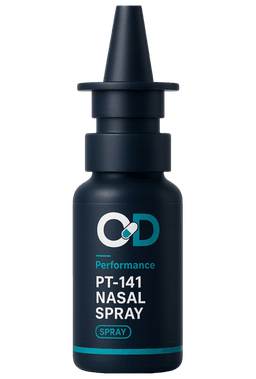 Discussed in this guidePT-141 Nasal Sprayfrom $87.50
A neutral, mechanism-focused look at how the lining of the nose absorbs molecules and why the intranasal route suits certain peptides.
On this page
Delivering a medicine through the nose
Intranasal drug delivery means administering a medication into the nasal cavity, usually as a spray or drops. It is one of several non-oral routes, and it draws attention because the lining of the nose has properties that make it a practical entry point for certain molecules. Some intranasal products are intended to act locally within the nose itself, while others are designed so that a molecule is absorbed into the bloodstream and carried through the body.
This route comes up often in discussions of peptides — chains of amino acids that tend to be broken down when swallowed. This article stays with the biology: what the nasal lining is made of, how molecules are understood to cross it, and why certain compounds are prepared this way rather than as a tablet.
Nothing here is medical advice, a recommendation, or a statement about what any individual should expect. Every prescription product mentioned is prescription-only, and a licensed provider decides whether any given approach is appropriate for a person.
The nasal cavity and its lining
The inside of the nose is more than an air passage. Its walls fold into ridged structures called turbinates, which greatly increase the surface area of the lining, and much of that surface is covered by respiratory mucosa — a thin epithelium sitting on a bed that is unusually rich in blood vessels. A separate, smaller patch of specialized tissue high in the nasal cavity, the olfactory region, is where the nerves responsible for smell reach the surface.
Two features of this lining are central to why it is used for drug delivery. First, the respiratory epithelium is thin and, unlike the outer skin, has no stratum corneum — the tough, largely impermeable outer layer that makes skin such a barrier. Second, the dense network of blood vessels just beneath the surface means that a molecule crossing the epithelium encounters circulation quickly.
The lining is also a working defense system. It is coated in a layer of mucus and lined with tiny hair-like cilia that continually sweep that mucus toward the throat, a process called mucociliary clearance. This steady movement protects the airway, but it also limits how long a substance stays in contact with the absorbing surface — a constraint that shapes how the nasal route behaves.
How molecules cross the nasal mucosa
A molecule presented to the nasal lining can take more than one path across the epithelium. Two are usually described:
- The transcellular route — passing directly through the epithelial cells. This path tends to favor smaller, more fat-soluble molecules that can move across cell membranes.
- The paracellular route — passing between adjacent cells, through the junctions that hold them together. This path is generally described as available to water-soluble and larger molecules, though the junctions themselves limit what can squeeze through.
Once a molecule has crossed the epithelium, it drains into the veins beneath the mucosa, which feed into the body's general venous return rather than into the portal vein that carries blood from the gut to the liver. For that reason, absorption across the nasal mucosa is understood to largely bypass the first-pass metabolism that faces a swallowed molecule, in which the liver can break down a portion of a dose before it reaches the rest of the body. How readily any particular molecule makes the crossing depends heavily on its properties: large, charged molecules — a category that includes many peptides — are generally understood to cross less easily than small, fat-soluble ones, and mucociliary clearance adds a time limit, since a molecule swept away before it is absorbed does not reach circulation. These factors are why the nasal route describes a pathway rather than a fixed measure of how much of any compound is absorbed.
Why some peptides are prepared as nasal sprays
Peptides pose a specific problem for oral delivery. The digestive tract is built to break peptides down into their component amino acids, so a peptide that is swallowed meets stomach acid and digestive enzymes, and whatever survives still faces first-pass metabolism in the liver. Many peptides are therefore poorly absorbed by mouth without specialized formulation. Non-oral routes — injection, sublingual troches, and nasal sprays among them — are used to give these molecules a path suited to their chemistry, which swallowing does not provide.
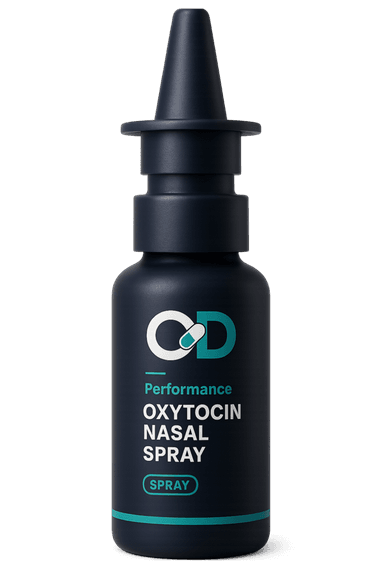
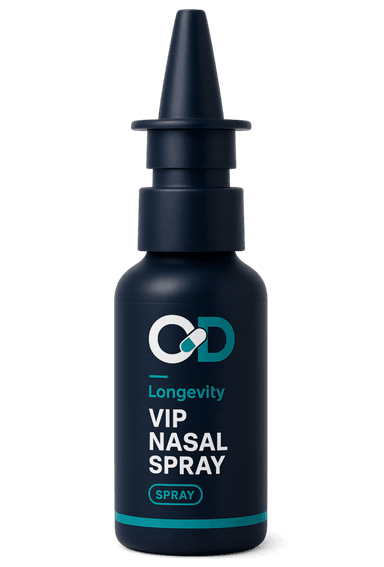
The nasal route is one such option, and several compounded peptide preparations are formulated this way. Examples offered as neutral category illustrations include PT-141 (bremelanotide), oxytocin, and vasoactive intestinal peptide (VIP), each of which appears in compounded nasal-spray form. Mentioning them here describes a route of administration; it is not a claim about what any of them does for a person.
One further idea attaches specifically to the nose and is worth stating carefully. Because the olfactory region provides a direct anatomical connection between the nasal cavity and the brain, researchers have studied whether some molecules might reach the central nervous system along nerve pathways from the nose — a so-called nose-to-brain route that could, in principle, sidestep the blood-brain barrier. This remains an active and unsettled area of investigation: how much of a given molecule travels this way, and whether it is meaningful, are debated methodological questions rather than established facts. This article notes that the pathway is studied; it makes no claim that any preparation delivers a compound to the brain in a person.
Devices, variables, and regulatory status
In practice, intranasal medications are usually delivered by a metered spray device, and a number of physical variables influence how a dose behaves — the volume sprayed, where in the nasal cavity the droplets land, and the details of the formulation all affect contact with the absorbing surface. Because the nose can only hold a small volume and clears it steadily, the amount that can be delivered at once is limited. These are properties of the route; the prescription defines how any specific product is to be used, and this article does not provide dosing guidance of any kind.
Regulatory status is worth stating plainly. Some nasal-spray medications are FDA-approved products, while many peptide nasal sprays are compounded — prepared by a licensed pharmacy to fill an individual prescription and not themselves FDA-approved. That is a neutral statement about the compounding pathway rather than a judgment about quality. Whether the nasal route, or any route, is appropriate for a person is a clinical judgment that depends on the molecule and the individual's health history.
How it works on OpenDoseRx
On OpenDoseRx, a licensed clinician — not the shopper — makes the medical decision. You choose a product and strength, then complete a medical intake with your health history. An independent, licensed U.S. provider reviews that intake and decides whether a prescription is appropriate for you.
If it is, a licensed U.S. pharmacy prepares and ships it; if the provider declines, you are not charged for the medication and you receive a full refund. Because every product is prescription-only, nothing is prepared or shipped without that independent review.
This article is educational only and is not a substitute for a conversation with your own healthcare provider. It describes how a route of administration is understood to work; it does not recommend a treatment for any particular person.
Common questions
- What is intranasal drug delivery?
- It is the administration of a medication into the nasal cavity, usually as a spray. The lining of the nose is thin, lacks the tough outer layer that makes skin a barrier, and sits over a dense bed of blood vessels, so some molecules can be absorbed across it into the bloodstream. Some nasal products are intended to act locally in the nose, while others are designed to reach systemic circulation. How readily any molecule crosses depends on its size, charge, and other properties.
- Why are some peptides given as a nasal spray instead of a pill?
- Peptides are chains of amino acids, and the digestive tract is built to break them down; a swallowed peptide meets stomach acid and enzymes, and whatever survives still faces first-pass metabolism in the liver. Absorption across the nasal mucosa drains into the general circulation and is understood to largely bypass that first-pass step, which is one reason some peptides are formulated as nasal sprays rather than tablets. It is a description of a delivery route, not a claim about any effect.
- Do I need a prescription for a compounded nasal spray?
- Yes. Peptide nasal sprays such as these are prescription-only. On OpenDoseRx, you complete a medical intake that is routed to an independent, licensed U.S. provider who reviews it and decides whether a prescription is appropriate. If it is, a licensed U.S. pharmacy prepares and ships it; if the provider declines, you are not charged for the medication and receive a full refund.
Ready when you are
PT-141 Nasal Sprayfrom $87.50
- Your exact strength
- Licensed provider review
- Full refund if declined
Also relevant
Exact strengths and prices up front — a licensed provider reviews every request.
Browse treatments
Exact strengths and prices up front — reviewed by a licensed U.S. provider.
Keep reading
The guides that explain how ordering and review work.
How online prescriptions work: intake, provider review, and pharmacy
A plain-language walkthrough of the telehealth path — from choosing a strength to intake, independent provider review, and licensed U.S. pharmacy fulfillment.
Compounded vs. FDA-approved medications: what's the difference?
A plain-language look at what "FDA-approved" and "compounded" actually mean, why both exist, and how each is regulated.
What a medical intake covers and why it matters
A plain-language look at the categories of information a telehealth intake collects and how each one gives a reviewing provider the context to make a clinical decision.
This guide is for general education and is not medical advice. Compounded medications are not FDA-approved drugs, and statements on this site have not been evaluated by the FDA. A licensed provider reviews every prescription request.