Guide
How sublingual absorption works
 Discussed in this guidePT-141 + Oxytocinfrom $150.00
A neutral, mechanism-focused look at how the mucosa under the tongue is understood to take up a compound directly into the bloodstream, bypassing the digestive tract and the liver's first pass.
On this page
What sublingual absorption means
"Sublingual" comes from the Latin for "under the tongue," and sublingual absorption refers to a compound being taken up through the mucous membrane lining the floor of the mouth rather than being swallowed and processed through the digestive tract. A sublingual product — a small quick-dissolving tablet, a soft dissolvable lozenge called a troche, or a thin film — is held under the tongue and allowed to dissolve, releasing its contents against that lining. This article describes how that route is understood to move a molecule from the mouth into the bloodstream, and why the path differs from swallowing.
The distinction matters because the two routes send a molecule on very different journeys. A swallowed tablet travels down to the stomach and intestine, where it meets acid and digestive enzymes and is absorbed across the gut wall; a sublingual form is designed so that a portion of the compound crosses the oral lining more directly. This is a description of an intended path, not a claim about any effect. What a given product does in a particular person, and whether a route suits them, are clinical questions for a licensed provider rather than matters an educational article can settle.
The tissue under the tongue
The floor of the mouth is lined by oral mucosa — a mucous membrane that, in the sublingual region, is relatively thin and, unlike the tougher surface of the gums or hard palate, is not heavily keratinized. Keratin is the protein that toughens and waterproofs the outer layer of skin; its relative absence under the tongue leaves a more permeable surface. Just beneath this membrane lies a dense network of small blood vessels, so the barrier between a dissolved compound and the bloodstream is comparatively short.
These two features — a thin, lightly keratinized surface and a rich blood supply close underneath — are what make the sublingual area of interest for absorption. A molecule that dissolves in the saliva there has a relatively direct route to cross the membrane and enter the small veins beneath it. The buccal area, the lining inside the cheek, is used on a similar principle, though its surface differs somewhat. The structure of the tissue sets what is possible; it does not by itself determine how much of any particular compound makes the crossing.
Bypassing first-pass metabolism
The feature most often associated with sublingual delivery is that it is designed to bypass first-pass metabolism. When a substance is absorbed from the stomach and intestine, the blood carrying it does not go straight into general circulation. It first drains into the portal vein, which delivers it to the liver — the body's main site for chemically processing and breaking down foreign substances. A fraction of the absorbed amount can be metabolized there before any of it reaches the rest of the body, a step known as first-pass metabolism.
The veins that drain the floor of the mouth follow a different course. Rather than emptying into the portal vein, they return blood to the systemic circulation more directly, by way of the veins of the head and neck. A molecule absorbed sublingually is therefore understood to reach the general circulation without first being routed through the liver, and without passing through the acid and digestive enzymes of the stomach at all. This is the same principle behind long-established sublingual medicines such as nitroglycerin, which is placed under the tongue precisely because that route avoids the liver's first pass.
Avoiding first-pass metabolism is the mechanistic rationale for choosing a sublingual route for certain compounds — particularly ones that are extensively broken down in the gut or liver, or, in the case of peptides, digested by enzymes before they can be absorbed intact. It is a statement about the path a molecule takes, not a promise about how much arrives. How much of any given compound clears the mucosa and reaches circulation depends heavily on the molecule itself.
What crosses the mucosa, and what does not
Not every molecule is well suited to sublingual absorption. Crossing the oral membrane is largely a matter of passive diffusion, and several properties of a compound are understood to influence how readily that happens:
- Size — smaller molecules generally cross the membrane more easily than large ones.
- Fat solubility — the membrane is lipid-based, so lipophilic (fat-soluble) molecules tend to pass through more readily than highly water-soluble ones.
- Electrical charge — uncharged molecules diffuse across more easily than charged, ionized ones.
- Contact time — the longer a compound stays dissolved against the mucosa before being swallowed, the more opportunity it has to be absorbed.
Because of these constraints, sublingual absorption tends to favor small, relatively fat-soluble molecules, and larger or charged compounds — many peptides among them — are understood to cross less completely. In practice, some portion of any dissolving sublingual dose is also swallowed with the saliva and then follows the ordinary digestive path, so the sublingual and oral routes are never entirely separate. For these reasons the fraction actually absorbed under the tongue varies with the molecule and the formulation, and describes an intended path rather than a measured result in any individual.
Forms made for sublingual use
Several dosage forms are built around this route. A sublingual tablet is a small, quick-dissolving tablet meant to disintegrate under the tongue rather than be swallowed whole. A troche is a soft, dissolvable lozenge, and a sublingual film is a thin strip that dissolves on contact with the moist lining. Each is formulated to release its contents into the saliva and hold them against the mucosa while absorption takes place, rather than to survive passage through the stomach.
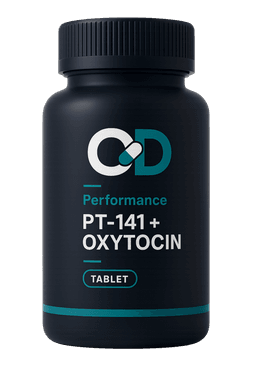
Compounded medicines are sometimes prepared in these forms, including combinations of more than one ingredient in a single sublingual tablet — the compounded PT-141 + Oxytocin sublingual tablet listed in this catalog is one example of a preparation formulated for this route. The form is a delivery choice; naming it here describes how a preparation is designed to be taken, not what it does or whether it is appropriate for anyone. Compounded preparations are made by a licensed pharmacy to fill an individual prescription and are not FDA-approved products, a neutral fact about the compounding pathway that a provider can explain during review.
How it works on OpenDoseRx
On OpenDoseRx, a licensed clinician — not the shopper — makes the medical decision. You choose a product and strength, then complete a medical intake with your health history. An independent, licensed U.S. provider reviews that intake and decides whether a prescription is appropriate for you. If it is, a licensed U.S. pharmacy prepares and ships it; if the provider declines, you are not charged for the medication and receive a full refund. This article is educational only and is not a substitute for a conversation with your own healthcare provider.
Common questions
- What does sublingual absorption mean?
- Sublingual means "under the tongue." Sublingual absorption refers to a compound being taken up through the thin, blood-vessel-rich mucous membrane on the floor of the mouth rather than being swallowed and processed through the digestive tract. A sublingual tablet, troche, or film is held under the tongue and allowed to dissolve so that a portion of its contents can cross that lining into the bloodstream.
- Why is a sublingual route used instead of swallowing?
- The mechanistic reason is that the veins under the tongue drain into the general circulation rather than through the liver first, so a molecule absorbed there is understood to bypass much of the first-pass metabolism — and the stomach acid and digestive enzymes — that a swallowed dose meets. How completely any given compound takes that path depends on its size, fat solubility, and charge, and some of a dissolving dose is inevitably swallowed. It is best described as an approach designed to reduce those losses rather than to eliminate them entirely.
- Do sublingual products here require a prescription?
- Yes. Every product on OpenDoseRx is prescription-only, regardless of its form. You complete a medical intake, an independent licensed U.S. provider reviews it and decides whether a prescription is appropriate for you, and a licensed U.S. pharmacy prepares and ships it only if the provider approves. If the provider declines, you are not charged for the medication and receive a full refund.
Ready when you are
PT-141 + Oxytocinfrom $150.00
- Your exact strength
- Licensed provider review
- Full refund if declined
Browse treatments
Exact strengths and prices up front — reviewed by a licensed U.S. provider.
Keep reading
The guides that explain how ordering and review work.
How online prescriptions work: intake, provider review, and pharmacy
A plain-language walkthrough of the telehealth path — from choosing a strength to intake, independent provider review, and licensed U.S. pharmacy fulfillment.
Compounded vs. FDA-approved medications: what's the difference?
A plain-language look at what "FDA-approved" and "compounded" actually mean, why both exist, and how each is regulated.
What a medical intake covers and why it matters
A plain-language look at the categories of information a telehealth intake collects and how each one gives a reviewing provider the context to make a clinical decision.
This guide is for general education and is not medical advice. Compounded medications are not FDA-approved drugs, and statements on this site have not been evaluated by the FDA. A licensed provider reviews every prescription request.