Guide
Oral vs. sublingual drug delivery
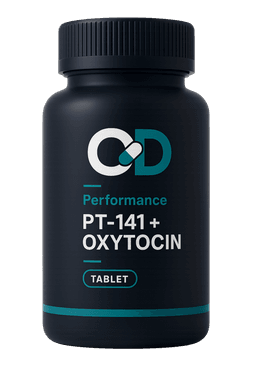 Discussed in this guidePT-141 + Oxytocinfrom $150.00
A plain-language, mechanism-focused look at how swallowing a medication and absorbing one under the tongue send a molecule into the bloodstream by different paths.
On this page
Two ways to take a medication by mouth
A medication taken "by mouth" can actually reach the bloodstream by two quite different paths. One is swallowing — a tablet or capsule goes down to the stomach and intestines, where its contents are absorbed. The other is sublingual or buccal delivery, in which a lozenge, tablet, or liquid is held in the mouth so the compound dissolves and is absorbed across the lining there. "Sublingual" means under the tongue; "buccal" means against the inside of the cheek. Both start in the same place, yet the route a molecule travels from there differs in an important way.
That difference centers on a step called first-pass metabolism, and it helps explain why a swallowed form and a sublingual form of the same compound are not simply interchangeable. This article describes how each path moves a molecule into circulation. It is educational only — mechanism and biology, not medical advice, and not a recommendation of one route over another. Which route or form is appropriate for a given person is a decision for a licensed provider.
What happens when a medication is swallowed
A swallowed tablet or capsule travels down the esophagus to the stomach, then to the small intestine, where most drug absorption takes place. As the compound crosses the lining of the gut, it enters small blood vessels — but those vessels do not lead straight to the rest of the body. They drain into the portal vein, which carries blood from the digestive tract first to the liver before it reaches general circulation.
The liver is the body's primary site of drug metabolism, rich in enzymes that chemically transform many compounds. On this first pass through the liver, a fraction of the absorbed molecule may be broken down or altered before any of it reaches the wider bloodstream. This is called first-pass metabolism, or the first-pass effect. For some compounds the liver removes only a little; for others it removes a large share. Digestion adds a separate hurdle: stomach acid and digestive enzymes can degrade certain molecules — peptides in particular — before they are ever absorbed.
How sublingual and buccal absorption differ
The lining of the mouth — the oral mucosa — is thin and richly supplied with small blood vessels. When a compound dissolves against it, a portion can be absorbed directly across the mucosa into those vessels. Crucially, the veins draining the mouth lead into systemic circulation without first passing through the liver. A molecule absorbed this way is therefore described as bypassing first-pass metabolism — it enters the general bloodstream more directly than a swallowed molecule does, and it avoids the acid and digestive enzymes of the stomach.
The oral mucosa is also selective. Whether a given molecule crosses it well depends on properties such as size and how fat- or water-soluble it is, so the sublingual route is not equally suited to every compound. Where it does apply, its defining feature is that it presents the molecule to systemic circulation while sidestepping the liver's first pass.
Why the route changes how much reaches the blood
Pharmacologists use the term bioavailability for the fraction of an administered dose that reaches the bloodstream in active form. Because a swallowed drug faces both digestive breakdown and first-pass metabolism, the fraction that survives to circulate can be quite different from what the same compound would deliver by the sublingual route. As a general property, avoiding the first pass tends to change — and for certain molecules raise — the proportion that becomes systemically available. This is a statement about the pathways themselves, not about what any product does for a person.
One consequence follows directly: the amount of drug substance in a swallowed form and in a sublingual form is not directly comparable, and a strength set for one route does not translate into the other. This is a central reason route and strength are chosen together by a prescriber rather than converted between forms. None of this ranks one route above another; each is a design choice suited to particular molecules and situations, and matching a molecule to a route is a formulation and clinical judgment.
Forms that use the sublingual route
Several compounded forms are designed to be absorbed in the mouth rather than swallowed:
- A troche — a small, dissolvable lozenge held in the mouth until it releases its contents against the oral mucosa.
- A sublingual tablet or film placed under the tongue to dissolve.
- A sublingual liquid or drops applied under the tongue and held there before swallowing.
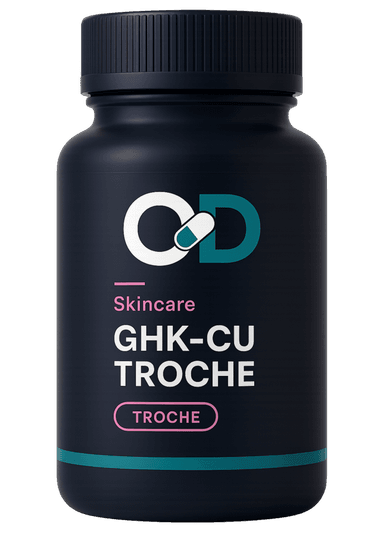
OpenDoseRx lists compounded products that use this route as neutral examples of the category — for instance a GHK-Cu troche (a copper-peptide lozenge) and a sublingual preparation combining bremelanotide (PT-141) with oxytocin. Naming them here describes their delivery form only; it is not a claim about what any of them does. These are compounded, non-FDA-approved preparations, and whether a sublingual form is appropriate for a given person, and at what strength, is decided by the prescribing provider.
How it works on OpenDoseRx
On OpenDoseRx, a licensed clinician — not the shopper — makes the medical decision. You choose a product and strength, including the form and route you are interested in, then complete a medical intake with your health history. An independent, licensed U.S. provider reviews that intake and decides whether a prescription is appropriate for you. If it is, a licensed U.S. pharmacy prepares and ships it; if the provider declines, you are not charged for the medication and receive a full refund. This article is educational only and is not a substitute for a conversation with your own healthcare provider.
Common questions
- What is first-pass metabolism?
- It is the processing a swallowed drug undergoes before reaching the wider bloodstream. Molecules absorbed from the stomach and intestine travel through the portal vein to the liver first, where enzymes can break down or chemically alter a fraction of the dose. Sublingual and buccal absorption instead enter circulation through the veins of the mouth, which reach the body without that first pass through the liver.
- Are swallowed and sublingual strengths interchangeable?
- No. Because the two routes face different obstacles — digestion and first-pass metabolism for a swallowed form, absorption across the oral mucosa for a sublingual one — the proportion of a dose that reaches circulation can differ, so a strength set for one route is not simply the same for the other. Route and strength are decided together by a prescribing provider rather than converted between forms.
- Do sublingual medications require a prescription?
- The compounded sublingual products discussed here are prescription-only in the United States. On OpenDoseRx, an independent, licensed U.S. provider reviews your medical intake and must decide that a prescription is appropriate before anything is dispensed. If it is, a licensed U.S. pharmacy prepares and ships it; if the provider declines, you are not charged for the medication and receive a full refund.
Ready when you are
PT-141 + Oxytocinfrom $150.00
- Your exact strength
- Licensed provider review
- Full refund if declined
Also relevant
Exact strengths and prices up front — a licensed provider reviews every request.
Browse treatments
Exact strengths and prices up front — reviewed by a licensed U.S. provider.
Keep reading
The guides that explain how ordering and review work.
How online prescriptions work: intake, provider review, and pharmacy
A plain-language walkthrough of the telehealth path — from choosing a strength to intake, independent provider review, and licensed U.S. pharmacy fulfillment.
Compounded vs. FDA-approved medications: what's the difference?
A plain-language look at what "FDA-approved" and "compounded" actually mean, why both exist, and how each is regulated.
What a medical intake covers and why it matters
A plain-language look at the categories of information a telehealth intake collects and how each one gives a reviewing provider the context to make a clinical decision.
This guide is for general education and is not medical advice. Compounded medications are not FDA-approved drugs, and statements on this site have not been evaluated by the FDA. A licensed provider reviews every prescription request.