Guide
What is a rapid-dissolve tablet?
 Discussed in this guideVast FDTfrom $199.00
A plain-language, mechanism-focused explainer on orally disintegrating dosage forms and how they release a medication in the mouth.
On this page
What a rapid-dissolve tablet is
A rapid-dissolve tablet is a solid oral dosage form designed to break apart quickly when it contacts saliva, without needing to be swallowed whole with a glass of water. In pharmacy and formulation science these are commonly called orally disintegrating tablets (ODTs) or fast-dissolving tablets (FDTs). The defining feature is the speed with which the tablet disintegrates in the mouth, rather than any property of the active ingredient it carries.
This makes them different from a conventional tablet, which is built to stay intact while it is swallowed and then dissolve later in the stomach or intestine. A rapid-dissolve tablet is engineered to do close to the opposite: to fall apart in the mouth within seconds. Because the format is about how the tablet is put together rather than what molecule it contains, many different active ingredients can, in principle, be prepared in this form.
This article describes the dosage form in general terms. Whether any particular medication is appropriate in a fast-dissolve tablet, and for whom, is a clinical question decided by a licensed provider, not something an educational guide can answer.
How the tablet disintegrates in the mouth
The behavior that gives these tablets their name comes mostly from how they are formulated. Alongside the active ingredient, a tablet contains inactive ingredients called excipients, and among the most important here are substances known as superdisintegrants. These are materials chosen for their tendency to draw in water rapidly and to swell or wick moisture through the compressed tablet.
When the tablet meets saliva, those excipients are understood to pull water into the tablet's structure through swelling and capillary action. The internal bonds holding the pressed powder together give way, and the tablet breaks apart into fine particles or a suspension. Many rapid-dissolve tablets are also made with a porous, loosely compacted structure — sometimes produced by a freeze-drying step — so that liquid penetrates quickly and the matrix collapses in seconds rather than minutes.
Where the medication goes next
Once the tablet has disintegrated, the active ingredient can take one of two broad paths, and which one dominates depends on the specific product. In many orally disintegrating tablets, the fine particles are mixed with saliva and swallowed, so the medication is absorbed lower down in the stomach and small intestine much as it would be from a conventional swallowed tablet. In that case the mouth is mainly a convenient place to break the tablet apart, not the site of absorption.
In other rapid-dissolve tablets — particularly those designed to be held under the tongue or against the cheek — a portion of the active ingredient is intended to be absorbed directly across the lining of the mouth. The tissue there is thin, is not keratinized the way outer skin is, and sits close to a rich network of small blood vessels, which is what makes the oral lining usable as an absorption surface. Substances absorbed this way are understood to enter the bloodstream directly rather than first passing through the digestive tract.
That distinction matters mechanistically because of something called first-pass metabolism. A medication absorbed through the stomach and intestine is carried to the liver before it reaches general circulation, and the liver may break down part of it along the way. Absorption across the oral lining is understood to largely bypass that first liver pass. How much of a given dose takes each route, and what that means in practice, varies from one formulation to another and is a matter for the prescriber, not for educational content.
Why a medication might be prepared this way
Formulators describe several reasons for developing a fast-dissolve tablet, and most trace back to the practical experience of taking a solid dose. Because the tablet disintegrates on contact with saliva, it can be taken without a separate glass of water, which is one reason the form is often discussed in settings where swallowing a whole tablet is difficult or inconvenient. That includes some older adults and some people with conditions that affect swallowing — described here as context, not as guidance for any individual.
Taste is the other major consideration. A powder disintegrating directly on the tongue would expose the palate to the active ingredient, so rapid-dissolve tablets are typically formulated with taste-masking techniques — flavorings, sweeteners, or coatings applied to the drug particles — so the disintegrating tablet is more palatable. These are formulation choices about the experience of taking the tablet, not changes to what the medication is or to what a provider decides it is for.
Fast-dissolve tablets among other oral forms
A rapid-dissolve tablet is one member of a broader family of forms that release a medication in the mouth. Others include troches — small lozenges that dissolve slowly against the cheek or under the tongue — and thin oral films that dissolve on the tongue. Each is a way to present an active ingredient to the oral cavity, and they differ mainly in how quickly they dissolve and whether absorption is intended locally, across the oral lining, or after the particles are swallowed.
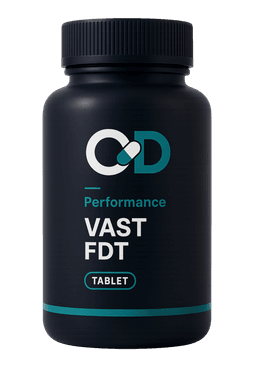
As a neutral example, OpenDoseRx lists a PDE5 inhibitor prepared as a fast-dissolve sublingual tablet (Vast FDT). It is named here only to illustrate the dosage form this guide describes; it is not a recommendation. A PDE5 inhibitor is a class of molecule studied for its action on the enzyme phosphodiesterase type 5, and the fast-dissolve tablet is simply one form in which such a molecule can be compounded. Whether any such product is appropriate is decided by a licensed provider after reviewing an individual's intake.
How it works on OpenDoseRx
On OpenDoseRx, a licensed clinician — not the shopper — makes the medical decision. You choose a product and strength, then complete a medical intake with your health history. An independent, licensed U.S. provider reviews that intake and decides whether a prescription is appropriate for you.
If it is, a licensed U.S. pharmacy prepares and ships it; if the provider declines, you are not charged for the medication and receive a full refund. This article is educational only and is not a substitute for a conversation with your own healthcare provider.
Common questions
- Is a rapid-dissolve tablet the same as a sublingual tablet?
- Not necessarily. "Rapid-dissolve" (or orally disintegrating) describes how quickly the tablet breaks apart in the mouth, while "sublingual" describes where it is placed — under the tongue — and implies absorption across the oral lining. Some fast-dissolve tablets are designed to be swallowed with saliva after they disintegrate and are then absorbed in the digestive tract; others are designed for a portion to be absorbed in the mouth. The two descriptions can overlap in a single product but are not identical.
- Is the medication absorbed in the mouth or in the stomach?
- It depends on the formulation. In many orally disintegrating tablets the particles are swallowed with saliva and absorbed in the stomach and small intestine, much like a conventional tablet. In sublingual or buccal fast-dissolve tablets, a portion is intended to be absorbed across the thin, blood-vessel-rich lining of the mouth, which is understood to largely bypass the liver's first pass. The specific product and the prescriber determine which applies.
- Do fast-dissolve tablets on OpenDoseRx require a prescription?
- Yes. The prescription medications discussed on OpenDoseRx are dispensed only after an independent, licensed U.S. provider reviews your medical intake and decides whether a prescription is appropriate for you. If it is, a licensed U.S. pharmacy prepares and ships it; if the provider declines, you are not charged for the medication and receive a full refund. This guide is educational only and is not medical advice.
Ready when you are
Vast FDTfrom $199.00
- Your exact strength
- Licensed provider review
- Full refund if declined
Browse treatments
Exact strengths and prices up front — reviewed by a licensed U.S. provider.
Keep reading
The guides that explain how ordering and review work.
How online prescriptions work: intake, provider review, and pharmacy
A plain-language walkthrough of the telehealth path — from choosing a strength to intake, independent provider review, and licensed U.S. pharmacy fulfillment.
Compounded vs. FDA-approved medications: what's the difference?
A plain-language look at what "FDA-approved" and "compounded" actually mean, why both exist, and how each is regulated.
What a medical intake covers and why it matters
A plain-language look at the categories of information a telehealth intake collects and how each one gives a reviewing provider the context to make a clinical decision.
This guide is for general education and is not medical advice. Compounded medications are not FDA-approved drugs, and statements on this site have not been evaluated by the FDA. A licensed provider reviews every prescription request.