Guide
What is a troche?
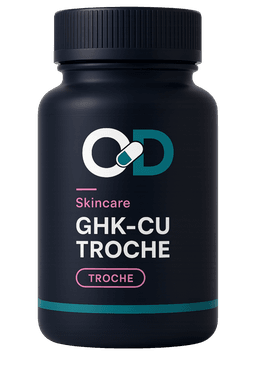 Discussed in this guideGHK-Cu Trochefrom $150.00
A troche is a compounded lozenge that dissolves in the mouth; this guide describes the form, where it sits against the oral lining, and how absorption across that surface is understood to work.
On this page
What a troche is
A troche (pronounced TROH-kee) is a small, solid dosage form designed to dissolve slowly while held in the mouth rather than to be swallowed whole. The word comes from the Greek trochiskos, meaning a little wheel or lozenge, and troches are among the older pharmaceutical forms — relatives of the medicated lozenges and pastilles used for centuries. In modern compounding, a troche is typically a firm or slightly chewy tablet-like piece, often set in a small mold, that a person keeps in the mouth until it dissolves.
The defining feature is where the form is meant to release its contents. A swallowed pill travels to the stomach and intestines before its contents enter the body; a troche is designed instead to break down against the moist tissue lining the mouth, so that a portion of the compound can be taken up across that surface. This places the troche within a family of orally dissolving forms studied for delivery across the oral mucosa.
This article describes the troche as a dosage form — what it is, where it sits, and how absorption across the mouth is generally understood to work. It is educational only, is not medical advice, and is not a recommendation to use any particular product. Troches prepared by a compounding pharmacy are made to fill an individual prescription and are not FDA-approved products.
Sublingual and buccal: where a troche sits in the mouth
The lining of the mouth is called the oral mucosa — a thin, moist tissue supplied by many small blood vessels. Two regions of it are most often used for dissolving forms. "Sublingual" refers to the floor of the mouth beneath the tongue, where the mucosa is especially thin. "Buccal" refers to the inside of the cheek, a slightly thicker surface between the cheek and the gum. A troche can be placed in either location, and some are shifted around the mouth as they dissolve.
These two sites are grouped together as the oral-mucosal, or transmucosal, route. What they share is that the compound is presented to a well-supplied tissue surface rather than being sent down into the digestive tract. The thinness and blood supply of these surfaces are the physiological reasons the route is studied for compounds intended to reach the bloodstream without first traveling through the gut.
How absorption across the oral mucosa is understood to work
When a troche dissolves, the compound it carries is released into saliva against the oral mucosa. Molecules able to cross this lining pass into the small blood vessels beneath it and, from there, into general circulation. How readily any given compound crosses depends on its chemistry — its size, its charge, and how fat- or water-soluble it is — so the route is understood to suit some molecules more than others.
One reason this route is used relates to a concept called first-pass metabolism. Substances absorbed from the gastrointestinal tract travel first to the liver, where a fraction can be broken down before reaching the rest of the body; swallowed peptides also meet stomach acid and digestive enzymes. Absorption across the oral mucosa drains into veins that reach the circulation more directly, which is the rationale often given for presenting certain compounds sublingually or buccally rather than by swallowing them.
In practice the separation is not complete. As a troche dissolves, some of its contents are inevitably swallowed and handled by the gut like any oral dose. How much of a given compound is taken up across the mucosa versus swallowed varies by molecule and formulation, and for many compounded preparations precise human absorption data is limited. The mechanism describes an intended path, not a measured result in any individual.
How compounding pharmacies make and use troches
A troche is a compounding-friendly form. A licensed pharmacy blends the active ingredient into a base — commonly a polyethylene-glycol or gelatin-type matrix, sometimes with flavoring — and sets the mixture in small molds to harden into individual pieces. Because the pharmacy prepares each batch to a prescription, the strength and the combination of ingredients can be tailored in ways a mass-manufactured tablet cannot, which is one reason compounders reach for the form.
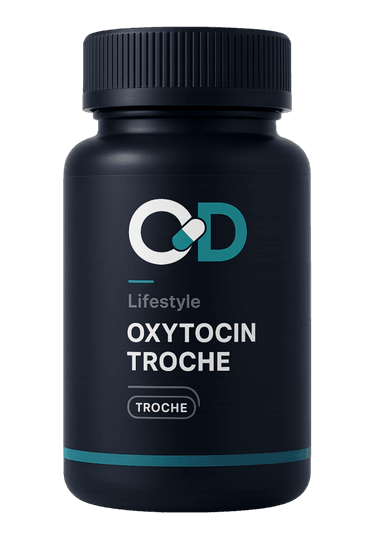
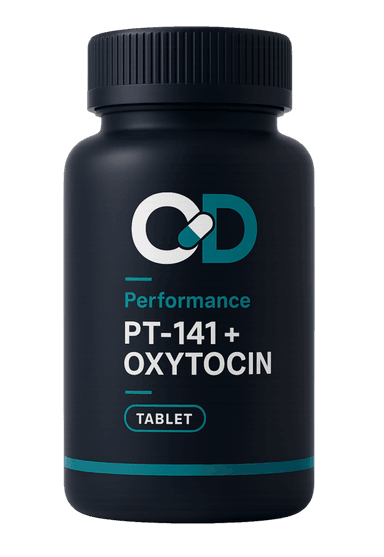
The troche is used particularly for compounds a compounder wants to present to the oral mucosa rather than the gut, including certain peptides and hormones that are poorly suited to being swallowed. On OpenDoseRx, several compounded preparations appear in this form as neutral examples — a copper-peptide (GHK-Cu) troche, an oxytocin troche, and a combined PT-141 and oxytocin sublingual preparation. Naming the form these take describes how they are made; it is not a claim about what any of them does for a person.
Because these are compounded rather than FDA-approved products, the form is chosen as part of a prescription written for an individual. Whether a troche is an appropriate form, and at what strength, is a clinical judgment — not something a shopper decides or an educational guide can determine.
Troches compared with other oral forms
It helps to place the troche alongside its neighbors. A conventional tablet or capsule is meant to be swallowed and processed through the digestive tract. A cough or throat lozenge dissolves in the mouth largely to act on the mouth and throat locally. A sublingual tablet or thin film is a faster-dissolving cousin of the troche aimed at the same under-the-tongue surface. The troche's distinguishing traits are that it is comparatively firm and dissolves slowly, keeping the compound in contact with the oral mucosa over a longer window.
Sprays and drops placed under the tongue pursue the same transmucosal route by a different physical format. None of these forms ranks above another; each is simply a different design choice about where a compound is released and how quickly. Which form a compound is prepared in reflects the molecule's chemistry, the goal of the preparation, and the prescriber's judgment.
How it works on OpenDoseRx
On OpenDoseRx, a licensed clinician — not the shopper — makes the medical decision. You choose a product and strength, including the form it comes in, then complete a medical intake with your health history. An independent, licensed U.S. provider reviews that intake and decides whether a prescription is appropriate for you.
If it is, a licensed U.S. pharmacy prepares and ships it; if the provider declines, you are not charged for the medication and receive a full refund. This article is educational only and is not a substitute for a conversation with your own healthcare provider.
Common questions
- What is the difference between a troche and a regular pill or a throat lozenge?
- A regular pill or capsule is meant to be swallowed and processed through the digestive tract. A throat lozenge usually dissolves in the mouth to act on the mouth and throat locally. A troche is a slow-dissolving lozenge held in the mouth so that a portion of its contents can be absorbed across the lining of the mouth, the oral mucosa, into the bloodstream. The differences are the form's firmness, how slowly it dissolves, and where it is designed to release the compound.
- Why would a medication be compounded as a troche instead of a tablet?
- Compounders use the troche form for compounds they want to present to the oral mucosa rather than the gut — for example, certain peptides and hormones that are poorly suited to being swallowed, since the sublingual and buccal route bypasses part of first-pass liver metabolism and gastrointestinal digestion. Compounding into a troche also lets a pharmacy tailor the strength and combination of ingredients to an individual prescription. Whether the form is appropriate for a given person is a decision for the prescribing provider.
- Do troches require a prescription?
- Yes. Compounded troches are prescription-only preparations. On OpenDoseRx you choose a product and strength and complete a medical intake; an independent, licensed U.S. provider reviews that intake and decides whether a prescription is appropriate for you. If it is, a licensed U.S. pharmacy prepares and ships it; if the provider declines, you are not charged for the medication and receive a full refund.
Ready when you are
GHK-Cu Trochefrom $150.00
- Your exact strength
- Licensed provider review
- Full refund if declined
Also relevant
Exact strengths and prices up front — a licensed provider reviews every request.
Browse treatments
Exact strengths and prices up front — reviewed by a licensed U.S. provider.
Keep reading
The guides that explain how ordering and review work.
How online prescriptions work: intake, provider review, and pharmacy
A plain-language walkthrough of the telehealth path — from choosing a strength to intake, independent provider review, and licensed U.S. pharmacy fulfillment.
Compounded vs. FDA-approved medications: what's the difference?
A plain-language look at what "FDA-approved" and "compounded" actually mean, why both exist, and how each is regulated.
What a medical intake covers and why it matters
A plain-language look at the categories of information a telehealth intake collects and how each one gives a reviewing provider the context to make a clinical decision.
This guide is for general education and is not medical advice. Compounded medications are not FDA-approved drugs, and statements on this site have not been evaluated by the FDA. A licensed provider reviews every prescription request.