Guide
What bioavailability means and why the route matters
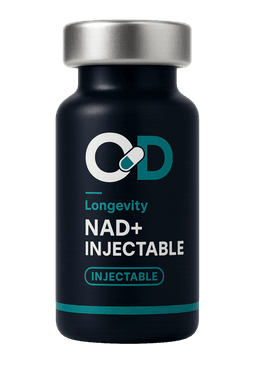 Discussed in this guideNAD+ Injectablefrom $87.60
A plain-language look at bioavailability — the share of a dose that reaches the bloodstream — and how the route of administration changes it.
On this page
What bioavailability means
Bioavailability is a pharmacology term for the fraction of an administered dose that reaches the bloodstream in active, unchanged form. It is usually expressed as a percentage, from 0 to 100, and is sometimes written as the letter F. In plain terms, it answers a simple question: of everything placed into or onto the body, how much actually shows up in general circulation, where it can travel to the tissues a molecule is designed to act on?
The reference point for the whole idea is intravenous administration. When a medication is placed directly into a vein, it enters the bloodstream without having to cross any barrier first, so its bioavailability is defined as 100 percent. Every other route is compared against that benchmark. A route that delivers, say, a smaller share of the dose into circulation is described as having lower bioavailability, not because the molecule changed, but because more of it was lost or delayed on the way in.
Two things mostly determine the number. The first is how much of the dose is absorbed at all — how much makes it across whatever barrier stands between the point of administration and the blood. The second is how much survives the trip before reaching general circulation, since some of an absorbed dose can be broken down along the way. The route of administration influences both of these, which is why the same drug substance can behave differently depending on how it is given.
Why the route of administration changes the number
Every medication has to travel from the place it is administered to the bloodstream, and the route defines both where that starting point is and which barriers the molecule must cross to get there. Swallowing a tablet, injecting a solution under the skin, letting a troche dissolve under the tongue, or spraying a formulation into the nose each set the molecule down in a different place, facing a different set of obstacles.
Those obstacles subtract from the dose. Skin, the lining of the gut, mucous membranes, digestive enzymes, and the liver can each remove or transform a portion of a medication before it reaches circulation. How much any given barrier subtracts depends on the molecule itself — its size, whether it is water-soluble or fat-soluble, its electrical charge, and how stable it is in acid or in the presence of enzymes. Small, fat-soluble molecules tend to cross biological membranes more readily than large, water-loving ones.
The practical result is that route and molecule interact. A compound that is well absorbed one way may be poorly absorbed another, and a route that works for one drug substance may be unsuitable for a different one. This is why bioavailability is discussed route by route rather than as a single fixed property of a medication, and why a formulation is engineered around the route it is meant for.
Swallowing: the oral route and first-pass metabolism
The oral route — swallowing a pill, capsule, or liquid — is the most familiar, and also one of the more demanding paths for a molecule to survive. A swallowed medication first has to withstand the acidic environment of the stomach and a range of digestive enzymes, then dissolve, and then cross the epithelium, the selective lining of the intestine, to be absorbed. Anything degraded or left unabsorbed along the way never counts toward bioavailability.
There is a second, less obvious step that makes the oral route distinctive. Blood leaving the intestine does not flow straight into general circulation; it is routed first through the hepatic portal vein to the liver. The liver is the body's primary site of drug metabolism, and it can transform a meaningful fraction of an absorbed dose before that dose ever reaches the rest of the body. This phenomenon is called first-pass metabolism, or the first-pass effect, and for some molecules it substantially lowers oral bioavailability.
Because both absorption and first-pass metabolism vary with conditions in the gut — such as whether food is present — oral bioavailability is often lower and more variable than other routes. Peptides, which are chains of amino acids, are a clear example: the digestive tract is built to break peptides down into their components, so many peptide medications are poorly absorbed by mouth without specialized formulation. That biology is a large part of why some medications have historically been delivered by injection rather than as a pill.
Absorbing under the tongue or through the nose
Placing a medication against a mucous membrane offers a different path into the body. Sublingual administration positions a troche, tablet, or film under the tongue, and buccal administration places it against the inside of the cheek. Both sit against thin, blood-vessel-rich tissue, and molecules absorbed there enter small veins that drain toward general circulation. Crucially, that drainage is understood to largely bypass the gut and the liver's initial pass, so a molecule taken this way can avoid much of the first-pass metabolism that reduces oral bioavailability.
The nasal route works on a similar principle. The lining of the nose is thin and richly supplied with blood vessels, and certain molecules are understood to be absorbed across it directly into systemic circulation. This is one reason some peptides and hormones are formulated as sublingual troches or nasal sprays rather than tablets — the goal is to give a molecule a route that its properties suit better than swallowing would.
These routes have their own limits. The surface area under the tongue or inside the nose is small, and the medication is only in contact for a limited time, so only molecules with the right size and solubility are absorbed efficiently this way. Any portion that is swallowed rather than absorbed at the membrane re-enters the ordinary digestive path and faces the same hurdles as an oral dose. As a result, bioavailability by these routes varies considerably from one molecule and formulation to the next.
Injecting: placing the molecule past the barriers
Injection routes deliver a medication past the digestive tract altogether. Intravenous injection places the solution directly into a vein, which is why it defines the 100 percent benchmark that every other route is measured against — there is no absorption barrier to cross. Intramuscular injection deposits the medication into muscle, and subcutaneous injection places it into the layer of tissue just beneath the skin.
From muscle or subcutaneous tissue, a molecule is absorbed gradually into the bloodstream through nearby blood and lymphatic vessels. Because it never passes through the stomach, intestines, or the liver's first pass, injection generally achieves higher and more predictable bioavailability than the oral route, particularly for fragile molecules like peptides. Some injectable peptides are also chemically modified — for instance with an attached fatty-acid chain that binds proteins in the blood — a design understood to slow their release and lengthen how long they remain active.
The trade-off is the injection itself, which involves a needle, and the fact that not every molecule or situation calls for that route. Whether an injectable, oral, sublingual, or nasal form is appropriate for a given person is a clinical judgment. A licensed provider weighs the molecule, the route, and an individual's health history together, and the prescription defines how any product is to be used.
Why this is background, not medical advice
One consequence of all this is that the amount of drug substance in a product is not directly comparable across routes. Because swallowing, injecting, and absorbing under the tongue each deliver a different fraction of an administered dose into circulation, a strength that makes sense for one route is not simply the same number for another. This is a central reason route and strength are decided together by a prescriber rather than converted from one form into the other, and why comparing products by their labeled amounts alone can be misleading.
This article is educational only and is not medical advice, a diagnosis, or a recommendation of any product, route, or strength. It describes how bioavailability and routes of administration are generally understood to work; it does not tell anyone what to do. Every decision about whether a medication is appropriate, and in what form, belongs to an independent licensed provider who reviews an individual's health information.
It is also worth noting that some medications available through compounding pharmacies are not FDA-approved products, and statements about them have not been evaluated by the FDA. That is a neutral fact a provider can explain during review. Understanding bioavailability is meant to make a conversation with a clinician clearer, not to replace it.
Common questions
- What does bioavailability actually measure?
- It measures the fraction of an administered dose that reaches the bloodstream in active, unchanged form, expressed as a percentage from 0 to 100. Intravenous administration is the reference point at 100 percent, because the medication enters the blood without crossing any absorption barrier. Every other route is compared against that benchmark.
- Why does swallowing a medication often deliver less to the bloodstream?
- A swallowed medication has to survive stomach acid and digestive enzymes, dissolve, and cross the selective lining of the intestine. Blood leaving the gut then passes through the liver first, where a portion of the dose can be metabolized before reaching general circulation — a step called first-pass metabolism. Together these hurdles often make oral bioavailability lower and more variable than other routes.
- Why are some medications given as injections, sublingual troches, or nasal sprays instead of pills?
- These routes are understood to bypass some of the barriers that reduce oral absorption. Injection skips the digestive tract entirely, while sublingual and nasal routes place a molecule against thin, blood-vessel-rich membranes that drain largely past the liver's first pass. Whether a molecule suits one of these routes depends on its size, solubility, and stability, which is why formulation is matched to the route.
- Does a route with higher bioavailability mean a medication is better?
- No. A higher number simply means a larger fraction of that dose reaches circulation; it is not a judgment of quality or of what is right for any individual. Because routes deliver different fractions, product strengths are set for a specific route rather than converted between forms. Which route and strength are appropriate is a decision an independent licensed provider makes, and this article is background only, not a recommendation.
Ready when you are
NAD+ Injectablefrom $87.60
- Your exact strength
- Licensed provider review
- Full refund if declined
Also relevant
Exact strengths and prices up front — a licensed provider reviews every request.
Browse treatments
Exact strengths and prices up front — reviewed by a licensed U.S. provider.
Keep reading
The guides that explain how ordering and review work.
How online prescriptions work: intake, provider review, and pharmacy
A plain-language walkthrough of the telehealth path — from choosing a strength to intake, independent provider review, and licensed U.S. pharmacy fulfillment.
Compounded vs. FDA-approved medications: what's the difference?
A plain-language look at what "FDA-approved" and "compounded" actually mean, why both exist, and how each is regulated.
What a medical intake covers and why it matters
A plain-language look at the categories of information a telehealth intake collects and how each one gives a reviewing provider the context to make a clinical decision.
This guide is for general education and is not medical advice. Compounded medications are not FDA-approved drugs, and statements on this site have not been evaluated by the FDA. A licensed provider reviews every prescription request.