Guide
ACE inhibitors and ARBs: how they are understood to act on the renin-angiotensin system
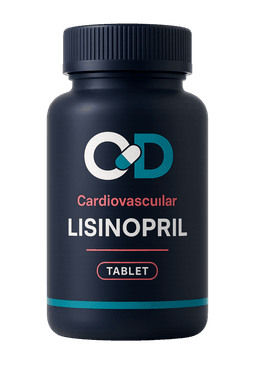 Discussed in this guideLisinoprilfrom $44.95
An educational overview of the renin-angiotensin system and how ACE inhibitors and angiotensin-receptor blockers are understood to act within it.
On this page
The renin-angiotensin-aldosterone system (RAAS)
The renin-angiotensin-aldosterone system, commonly abbreviated RAAS, is a hormone cascade that the body uses to help regulate blood pressure and fluid balance. It begins in the kidneys, which release an enzyme called renin in response to signals such as reduced blood flow or lower sodium levels. Renin acts on angiotensinogen, a protein produced by the liver and circulating in the blood, converting it into a peptide called angiotensin I.
Angiotensin I is largely inactive on its own. It is converted into angiotensin II by angiotensin-converting enzyme (ACE), which is found in high concentrations in the lining of blood vessels, particularly in the lungs. Angiotensin II is generally described as the principal active signal of the pathway. It binds to receptors known as angiotensin II type 1 (AT1) receptors on blood vessels and other tissues, and this binding is understood to promote narrowing of blood vessels. Angiotensin II also signals the adrenal glands to release aldosterone, a hormone understood to prompt the kidneys to retain sodium and water.
Because this cascade influences both vessel tone and fluid volume, it is a common pharmacological target for medications a clinician may consider in blood-pressure management. Two widely described drug classes act at different points along this pathway: angiotensin-converting enzyme inhibitors (ACE inhibitors) and angiotensin II receptor blockers (ARBs). Understanding where each class is understood to intervene helps explain how they are categorized.
How ACE inhibitors are understood to act
ACE inhibitors are a class of prescription medications that includes lisinopril, among others. As the name suggests, they are designed to inhibit angiotensin-converting enzyme. By occupying the enzyme, an ACE inhibitor is understood to reduce the conversion of angiotensin I into angiotensin II. With less angiotensin II being formed, the downstream signals attributed to it — vessel narrowing and aldosterone release — are understood to be diminished.
Lisinopril is a long-established generic ACE inhibitor. Reference materials describe it as being eliminated largely unchanged by the kidneys, which is one of several factors a clinician weighs when deciding whether the class is appropriate for a given person. Any decision to prescribe, and any dose, is determined by an independent licensed provider based on an individual's medical history.
How ARBs are understood to act — angiotensin-receptor blockade
Angiotensin II receptor blockers, or ARBs, include losartan and telmisartan. Rather than reducing how much angiotensin II is produced, ARBs act one step further along the pathway. They are designed to bind to the AT1 receptor, the site where angiotensin II would otherwise attach. By occupying this receptor, an ARB is understood to block angiotensin II from delivering its signal, regardless of how much of the peptide is circulating.
This difference in mechanism explains a frequently cited distinction between the two classes. Because ARBs do not inhibit angiotensin-converting enzyme, they do not cause bradykinin to accumulate in the same way, and the dry cough associated with ACE inhibitors is described as less common with ARBs. This is one reason a provider may consider an ARB for someone who did not tolerate an ACE inhibitor, though that clinical judgment belongs to the provider.
Losartan and telmisartan are both long-established generic ARBs. They differ from one another in properties such as how long they remain active in the body, and telmisartan is often described as having a particularly long duration of receptor binding. These pharmacologic characteristics are among the details a clinician may consider; they are descriptive and are not a substitute for individualized medical evaluation.
What these medications are, and who decides to use them
Lisinopril, losartan, and telmisartan are prescription blood-pressure medications. In the United States they are dispensed only with a valid prescription from a licensed provider. They are categorized as antihypertensive agents, meaning they belong to the group of medications a clinician may consider as part of blood-pressure management, alongside lifestyle measures and other treatments a provider might recommend.
Because these classes act on the renin-angiotensin system, reference materials describe several situations that call for caution and provider oversight. For example, both ACE inhibitors and ARBs are generally described as not appropriate during pregnancy, and providers commonly monitor kidney function and blood potassium in people taking them. These are descriptive class characteristics, not instructions; the relevance of any of them to an individual is determined during a medical evaluation.
This guide is educational and is not medical advice. It does not diagnose any condition, recommend any specific medication, or tell anyone how to use one. The decision about whether any medication is appropriate, and at what dose, rests with an independent licensed provider who reviews a person's medical history. A patient's role on a telehealth platform is to request a product and provide accurate health information for that review.
How prescription review works on OpenDoseRx
On OpenDoseRx, requesting a prescription medication follows a defined sequence. First, a person chooses the product and strength they wish to request. Next, they complete a medical intake — a set of questions about their health history, current medications, and relevant background. This information is submitted for review rather than resulting in an automatic prescription.
An independent licensed U.S. provider then reviews the request and the intake responses. The provider makes the clinical decision: whether the requested medication is appropriate for that individual and, if so, what strength and dose to authorize. Orders that are approved are filled by a licensed U.S. pharmacy. Orders that are declined are refunded in full.
This review process is a safeguard, not a substitute for a person's own healthcare relationship. It does not replace the patient's primary care provider or any specialist involved in their care, and it is not emergency care. People are encouraged to share any new prescription with the clinicians who manage their overall health, and to seek in-person or emergency care when their situation calls for it.
Common questions
- What is the difference between an ACE inhibitor and an ARB?
- Both classes act on the renin-angiotensin system but at different points. An ACE inhibitor such as lisinopril is understood to reduce the enzyme that converts angiotensin I into angiotensin II, so less angiotensin II is formed. An ARB such as losartan or telmisartan is understood to block the AT1 receptor where angiotensin II would attach, interrupting its signal rather than its production. The choice between classes is a clinical judgment made by an independent licensed provider.
- Why is a dry cough linked to ACE inhibitors but less so to ARBs?
- Angiotensin-converting enzyme also breaks down a peptide called bradykinin. Because ACE inhibitors slow that enzyme, bradykinin can accumulate, and this is the commonly described explanation for the dry cough some people notice. ARBs do not inhibit the enzyme, so they are described as less likely to cause bradykinin buildup. Whether this is relevant to any individual is something to discuss with a prescribing provider.
- Can I decide which of these medications I receive on OpenDoseRx?
- You can request a specific product and strength, but the prescribing decision belongs to an independent licensed provider who reviews your medical intake. The provider determines whether a requested medication is appropriate and what dose to authorize. If a request is declined, the order is refunded in full. This service does not replace your own provider or in-person care.
Ready when you are
Lisinoprilfrom $44.95
- Your exact strength
- Licensed provider review
- Full refund if declined
Also relevant
Exact strengths and prices up front — a licensed provider reviews every request.
Browse cardiovascular treatments
Exact strengths and prices up front — reviewed by a licensed U.S. provider.
Keep reading
More plain-language guides on this topic.
How statins work: the cholesterol synthesis pathway
A plain-language, mechanism-focused look at the cholesterol-synthesis pathway and how statins act on the enzyme that helps drive it.
How beta blockers are understood to act on beta-adrenergic receptors
An educational, mechanism-focused overview of how beta blockers such as propranolol and nebivolol are understood to act on beta-adrenergic receptors within the sympathetic nervous system.
Ezetimibe vs. statins: two different cholesterol-lowering mechanisms
A plain-language, mechanism-focused comparison of two cholesterol-lowering approaches: one understood to act on cholesterol absorption in the gut, the other on the body's own manufacture of cholesterol in the liver.
This guide is for general education and is not medical advice. Compounded medications are not FDA-approved drugs, and statements on this site have not been evaluated by the FDA. A licensed provider reviews every prescription request.