Guide
Ezetimibe vs. statins: two different cholesterol-lowering mechanisms
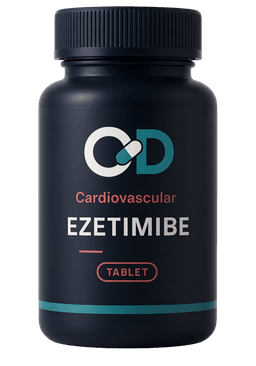 Discussed in this guideEzetimibefrom $49.00
A plain-language, mechanism-focused comparison of two cholesterol-lowering approaches: one understood to act on cholesterol absorption in the gut, the other on the body's own manufacture of cholesterol in the liver.
On this page
Two different ways to influence cholesterol
Ezetimibe and the statins are both prescription medications discussed in the context of cholesterol, but they belong to different drug classes and are understood to act at entirely different points in the body's handling of cholesterol. One class is understood to work in the small intestine; the other is understood to work inside liver cells. This article describes that contrast at the level of mechanism, using ezetimibe and the statin rosuvastatin as the two examples.
Ezetimibe is described as a cholesterol-absorption inhibitor: it is understood to act at the step where cholesterol is taken up from the gut. Rosuvastatin belongs to the statin class, known formally as the HMG-CoA reductase inhibitors, which are understood to act on the step where the body manufactures cholesterol internally. Naming the two targets — an intestinal transport protein versus a liver enzyme — is the cleanest way to see how the two approaches differ from each other.
This article is educational and describes how these molecules are understood to act on the body's chemistry. It does not rank the two as better or worse, does not recommend one over the other, provides no dosing figures, and is not a substitute for guidance from a licensed clinician. Whether either class is appropriate for a given person is a clinical decision, not something an article can answer.
Where the body's cholesterol comes from
Cholesterol is a lipid the body uses as a building block. It is:
- A component of cell membranes
- A raw material for making certain hormones
- A raw material for making vitamin D
- A raw material for making the bile acids that help digest fats
Because it serves these roles, the body does not rely on food alone to supply it. Cholesterol reaches the bloodstream from two broad sources — the diet and internal manufacture — and in most people the amount the body makes on its own accounts for a large share of the total.
The small intestine is where dietary cholesterol enters the body, but it also handles a second stream. The liver secretes cholesterol into bile, which flows into the gut to aid digestion, and much of that biliary cholesterol is reabsorbed through the intestinal wall rather than being lost. So the intestine is a site where both food-derived and bile-derived cholesterol can be taken up back into the body. Internal manufacture, by contrast, happens mainly in the liver, through a multi-step chemical route called the mevalonate pathway that begins with a small molecule named acetyl-CoA.
These two locations — the intestine, where cholesterol is absorbed, and the liver, where much of it is synthesized — are exactly the two points the two drug classes are built around. Ezetimibe is understood to act on the first; the statins are understood to act on the second. Keeping the absorption step and the synthesis step separate in mind is what makes the rest of the comparison straightforward.
How rosuvastatin acts on cholesterol synthesis
Rosuvastatin is a member of the statin class, known in pharmacology as HMG-CoA reductase inhibitors — a name that describes the mechanism directly. The class is understood to act inside cells, chiefly liver cells, on an enzyme called HMG-CoA reductase. That enzyme catalyzes an early step of the mevalonate pathway, converting a molecule named HMG-CoA into mevalonate. In biochemistry this is described as the rate-limiting, or committed, step of cholesterol synthesis, meaning it is the tightly controlled reaction that sets the pace for the whole route. Acting on it is understood to slow the pace of internal cholesterol production.
A statin molecule is shaped to resemble part of the enzyme's natural substrate, so it can occupy the enzyme's active site and compete with the true substrate for that pocket. Rosuvastatin is described in reference materials as a synthetic, hydrophilic (water-soluble) statin, a property that is associated with its being concentrated in the liver rather than diffusing broadly into other tissues. It was approved by the U.S. Food and Drug Administration in 2003 under the brand name Crestor and is now also available as a generic.
The synthesis step connects to a second, indirect effect. When a liver cell makes less cholesterol internally, it senses that its supply has fallen and, through a signaling system involving proteins called SREBPs, places more LDL receptors on its surface. Those receptors are the docking points the liver uses to pull low-density lipoprotein (LDL) particles out of the bloodstream. In this way a statin's action on the synthesis enzyme is indirectly associated with increased LDL-receptor activity. This mechanism is covered in more depth in the companion guide on how statins work; here it stands as the 'synthesis' half of the contrast.
How ezetimibe acts on cholesterol absorption
Ezetimibe is described as a selective cholesterol-absorption inhibitor, and structurally as a compound in a group called the 2-azetidinones. Rather than acting in the liver, it is understood to act at the brush border of the small intestine — the densely folded surface of the enterocytes, the cells that line the gut, where absorption takes place. Its molecular target is a transport protein named Niemann-Pick C1-Like 1, usually abbreviated NPC1L1, which is understood to be the route through which enterocytes take cholesterol up from the intestine.
Ezetimibe is understood to bind NPC1L1 and interfere with that uptake process; research describes it as blocking the internalization step that would normally carry cholesterol into the cell, so that cholesterol stays in the intestinal lumen instead of being absorbed. Because this uptake step handles both dietary cholesterol and the biliary cholesterol described earlier, the mechanism is understood to affect both streams at the intestinal wall. Notably, reference materials describe ezetimibe as not inhibiting cholesterol synthesis in the liver and not increasing bile-acid excretion — its action is understood to be at the absorption step specifically, which is what sets it apart from the statin class.
In terms of how the body handles the drug itself, ezetimibe is rapidly converted to an active glucuronide form and is described as undergoing enterohepatic recirculation — cycling between the gut and the liver — which reference materials associate with its relatively long duration in the body and its repeated delivery back to the intestinal site where it acts. Ezetimibe was approved by the FDA in 2002 under the brand name Zetia. It is available as a generic and also appears in fixed-dose combination products that pair it with a statin.
Comparing the two mechanisms side by side
The clearest way to hold the two together is by the point in the body each one is understood to act on. Rosuvastatin, as a statin, acts on the manufacturing step inside liver cells — it is understood to reduce how much cholesterol the body makes. Ezetimibe acts on the absorption step in the intestine — it is understood to reduce how much cholesterol is taken up from the gut. One targets a hepatic enzyme; the other targets an intestinal transporter. They are different drug classes with different molecular targets, not two versions of the same approach.
Despite acting in different organs, both mechanisms converge on the same downstream regulator. Whether the liver is making less cholesterol itself (the statin route) or receiving less cholesterol from the gut (the ezetimibe route), a liver cell that senses a lower cholesterol supply is understood to respond by increasing LDL-receptor activity, which is associated with greater clearance of LDL particles from the blood. Reaching that common regulatory point by two independent routes is why the pharmacology literature often describes the synthesis and absorption pathways as complementary. The literature also notes that the body tends to partially offset one route with the other — for instance, cholesterol synthesis is described as rising when absorption is blocked, and absorption as rising when synthesis is inhibited.
None of this establishes that either medication, on its own or in combination, is appropriate or effective for any individual — that is not something a mechanism description can determine. Whether either class fits a particular person, which molecule and strength might be involved, and whether two mechanisms are ever used at once are clinical judgments that depend on medical history, other medications, tolerability, and lab findings. Those decisions belong to an independent licensed provider, not to a general article or a product page.
How prescription review works on OpenDoseRx
OpenDoseRx is built so that a clinician — not the shopper — makes the medical decision. You begin by choosing a product and strength, then complete a medical intake that collects your health history and other relevant information. Nothing is dispensed on the basis of the product page alone, because every product on the site is prescription-only.
That intake is routed to an independent, licensed U.S. provider who reviews it and decides whether a prescription is appropriate for you. If the provider determines it is, the prescription is prepared and dispensed by a licensed U.S. pharmacy and shipped to you. If the provider declines, your order does not proceed and you are not charged for the medication — you receive a full refund. Where a product is a compounded preparation, it is not an FDA-approved drug, and statements about it have not been evaluated by the FDA.
This review is a clinical decision, not an automatic one, and it is not a substitute for a relationship with your own healthcare provider or for in-person care. Nothing here should be read as a promise of any particular outcome; it is a description of how these classes are understood to act and how a request is reviewed. Use this guide to understand the biology, and bring your questions to the licensed clinician who reviews your intake.
Common questions
- What is the main difference between ezetimibe and a statin like rosuvastatin?
- They act on different steps in different organs. Ezetimibe is understood to act in the small intestine, where it interferes with a transport protein (NPC1L1) involved in absorbing cholesterol from the gut. Rosuvastatin, a statin, is understood to act inside liver cells on the enzyme HMG-CoA reductase, slowing the body's internal manufacture of cholesterol. One targets absorption; the other targets synthesis. Which, if either, is appropriate is a clinical judgment for a licensed provider.
- What is NPC1L1?
- NPC1L1 (Niemann-Pick C1-Like 1) is a transport protein found at the brush border of the small intestine, on the cells that line the gut. It is understood to be the route through which those cells take cholesterol up from the intestine. Ezetimibe is understood to bind NPC1L1 and interfere with that uptake, so cholesterol remains in the intestinal lumen rather than being absorbed.
- Do ezetimibe and statins act on the same part of the body?
- No. This is the core contrast. Ezetimibe is understood to act at the intestinal wall, on the absorption of cholesterol from the gut. Statins such as rosuvastatin are understood to act inside liver cells, on the enzyme that drives internal cholesterol synthesis. Reference materials describe the two mechanisms as reaching the same downstream point — LDL-receptor activity in the liver — by different, independent routes.
- Does this mean ezetimibe and a statin should be taken together?
- This article does not make that recommendation. It describes only how the two mechanisms differ and why the pharmacology literature calls the absorption and synthesis pathways complementary. Whether either medication is appropriate for a person, and whether two mechanisms would ever be used at the same time, is a clinical decision that depends on medical history, other medications, and lab findings — determined by an independent licensed provider, not by an educational article.
- Do these medications require a prescription?
- Yes. Ezetimibe and the statins, including rosuvastatin, are prescription-only in the United States. On OpenDoseRx, a product is dispensed only after an independent, licensed U.S. provider reviews your medical intake and determines that a prescription is appropriate for you; if the request is declined, you are not charged for the medication and receive a full refund. This guide is educational and is not medical advice.
Ready when you are
Ezetimibefrom $49.00
- Your exact strength
- Licensed provider review
- Full refund if declined
Also relevant
Exact strengths and prices up front — a licensed provider reviews every request.
Browse cardiovascular treatments
Exact strengths and prices up front — reviewed by a licensed U.S. provider.
Keep reading
More plain-language guides on this topic.
How statins work: the cholesterol synthesis pathway
A plain-language, mechanism-focused look at the cholesterol-synthesis pathway and how statins act on the enzyme that helps drive it.
ACE inhibitors and ARBs: how they are understood to act on the renin-angiotensin system
An educational overview of the renin-angiotensin system and how ACE inhibitors and angiotensin-receptor blockers are understood to act within it.
How beta blockers are understood to act on beta-adrenergic receptors
An educational, mechanism-focused overview of how beta blockers such as propranolol and nebivolol are understood to act on beta-adrenergic receptors within the sympathetic nervous system.
This guide is for general education and is not medical advice. Compounded medications are not FDA-approved drugs, and statements on this site have not been evaluated by the FDA. A licensed provider reviews every prescription request.