Guide
Anastrozole vs. exemestane: two aromatase inhibitors
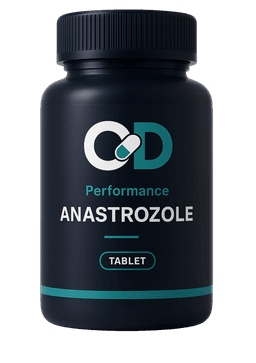 Discussed in this guideAnastrozolefrom $33.00
A neutral, mechanism-focused comparison of how anastrozole and exemestane are understood to interact with the aromatase enzyme — reversibly versus irreversibly.
On this page
Two aromatase inhibitors with different chemistry
Anastrozole and exemestane are two prescription medications that share a target but not a chemical strategy. Both belong to the class known as aromatase inhibitors — molecules designed to act on aromatase, the enzyme understood to carry out the conversion of androgens such as testosterone into estrogens such as estradiol. What separates the two is not the enzyme they engage but the way they are understood to engage it. Anastrozole is a non-steroidal inhibitor understood to bind reversibly, while exemestane is a steroidal inhibitor understood to bind irreversibly.
This guide is a mechanism-focused comparison of those two binding styles. It describes how each molecule is understood to interact with the enzyme at a chemical level; it is not a ranking, a recommendation, or a claim about what either does for any person. The distinction between reversible and irreversible inhibition is a description of chemistry, not a statement that one approach ranks above the other.
This article is educational only and is not medical advice, a diagnosis, or a recommendation. Both medications are prescription-only in the United States, and a licensed provider makes every clinical decision. When agents in this class are prepared by a compounding pharmacy, the resulting preparations are not FDA-approved, and statements about them have not been evaluated by the FDA.
The aromatase active site
Aromatase is the product of the CYP19A1 gene, and it belongs to the cytochrome P450 family of enzymes. Like other members of that family, it contains a heme group — an iron-bearing chemical center — at the heart of its active site. In the reaction called aromatization, an androgen substrate settles into that active site and the heme iron is understood to help drive the chemical steps that convert it into an estrogen.
Because the active site is the pocket where the natural androgen normally docks, it is also the point at which an inhibitor can engage the enzyme. Understanding that this single pocket, organized around the heme group, is the shared point of contact makes it easier to see how two very differently built molecules — one steroidal, one not — can both be described as acting on the same enzyme, and why the manner of their binding is what sets them apart.
How anastrozole is understood to bind
Anastrozole is a non-steroidal molecule, meaning it does not share the four-ring steroid backbone of the enzyme's natural androgen substrate. It is generally described in the literature as a reversible, competitive inhibitor. In that model it is understood to enter the active site and coordinate with the heme iron, occupying the pocket that an androgen would otherwise enter and thereby competing with the substrate for access to the enzyme.
The word reversible refers to the nature of that occupancy. Anastrozole is understood to associate with the enzyme and later dissociate from it rather than altering the enzyme permanently. The interaction is often characterized as an equilibrium between bound and unbound states. When the molecule is present in the active site, that enzyme copy is understood to carry out less of its conversion; when it dissociates, the enzyme molecule itself is understood to be unchanged and able to resume its normal reaction. This describes binding dynamics only, not any downstream effect on a person.
How exemestane is understood to bind
Exemestane takes a different approach that follows from its structure. It is a steroidal molecule that structurally resembles the enzyme's natural androgen substrate, so aromatase is understood to take it up into the active site as though it were that substrate. It is generally described as a mechanism-based inhibitor — sometimes called a "suicide" inhibitor — because the enzyme's own catalytic machinery is understood to begin processing it.
In the course of that processing, exemestane is understood to form a lasting, covalent-style attachment within the active site that inactivates that particular enzyme molecule. This is what the term irreversible describes: the affected enzyme copy is understood not to simply release the inhibitor and resume activity. For a tissue's overall aromatase capacity to return, the model holds that new enzyme must be synthesized — so the timescale of recovery is tied to the body's ordinary turnover of the protein rather than to the molecule dissociating. As with anastrozole, this is a description of enzyme chemistry, not a claim about any result in a person.
Reversible versus irreversible: what the distinction describes
The reversible-versus-irreversible framing is the most common way these two molecules are distinguished in pharmacology writing. It captures a difference in how each is understood to remain associated with the enzyme, and nothing more:
- Anastrozole (non-steroidal): understood to compete for the active site and to associate with and dissociate from the enzyme, so its inhibition is described as reversible and equilibrium-based.
- Exemestane (steroidal): understood to be taken up like the natural substrate and to form a lasting attachment that inactivates the enzyme copy, so its inhibition is described as irreversible and dependent on new enzyme synthesis to reverse.
- Shared target: both are understood to act on the aromatization step itself, rather than on estrogen receptors or on the androgens directly.
This contrast is a difference in the type of chemistry, not a claim that either molecule is stronger, safer, or preferable. This article gives no dosing guidance of any kind — no amounts, frequencies, or schedules. In men's-health settings these agents are frequently prepared by compounding pharmacies at strengths that differ from the manufactured products used elsewhere, and such compounded preparations are not FDA-approved. Whether either molecule is appropriate for a specific person, and at what strength, is determined solely by an independent licensed provider who can weigh that person's health history and laboratory evaluation.
How it works on OpenDoseRx
On OpenDoseRx, a licensed clinician — not the shopper — makes the medical decision. You choose a product and strength, then complete a medical intake with your health history. An independent, licensed U.S. provider reviews that intake and decides whether a prescription is appropriate for you.
If it is, a licensed U.S. pharmacy prepares and ships it; if the provider declines, you are not charged for the medication and receive a full refund. This article is educational only and is not a substitute for a conversation with your own healthcare provider.
Common questions
- What is the main mechanistic difference between anastrozole and exemestane?
- Both are aromatase inhibitors understood to act on the same enzyme, but through different chemistry. Anastrozole is non-steroidal and is generally described as a reversible, competitive inhibitor that occupies the active site and can dissociate from it. Exemestane is steroidal and is generally described as an irreversible, mechanism-based inhibitor that is processed like the natural substrate and forms a lasting attachment inactivating that enzyme copy. This is a difference in the type of binding, not a ranking of one against the other.
- Does 'irreversible' mean exemestane behaves more powerfully in the body?
- No. Irreversible is a description of how the molecule is understood to remain associated with the enzyme — a lasting attachment whose reversal depends on the body synthesizing new enzyme — rather than a statement about strength, results, or suitability for any person. Reversible and irreversible describe two different binding mechanisms only. This page is educational and does not compare outcomes or recommend one molecule over another.
- Do anastrozole and exemestane require a prescription?
- Yes. Both are prescription-only in the United States. On OpenDoseRx you choose a product and strength and complete a medical intake with your health history; an independent, licensed U.S. provider then reviews that intake and decides whether a prescription is appropriate. If it is, a licensed U.S. pharmacy prepares and ships it; if the provider declines, you are not charged for the medication and receive a full refund. This article is educational only and is not medical advice.
Ready when you are
Anastrozolefrom $33.00
- Your exact strength
- Licensed provider review
- Full refund if declined
Also relevant
Exact strengths and prices up front — a licensed provider reviews every request.
Browse performance & vitality
Exact strengths and prices up front — reviewed by a licensed U.S. provider.
Keep reading
More plain-language guides on this topic.
How testosterone works in the body: the androgen pathway
A plain-language look at testosterone as an androgen and how androgen-receptor signaling is understood to act on tissues across the body.
How enclomiphene is understood to act on the HPG axis
An educational overview of how enclomiphene is understood to interact with the hypothalamic-pituitary-gonadal axis through estrogen-receptor modulation.
How aromatase inhibitors are understood to work in estrogen management
A neutral, mechanism-focused look at the aromatase enzyme and how the medications known as aromatase inhibitors are understood to act on it.
This guide is for general education and is not medical advice. Compounded medications are not FDA-approved drugs, and statements on this site have not been evaluated by the FDA. A licensed provider reviews every prescription request.