Guide
How aromatase inhibitors are understood to work in estrogen management
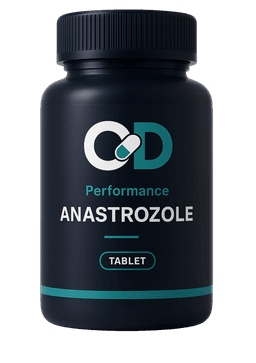 Discussed in this guideAnastrozolefrom $33.00
A neutral, mechanism-focused look at the aromatase enzyme and how the medications known as aromatase inhibitors are understood to act on it.
On this page
Where estrogen comes from in the body
Estrogens are a family of steroid hormones present in everyone, not only in people assigned female at birth. The two most-discussed members are estradiol and estrone. In people assigned male at birth, comparatively little estrogen is secreted directly by a gland; instead, most of it is generated from androgens — the family of hormones that includes testosterone — by an enzymatic conversion that takes place in tissues throughout the body.
The enzyme responsible for that conversion is called aromatase, the product of the CYP19A1 gene. Aromatase catalyzes a reaction known as aromatization, in which an androgen is chemically modified into an estrogen: testosterone is converted into estradiol, and androstenedione into estrone. Aromatase is expressed in a range of tissues, including adipose (fat) tissue, the gonads, bone, and parts of the brain. Because so much of the estrogen circulating in an androgen-dominant physiology arises from this single enzymatic step, aromatase is a natural focal point whenever estrogen is discussed in the context of the androgen pathway.
This article is educational only — a description of how the aromatase enzyme and the medications that act on it are understood to work. It is not medical advice, a diagnosis, or a recommendation for any person. The medications discussed here are prescription-only in the United States, and a licensed provider makes every clinical decision.
What aromatase inhibitors are
Aromatase inhibitors are a class of prescription medications named for the enzyme they are designed to act on. As a class, they are generally described as molecules built to bind the aromatase enzyme and interrupt its catalytic activity — that is, to occupy or inactivate the enzyme so that it is understood to carry out less of the conversion of androgens into estrogen. The class is defined by this mechanism: it acts on the aromatization step itself rather than on estrogen receptors or on the androgens directly.
Anastrozole and exemestane are two prescription medications within this class, and they are commonly grouped into two structural families. Anastrozole belongs to the non-steroidal group, whose members do not share the steroid backbone of the enzyme's natural substrate. Exemestane belongs to the steroidal group, whose members are structurally related to that natural substrate. This structural distinction is the basis for the difference in how each type is understood to interact with the enzyme, described in the next section.
Both are prescription-only, and neither is available without review by a licensed provider. When agents in this class are prepared by a compounding pharmacy for use outside the setting they were originally manufactured for, the resulting compounded preparations are not FDA-approved products, and statements about them have not been evaluated by the FDA. This article does not recommend one product over another; it describes mechanism only.
How the two structural types are understood to act
Non-steroidal aromatase inhibitors, the group that includes anastrozole, are generally described as reversible, competitive inhibitors. They are understood to interact with the enzyme's active site — coordinating with the heme (iron-containing) group that aromatase uses to carry out its reaction — and, while bound, to occupy the site that an androgen would otherwise enter. Because this binding is reversible, the molecule is understood to associate with and dissociate from the enzyme rather than altering it permanently.
Steroidal aromatase inhibitors, the group that includes exemestane, are generally described as irreversible, mechanism-based inhibitors, sometimes called "suicide" inhibitors. Because a steroidal inhibitor structurally resembles the enzyme's natural androgen substrate, it is understood to be taken up by aromatase as if it were that substrate; in the course of being processed, it forms a lasting attachment that inactivates that particular enzyme molecule. For activity to return, the tissue is understood to need to produce new enzyme.
How prescription review works on OpenDoseRx
This article is educational and describes the aromatase enzyme and the mechanism of the medications that act on it; it is not medical advice and does not recommend any product for you. On OpenDoseRx, medications in this class are prescription-only, and the process is built so that a clinician — not the shopper — makes the medical decision. You begin by choosing a product and strength, then complete a medical intake covering your health history and other relevant information.
That intake is routed to an independent, licensed U.S. provider who reviews it and decides whether a prescription is appropriate for you — a clinical judgment, not an automatic one. If the provider determines it is appropriate, the order is sent to a licensed U.S. pharmacy to be filled and shipped to you. If the request is declined, you are not charged for the medication and you receive a full refund. Compounded preparations are not FDA-approved drugs, and nothing here replaces a conversation with your own provider; no product is dispensed without that independent clinical review.
Common questions
- What is aromatase?
- Aromatase is an enzyme, the product of the CYP19A1 gene, that carries out aromatization — the chemical conversion of androgens into estrogens. It is understood to convert testosterone into estradiol and androstenedione into estrone, and it is found in tissues including fat, the gonads, bone, and the brain.
- How do anastrozole and exemestane differ in how they are understood to act?
- Both act on the aromatase enzyme, but by different mechanisms. Anastrozole is non-steroidal and is generally described as a reversible, competitive inhibitor that occupies the enzyme's active site. Exemestane is steroidal and is generally described as an irreversible, mechanism-based inhibitor that inactivates the enzyme molecule it binds. This is a difference in the type of binding, not a ranking of one against the other.
- Do aromatase inhibitors require a prescription?
- Yes. In the United States these are prescription-only. On OpenDoseRx, an independent licensed U.S. provider reviews your medical intake, and a licensed U.S. pharmacy fills an order only if the provider determines it is appropriate. If the request is declined, you receive a full refund. Compounded preparations are not FDA-approved products, and this is educational information, not medical advice.
Ready when you are
Anastrozolefrom $33.00
- Your exact strength
- Licensed provider review
- Full refund if declined
Also relevant
Exact strengths and prices up front — a licensed provider reviews every request.
Browse performance & vitality
Exact strengths and prices up front — reviewed by a licensed U.S. provider.
Keep reading
More plain-language guides on this topic.
How testosterone works in the body: the androgen pathway
A plain-language look at testosterone as an androgen and how androgen-receptor signaling is understood to act on tissues across the body.
How enclomiphene is understood to act on the HPG axis
An educational overview of how enclomiphene is understood to interact with the hypothalamic-pituitary-gonadal axis through estrogen-receptor modulation.
How sermorelin is understood to work: the growth hormone-releasing hormone pathway
A neutral, mechanism-focused look at growth hormone-releasing hormone (GHRH) and how the compounded peptide sermorelin is understood to act on the GHRH receptor in the pituitary.
This guide is for general education and is not medical advice. Compounded medications are not FDA-approved drugs, and statements on this site have not been evaluated by the FDA. A licensed provider reviews every prescription request.