Guide
Copper peptides (GHK-Cu): the tripeptide-copper complex in skin
 Discussed in this guideGHK-Cu 3% Creamfrom $119.00
GHK-Cu is a tripeptide bound to a copper ion; this guide describes the complex and the skin-signaling roles attributed to it in the scientific literature.
On this page
What GHK-Cu is: the tripeptide-copper complex
GHK-Cu is the shorthand for a copper complex of the tripeptide glycyl-L-histidyl-L-lysine. A tripeptide is a short chain of three amino acids — here glycine, histidine, and lysine — linked by peptide bonds. On its own this three-amino-acid sequence is referred to as GHK; when it is bound to a copper(II) ion, it is written GHK-Cu and generally described as a copper-peptide complex.
The copper ion is not simply mixed with the peptide; it is coordinated by specific atoms on the molecule. GHK is generally described as binding copper(II) through nitrogen atoms of its histidine side chain and peptide backbone, giving the complex a defined and relatively stable geometry. Because the histidine-containing sequence has a high affinity for copper, GHK is often categorized in the literature as a copper-binding peptide.
It helps to distinguish the two things the name refers to. GHK is the peptide; copper is a trace metal the body already uses as a cofactor in several enzymes. GHK-Cu is the paired form, in which the peptide is understood to act as a carrier and coordinating partner for the copper ion. Products described as "copper peptides" in skincare generally refer to this GHK-Cu complex or closely related copper-peptide chemistry.
Where GHK is understood to come from
GHK was first identified in human blood plasma, and it also occurs in saliva and other tissues. The peptide is generally described as a fragment that can be released from larger proteins of the extracellular matrix — the scaffold of collagen and other proteins surrounding skin cells — particularly during periods of tissue remodeling or injury. In this framing, GHK is discussed as a naturally occurring signal molecule rather than a foreign compound.
Literature on GHK frequently notes that its measured concentration in plasma is described as highest in younger individuals and as declining over the decades of adult life. This is presented as a descriptive observation about the molecule's natural abundance, not as a statement about what any product does. Researchers have cited this age-related pattern as one reason GHK has been studied in the context of skin and connective tissue.
Because GHK appears where matrix proteins are being broken down and rebuilt, it is often described as being associated with the body's remodeling and repair signaling. The sections below describe the roles researchers have attributed to it in cell and laboratory studies; they are descriptions of proposed mechanism, not claims about outcomes in any person.
Described roles in skin-remodeling signaling
In cell-culture and laboratory research, GHK-Cu has been studied as a signaling molecule that interacts with skin fibroblasts, the cells responsible for producing the extracellular matrix. Investigators have described it in connection with the expression of genes for matrix components such as collagen, elastin, proteoglycans, and glycosaminoglycans — the structural and water-binding molecules that make up the dermis. These are mechanistic descriptions of what has been observed or proposed in research settings.
GHK-Cu has also been described in relation to the enzymes that continuously remodel the matrix, including matrix metalloproteinases and their inhibitors, which govern the balance between breaking down and rebuilding matrix. The copper carried by the complex is itself a required cofactor for enzymes such as lysyl oxidase, which participates in the cross-linking of collagen and elastin. Copper's role as an enzyme cofactor is well established in general biochemistry, independent of any particular product.
It is important to read all of this as description rather than promise. Saying that a molecule is understood to act on a signaling pathway, or has been studied in connection with matrix gene expression, describes proposed mechanism and research context. It does not state that a cream or troche produces any particular change in a person's skin. Whether any of these mechanisms is clinically meaningful for a given individual is a medical question for a licensed provider.
Copper-peptide forms offered here: cream and troche
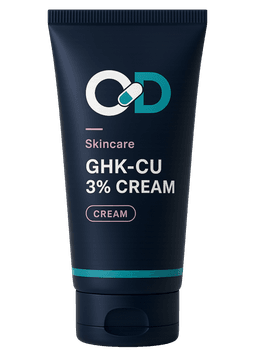
OpenDoseRx lists GHK-Cu in two formulations. The GHK-Cu cream is a topical preparation intended to be applied to the skin, where the copper-peptide complex is presented directly at the surface. The GHK-Cu troche is a different delivery form: a troche is a small, dissolvable lozenge held in the mouth, where a compound can be absorbed across the oral mucosa rather than swallowed as a pill. The two forms differ in how and where the complex is introduced to the body.
Both are compounded preparations. Compounded medications are made by a licensed pharmacy for an individual patient and are not FDA-approved products; the statements in this guide have not been evaluated by the FDA. This guide does not provide a strength, an amount, or a schedule for either form. Any formulation, strength, and directions are determined by the prescribing provider based on the intake information, not selected from a guide.
A person using OpenDoseRx requests a specific product and strength; they do not prescribe for themselves. The decision of whether a copper-peptide cream or troche is appropriate, and in what form, rests with an independent licensed clinician. This guide is educational and is not medical advice or a recommendation to use any product.
How prescription review works on OpenDoseRx
On OpenDoseRx, you begin by choosing a product and strength and completing a medical intake — a set of health questions relevant to what you are requesting. Your request and intake are then reviewed by an independent licensed U.S. provider, who makes the clinical decision. The provider, not the platform and not the patient, determines whether a prescription is appropriate.
If the provider approves the order, it is filled by a licensed U.S. pharmacy and shipped to you. If the provider declines the request, the order is refunded in full. This process is a prescribing review, not a substitute for your own doctor: it does not replace the ongoing relationship you have with your personal healthcare provider, and you are encouraged to keep them informed about the medications you request.
Common questions
- Is GHK-Cu just copper for the skin?
- No. GHK-Cu is a defined complex in which the tripeptide GHK (glycine-histidine-lysine) coordinates a copper(II) ion. The peptide is understood to act as a carrier and coordinating partner for the copper, so the complex is chemically distinct from copper alone or from the peptide alone.
- What is a troche, and how is it different from the cream?
- A troche is a small lozenge that dissolves in the mouth, allowing a compound to be absorbed across the lining of the mouth. The cream is a topical preparation applied to the skin. The two are different delivery forms of the same copper-peptide complex; which form, if any, is appropriate is decided by the prescribing provider.
- Are these copper-peptide products FDA-approved?
- No. They are compounded preparations made by a licensed pharmacy for an individual patient, and compounded medications are not FDA-approved. The statements in this guide are educational, have not been evaluated by the FDA, and are not medical advice. An independent licensed provider determines whether a product is appropriate.
Ready when you are
GHK-Cu 3% Creamfrom $119.00
- Your exact strength
- Licensed provider review
- Full refund if declined
Also relevant
Exact strengths and prices up front — a licensed provider reviews every request.
Browse skincare & dermatology
Exact strengths and prices up front — reviewed by a licensed U.S. provider.
Keep reading
More plain-language guides on this topic.
How tretinoin works: retinoids and skin cell turnover
A plain-language look at the biology of retinoids — how tretinoin engages retinoic-acid receptors and is understood to influence how the skin renews itself.
How bimatoprost is understood to affect eyelash growth: the prostaglandin analog pathway
A plain-language look at how bimatoprost, a prostaglandin analog first used in glaucoma care, is understood to act on the eyelash growth cycle.
GHK-Cu troche vs. cream: how the delivery routes differ
GHK-Cu is a copper-bound tripeptide offered here in two compounded forms; this guide describes how a sublingual troche and a topical cream present that same complex to the body differently.
This guide is for general education and is not medical advice. Compounded medications are not FDA-approved drugs, and statements on this site have not been evaluated by the FDA. A licensed provider reviews every prescription request.