Guide
GHK-Cu troche vs. cream: how the delivery routes differ
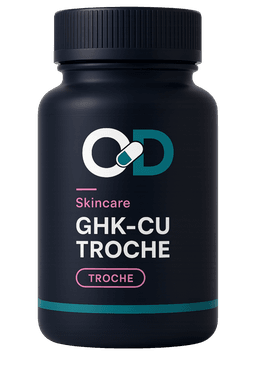 Discussed in this guideGHK-Cu Trochefrom $150.00
GHK-Cu is a copper-bound tripeptide offered here in two compounded forms; this guide describes how a sublingual troche and a topical cream present that same complex to the body differently.
On this page
Two delivery forms of the same copper-peptide complex
GHK-Cu is the shorthand for a copper complex of the tripeptide glycyl-L-histidyl-L-lysine — the three amino acids glycine, histidine, and lysine, linked together and bound to a copper(II) ion. OpenDoseRx lists this same complex in two compounded forms: a topical cream applied to the skin, and a sublingual troche that dissolves in the mouth. Changing the form does not change the molecule itself; it changes how and where the complex is introduced to the body, which is the subject of this guide.
This article is a route-and-delivery explainer. It sits alongside a separate guide that describes what GHK-Cu is and the skin-signaling roles attributed to it in the research literature; here the focus is narrower — the path each form takes from the point of administration into the body. It is educational only, is not medical advice, and is not a recommendation of one form over the other.
Both preparations are compounded. Compounded medications are made by a licensed pharmacy for an individual patient and are not FDA-approved products; the statements in this guide have not been evaluated by the FDA. Whether either form is appropriate, and in what strength, is a decision for an independent licensed provider, not something a guide can determine.
What the molecule has to travel through
GHK-Cu is a small peptide carrying a coordinated copper ion. The free tripeptide has a molecular weight of roughly 340 daltons, and the copper complex remains modest in size — under the approximately 500-dalton threshold often cited (the "500-dalton rule" described by Bos and Meinardi) as a rough upper limit for compounds that cross intact skin by passive diffusion. Size, though, is only one factor in how a molecule moves across a biological surface.
The complex is also hydrophilic, or water-loving, and it carries charge from its copper coordination, whereas many biological barriers tend to favor small, fat-soluble molecules. Being under a size threshold therefore does not by itself mean a molecule passes freely across a given surface; the chemistry of the barrier and the vehicle the molecule is carried in matter as well. This is part of why the same complex is understood to behave differently depending on which surface it meets.
Each delivery form presents GHK-Cu to a different biological surface — the skin's outer barrier in the case of the cream, and the lining of the mouth in the case of the troche. The two sections that follow describe what each surface is and what crossing it is generally understood to involve.
How the topical cream presents the complex
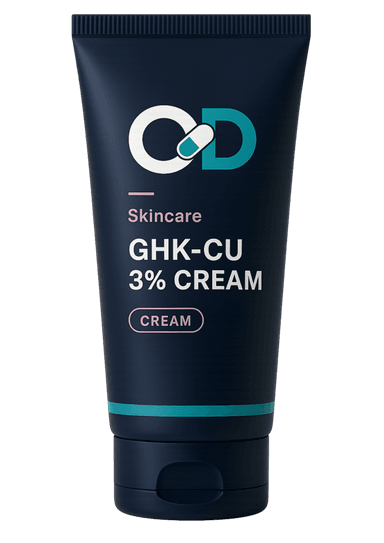
The GHK-Cu cream is a topical preparation applied to the skin, placing the copper-peptide complex directly at the surface. The outermost layer of skin, the stratum corneum, is a barrier of flattened dead cells embedded in lipids; it is what any topically applied molecule must cross to reach the living epidermis and, below it, the dermis — the fibroblast-rich layer where GHK-Cu's described skin-signaling roles have been studied. Presenting the complex at the skin is the starting point of this route, not the endpoint.
Because GHK-Cu is small, it is generally discussed as capable of crossing this barrier, but its hydrophilic, copper-coordinated nature makes passive penetration variable. Formulation is understood to play a large part here: the vehicle a cream uses — for example a base that transiently loosens the tightly packed lipids of the stratum corneum — is described as influencing how much of the complex reaches the viable skin layers rather than remaining at the surface. The formulation, not the molecule alone, shapes what topical delivery is expected to accomplish.
The defining feature of the topical route is that it presents the complex to the skin locally, at and beneath the site of application. It is a regional delivery to the skin compartment rather than a route designed to distribute the molecule broadly through the bloodstream. How much a given cream is formulated to deliver, and whether that is appropriate for a person, is determined in the formulation and in clinical review — not by educational content.
How the sublingual troche presents the complex
A troche is a small, dissolvable lozenge held in the mouth — under the tongue, called sublingual, or against the cheek, called buccal — where it releases its contents against the oral mucosa, the moist lining of the mouth. Unlike a tablet that is swallowed and processed through the stomach and intestines, a troche is designed so that a portion of the compound can be absorbed across this mucosa into the bloodstream.
One reason this route is used relates to a concept called first-pass metabolism. Substances absorbed from the gastrointestinal tract travel first to the liver, where a fraction can be broken down before reaching general circulation; peptides swallowed into the gut also encounter stomach acid and digestive enzymes. Absorption across the oral mucosa drains into veins that reach systemic circulation more directly, which is the rationale for delivering some compounds sublingually rather than by swallowing. In practice, some of a dissolving troche is inevitably swallowed, so the two paths are not fully separate.
The defining feature of the sublingual route is that it is designed to present GHK-Cu systemically — absorbed into the bloodstream and distributed through the body — rather than depositing it at a specific external site. It is worth noting that human data on how much GHK-Cu is absorbed sublingually, and in what form, is limited; the mechanism describes an intended path, not a measured result in any individual. What a given troche contains, and whether it suits a person, are matters for the prescribing provider.
How the two routes differ in presentation
The clearest way to frame the difference is by where each form presents the complex and what it must cross to get there. The cream is a topical, local delivery: it places GHK-Cu at the skin and relies on the complex crossing the stratum corneum into the underlying tissue. The troche is a sublingual, systemic delivery: it releases GHK-Cu against the oral mucosa, from which a portion is absorbed into the bloodstream and carried through the body. One is directed at a surface tissue; the other is designed to enter general circulation.
Because the routes present the complex to different places and by different mechanisms, the amount of drug substance in a cream and in a troche is not directly comparable, and a strength set for one form does not translate into the other. This is one reason form and strength are decided together by a prescriber rather than converted between forms. None of this ranks one route above the other; site and manner of presentation are simply different design choices.
Both remain compounded, non-FDA-approved preparations, and this guide describes proposed mechanism and delivery pathways rather than clinical results in any person. Whether a copper-peptide cream or troche is appropriate for a given individual, and in what form and strength, is a clinical judgment that belongs to an independent licensed provider who has reviewed that person's information.
How prescription review works on OpenDoseRx
On OpenDoseRx, you begin by choosing a product and strength — including the form you are interested in — and completing a medical intake, a set of health questions relevant to what you are requesting. Your request and intake are then reviewed by an independent licensed U.S. provider, who makes the clinical decision. The provider, not the platform and not the patient, determines whether a prescription is appropriate and in which form.
If the provider approves the order, it is filled by a licensed U.S. pharmacy and shipped to you. If the provider declines the request, the order is refunded in full. This process is a prescribing review, not a substitute for your own doctor: it does not replace the ongoing relationship you have with your personal healthcare provider, and you are encouraged to keep them informed about the medications you request.
Common questions
- What is the core difference between the GHK-Cu troche and the cream?
- The cream is a topical form applied to the skin, where the copper-peptide complex is presented locally and must cross the skin's outer barrier to reach the tissue beneath. The troche is a sublingual form that dissolves in the mouth, where a portion of the complex is absorbed across the oral lining into the bloodstream and distributed systemically. The difference is where the complex is presented and what it crosses to get there, not the molecule itself.
- Does the troche deliver GHK-Cu to the skin the way the cream does?
- The two routes are understood to work differently. The cream presents the complex directly at the skin, a local delivery. The troche is designed to route a portion of the complex into general circulation through the lining of the mouth, a systemic delivery. Describing these as intended paths is not a claim about how much reaches any particular tissue in a given person, which is not something an educational guide can state.
- If GHK-Cu is a small molecule, why does the cream need special formulation to get it into the skin?
- Molecular size is only one factor. The tripeptide is small — under the roughly 500-dalton threshold often cited for passive skin penetration — but it is also hydrophilic and copper-coordinated, and the skin's outer layer tends to favor small, fat-soluble molecules. The vehicle a cream uses is understood to influence how much of the complex reaches the living skin layers rather than staying at the surface, which is why formulation matters alongside molecular weight.
- Are the troche and cream strengths interchangeable?
- No. The two forms present the complex to different places by different mechanisms, so the amount in a cream and in a troche is not directly comparable, and a strength for one does not convert to the other. Form and strength are decided together by a prescribing provider rather than translated between forms.
- Are these copper-peptide products FDA-approved?
- No. Both the cream and the troche are compounded preparations made by a licensed pharmacy for an individual patient, and compounded medications are not FDA-approved. The statements in this guide are educational, have not been evaluated by the FDA, and are not medical advice. An independent licensed provider determines whether either form is appropriate.
Ready when you are
GHK-Cu Trochefrom $150.00
- Your exact strength
- Licensed provider review
- Full refund if declined
Also relevant
Exact strengths and prices up front — a licensed provider reviews every request.
Browse skincare & dermatology
Exact strengths and prices up front — reviewed by a licensed U.S. provider.
Keep reading
More plain-language guides on this topic.
How tretinoin works: retinoids and skin cell turnover
A plain-language look at the biology of retinoids — how tretinoin engages retinoic-acid receptors and is understood to influence how the skin renews itself.
Copper peptides (GHK-Cu): the tripeptide-copper complex in skin
GHK-Cu is a tripeptide bound to a copper ion; this guide describes the complex and the skin-signaling roles attributed to it in the scientific literature.
How bimatoprost is understood to affect eyelash growth: the prostaglandin analog pathway
A plain-language look at how bimatoprost, a prostaglandin analog first used in glaucoma care, is understood to act on the eyelash growth cycle.
This guide is for general education and is not medical advice. Compounded medications are not FDA-approved drugs, and statements on this site have not been evaluated by the FDA. A licensed provider reviews every prescription request.