Guide
Extended-release vs. immediate-release metformin: how the formulations differ
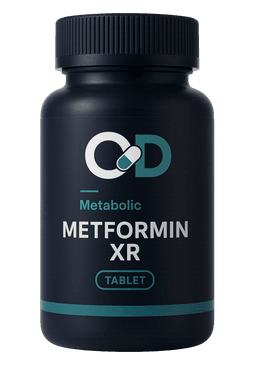 Discussed in this guideMetformin XRfrom $39.99
A neutral, formulation-focused look at how extended-release and immediate-release metformin differ in the way each tablet releases the drug, and how that shapes absorption over time.
On this page
One molecule, two release profiles
Metformin is a biguanide prepared in two main oral formulations: immediate-release, often shortened to IR, and extended-release, written as ER or XR. The active molecule is the same in both. What differs is the formulation itself — the physical way each tablet is built to release that molecule over time. Changing the release profile does not change the drug or the mechanism it is understood to act through; it changes the pace at which the medication becomes available to be absorbed. This article is educational only and is not medical advice or a recommendation of one form over the other.
It is worth separating this from mechanism. A companion guide on this hub describes how metformin is understood to work at the level of the liver, muscle, and gut, and this article does not revisit that biology. Instead it looks only at how immediate-release and extended-release formulations differ in the timing and pattern of drug release, and how that timing interacts with the way metformin is absorbed. The question here is not what the molecule does once it reaches the body, but how quickly the tablet lets it get there.
Both forms are prescription-only in the United States. Which formulation, if any, suits a given person is a clinical decision that belongs to an independent licensed provider, weighed alongside health history and other factors. The description below is background for that conversation rather than guidance on what to choose.
How immediate-release metformin is released
An immediate-release tablet dissolves and releases its full dose relatively quickly after it is swallowed. In pharmacokinetic studies, blood concentrations of metformin from an immediate-release tablet tend to rise to their peak within roughly two to three hours, then decline over the following several hours. Because the medication is delivered in a comparatively short window, immediate-release products are conventionally associated with being taken more than once a day — a rhythm defined by the specific product and the prescriber, not by educational content.
The shape of that curve — a fairly quick rise to a peak concentration followed by a fall — is what the phrase “immediate release” describes. This peak-and-decline pattern is the baseline against which extended-release designs are usually compared. Nothing about the pattern is a statement of how well the medication works for any individual; it is simply a description of how the formulation delivers the molecule over time.
Historically, the immediate-release tablet is the long-established oral form of metformin, and its pharmacokinetics are the reference point regulators and researchers use when characterizing newer release designs. When a study reports that an extended-release product behaves differently, the immediate-release curve is almost always the comparison it is measured against.
How extended-release metformin is engineered
Extended-release formulations are built to release the same metformin molecule gradually, over many hours, rather than all at once. In studies, peak blood concentrations from an extended-release tablet tend to occur substantially later — on the order of about seven hours after a dose — and the peak itself tends to be lower, with a flatter overall curve, than an immediate-release tablet of a comparable amount. This slower, more spread-out delivery is the defining feature of the extended-release design, and it is associated with a once-daily administration rhythm in the products studied to date. Whether that slower rise and lower peak matter for any individual is a clinical question a provider considers, not something an explainer can answer.
Manufacturers achieve that gradual release through different engineered delivery systems, and not every extended-release product works the same way:
- A hydrophilic polymer matrix: the tablet swells on contact with digestive fluid and forms a gel layer, through which metformin diffuses out slowly
- An osmotic system, in which water is drawn into the tablet and pushes drug out through a small laser-drilled orifice at a controlled rate
- A gastroretentive design intended to keep the tablet in the stomach so it releases into the upper digestive tract over time
These are engineering strategies for controlling timing; they do not alter the metformin molecule itself.
One visible consequence of several of these matrix and shell designs is what clinicians call a “ghost tablet.” Because the structural component that controls release is often not absorbed, it can pass largely intact in the stool after the active medication has been released from it. This is a described, commonly reported characteristic of certain extended-release delivery systems rather than a sign the tablet was not used — though, as with anything unexpected, it is reasonable to raise with a prescribing provider.
Where metformin is absorbed, and why timing is studied
To see why release timing matters, it helps to know where metformin enters the body. Metformin is understood to be absorbed mainly in the upper part of the small intestine, and its uptake there is thought to rely on active transporter proteins rather than simple passive diffusion. Because those transporters can become saturated, absorption is described as dose-dependent: as the amount presented at once increases, the fraction absorbed tends to fall. Reported oral bioavailability for a standard immediate-release dose is on the order of 50 to 60 percent under fasting conditions.
That saturable, location-specific absorption is part of why a slower delivery profile is of scientific interest. Presenting the molecule to its absorption window more gradually, rather than as a single large bolus, is one of the ideas behind extended-release and gastroretentive designs. Whether and how that translates into anything meaningful for a given person is a clinical question — the pharmacology here describes the rationale researchers study, not an outcome for any individual.
It is also worth noting what does not change between the two forms downstream. Metformin is understood not to be appreciably broken down by the liver, and to be excreted largely unchanged by the kidneys. That renal clearance is one reason kidney function is among the factors a provider weighs when considering metformin in any formulation — a point that sits with the prescriber and the medical intake rather than with a general explainer.
Why the choice between forms is a provider's decision
Because immediate-release and extended-release products deliver the same molecule on different timelines, they are not simply interchangeable tablet-for-tablet. The strength, the formulation, and the administration conditions for any metformin product are set together — defined by the specific product and the prescribing provider — rather than converted casually from one form to the other. Switching between forms, if it is done at all, is a clinical decision, not a substitution a shopper makes.
For someone weighing the difference, the practical considerations often include the release profile, the administration rhythm a form is associated with, and how each interacts with metformin's absorption — all factors a licensed provider evaluates against an individual's health history. None of that is captured by a preference for one word over another on a label, which is why formulation is decided in review rather than at the point of purchase.
It is also worth noting that some metformin-containing products available through compounding pharmacies are not FDA-approved products, a neutral fact a provider can explain during review. As with everything above, this is background for a conversation with a clinician, not a recommendation of any particular product or formulation.
How prescription review works on OpenDoseRx
On OpenDoseRx, the clinical decision rests with a licensed clinician, not the shopper. You begin by choosing a product and strength, then complete a medical intake that collects your health history and other relevant information. For a medication like metformin, the kinds of factors a provider weighs can include considerations such as kidney function, which is one reason the intake and independent review exist in the first place — and formulation is part of what a provider, not the shopper, decides.
That intake is routed to an independent, licensed U.S. provider who reviews it. If the provider determines a prescription is appropriate, it is sent to a licensed U.S. pharmacy to be filled and shipped to you. If the request is declined, you are not charged for the medication and receive a full refund. Nothing here replaces a conversation with your own provider, and every product is dispensed only after that independent clinical review.
Common questions
- Is extended-release metformin a different drug from immediate-release?
- No. Both contain the same metformin molecule and are understood to act through the same mechanism. What differs is the formulation — the way the tablet is engineered to release that molecule over time. Immediate-release delivers its dose relatively quickly, while extended-release spreads delivery out over many hours. This is a description of the formulations, not a judgment about which is right for anyone.
- Why is metformin made in an extended-release form at all?
- Metformin is understood to be absorbed mainly in the upper small intestine through a transporter-based process that can become saturated, so absorption is described as dose-dependent. Delivering the molecule to that absorption window more gradually, rather than all at once, is one of the ideas researchers study behind extended-release and gastroretentive designs. That describes the rationale scientists explore; whether it matters for a given person is a clinical question for a provider.
- Should I take the immediate-release or the extended-release form?
- That is not something to decide from an explainer. Because the two forms deliver the same molecule on different timelines, they are not simply interchangeable, and the strength, formulation, and administration conditions are set together by the specific product and a prescribing provider. Which formulation, if any, is appropriate is a clinical decision that belongs to an independent licensed provider, weighed against your health history.
- Why did I see what looked like a tablet in my stool after taking extended-release metformin?
- Many extended-release tablets use a structural matrix or shell that controls release but is not itself absorbed, so it can pass largely intact in the stool after the active medication has been released from it — sometimes called a “ghost tablet.” This is a commonly reported characteristic of certain extended-release delivery systems. As with anything unexpected, it is reasonable to raise with your prescribing provider.
- Do both forms require a prescription?
- Yes. Immediate-release and extended-release metformin are both prescription-only in the United States. On OpenDoseRx, an independent, licensed U.S. provider reviews your medical intake and decides whether a prescription — and which formulation — is appropriate for you. A licensed U.S. pharmacy fills approved orders, and if the request is declined you receive a full refund.
Ready when you are
Metformin XRfrom $39.99
- Your exact strength
- Licensed provider review
- Full refund if declined
Also relevant
Exact strengths and prices up front — a licensed provider reviews every request.
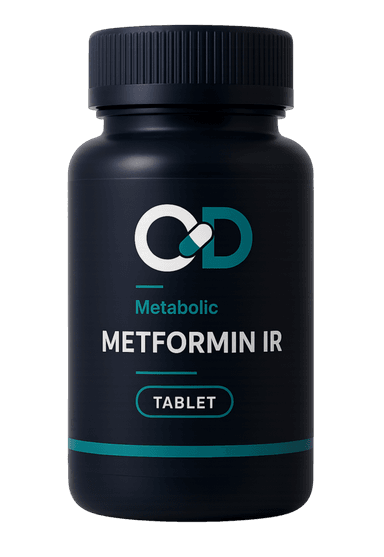
Browse metabolic health
Exact strengths and prices up front — reviewed by a licensed U.S. provider.
Keep reading
More plain-language guides on this topic.
How metformin works: the biguanide mechanism
A neutral, mechanism-focused look at how metformin, a biguanide, is understood to act on the liver, insulin sensitivity, and AMPK signaling.
How acarbose is understood to work: the alpha-glucosidase inhibitor pathway
A neutral, mechanism-focused look at how acarbose, an alpha-glucosidase inhibitor, is understood to act on the enzymes that digest carbohydrates in the small intestine.
Low-dose naltrexone (LDN): the history and proposed mechanism
A plain-language history of naltrexone — how it was developed as an opioid antagonist — and the low-dose opioid-rebound and immune-modulation mechanisms studied in research.
This guide is for general education and is not medical advice. Compounded medications are not FDA-approved drugs, and statements on this site have not been evaluated by the FDA. A licensed provider reviews every prescription request.