Guide
Low-dose naltrexone (LDN): the history and proposed mechanism
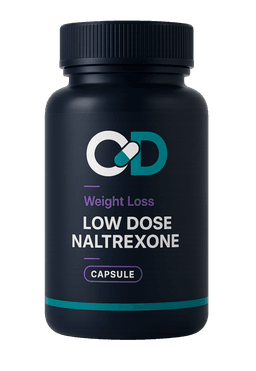 Discussed in this guideLow Dose Naltrexonefrom $79.00
A plain-language history of naltrexone — how it was developed as an opioid antagonist — and the low-dose opioid-rebound and immune-modulation mechanisms studied in research.
On this page
One molecule, two very different dose ranges
Naltrexone is a prescription medication most people first encounter as a standard-dose opioid antagonist. In recent years the same molecule has drawn interest at far smaller amounts, referred to as low-dose naltrexone, or LDN. This article is a background and mechanism piece: it explains how naltrexone was originally developed and the hypotheses researchers have proposed for how it may act at low doses. It is educational only, and is not medical advice or a recommendation.
Because those two stories are easy to blur together, this guide keeps them separate: first the history and standard pharmacology, then what "low-dose" means, then the mechanisms proposed for the low-dose use. Nothing here describes what LDN does for any condition or any person. Whether it is appropriate is a decision for a licensed provider.
How naltrexone was originally developed
Naltrexone was first synthesized in 1963 by Endo Laboratories — a company later absorbed into DuPont — and patented in 1967. Researchers were looking for an orally active, longer-acting opioid antagonist: a molecule that could occupy opioid receptors without activating them. After clinical development through the 1970s, the U.S. Food and Drug Administration approved naltrexone in 1984 for the treatment of opioid dependence, where it was marketed under the brand name Trexan.
Its approved indications expanded over time. In the mid-1990s, naltrexone received FDA approval for alcohol dependence and was rebranded ReVia. A long-acting injectable extended-release formulation was later approved as well, and naltrexone was also combined with bupropion in a separate FDA-approved product studied in the context of weight management. Across the oral products, the standard tablet is 50 mg, with daily amounts commonly cited in the 50-to-100 mg range.
This history matters because it establishes what naltrexone was designed to do: block opioid receptors at conventional doses. The low-dose use described later in this article emerged separately, and it rests on a different set of proposed mechanisms rather than on the receptor-blocking action behind naltrexone's original approvals.
How naltrexone acts as an opioid antagonist
At standard doses, naltrexone is understood to work as a pure competitive opioid antagonist. "Antagonist" means it binds to opioid receptors and occupies them without switching them on; "competitive" means it competes with opioid molecules for the same binding sites. Because it is a pure antagonist rather than a partial agonist, it is not designed to produce opioid-like effects of its own at these doses.
Naltrexone acts most strongly at the mu-opioid receptor, with weaker antagonist activity at the kappa and delta-opioid receptors. By occupying these receptors, it is designed to blunt the effects of opioid drugs and of the body's own opioid signaling at conventional doses. This receptor-blocking action is the basis for its FDA-approved standard-dose uses.
It helps to keep this baseline in mind. The standard-dose mechanism is relatively straightforward receptor blockade. The proposed low-dose mechanisms are more nuanced and, importantly, are hypotheses studied in research rather than settled facts — a difference the next sections return to repeatedly.
What "low-dose" naltrexone means
Low-dose naltrexone refers to the same molecule taken at a small fraction of the standard amount — often described as roughly one-tenth or less of a conventional dose. Amounts commonly cited in the research literature fall around 1.5 to 4.5 mg, compared with the 50 mg standard tablet. The term LDN describes this low-dose use rather than a distinct, separately approved drug.
The low-dose approach is generally traced to clinical observations made by the physician Bernard Bihari in the mid-1980s, and formal human research on LDN began appearing in the decades that followed. Because the very small strengths involved are not a standard manufactured product, low-dose naltrexone is typically prepared by a compounding pharmacy to fit an individual prescription.
Two points follow from this. First, low-dose naltrexone is used off-label — that is, outside naltrexone's FDA-approved standard-dose indications. Second, a compounded low-dose preparation is not itself FDA-approved, because the FDA approves finished, mass-manufactured products rather than the individualized preparations a pharmacy compounds for a single prescription. Whether a compounded product is appropriate is a clinical decision for a licensed provider.
The proposed mechanisms studied in research
One hypothesis centers on a brief, transient blockade of opioid receptors. The idea studied in research is that a small dose occupies opioid receptors for only a short window, and that the body may respond to this brief blockade with a compensatory, rebound increase in its own opioid signaling — endorphins and enkephalins, including a peptide sometimes called met-enkephalin, or opioid growth factor. This is a proposed mechanism, described in the literature as the opioid-rebound, or endorphin-rebound, hypothesis.
A second set of hypotheses looks beyond the classic opioid receptors. Researchers have proposed that naltrexone — including a mirror-image (+)-form studied in the laboratory — may act on non-opioid targets such as Toll-like receptor 4 (TLR4) on glial cells like microglia. Through this proposed pathway, low-dose naltrexone is studied in the context of modulating glial activation and the release of inflammatory signaling molecules called cytokines. Like the rebound hypothesis, this is a proposed mechanism under investigation rather than an established one.
It is important to be clear about the state of the evidence. These mechanisms are hypotheses that researchers continue to study, not settled facts, and a single agreed-upon explanation for how low-dose naltrexone acts is still lacking. Some studies have questioned parts of the endorphin-rebound hypothesis, for example. This article describes what has been proposed and studied; it makes no claim about whether low-dose naltrexone produces any particular effect in any person.
Why appropriateness is a provider's decision
Because low-dose naltrexone is used off-label, is typically compounded, and rests on mechanisms that remain under study, whether it is appropriate for any individual is a clinical judgment. This article does not provide dosing guidance. Any strength, schedule, or decision to use it is determined by a prescribing provider based on the person in front of them, not by educational content.
On OpenDoseRx, you begin by choosing a product and strength, then complete a medical intake covering your health history and other relevant information. That intake is routed to an independent, licensed U.S. provider who reviews it and decides whether a prescription is appropriate — a clinical decision, not an automatic one. If it is approved, a licensed U.S. pharmacy prepares and ships it; where a compounded preparation is involved, a compounding pharmacy fills it. If the provider declines, you are not charged for the medication and receive a full refund.
Nothing here is a substitute for a conversation with your own provider. Use this guide to understand where naltrexone came from and what has been proposed about its low-dose use, and bring your questions to the licensed provider who reviews your intake.
Common questions
- Is low-dose naltrexone FDA-approved?
- Naltrexone is FDA-approved at standard doses for specific indications, but the low-dose use (LDN) is off-label. Because the small strengths involved are typically prepared by a compounding pharmacy, a compounded low-dose preparation is not itself FDA-approved — the FDA approves finished manufactured products, not the individualized preparations a pharmacy compounds. A licensed provider decides whether it is appropriate.
- What does "low-dose" actually mean here?
- It refers to the same naltrexone molecule taken at a small fraction of the standard amount — often described as roughly one-tenth or less of a conventional dose. The research literature commonly cites amounts around 1.5 to 4.5 mg, compared with the 50 mg standard tablet. The exact amount and whether it is appropriate are decisions for a prescribing provider, not something this article specifies.
- How is low-dose naltrexone thought to work?
- Two mechanisms have been proposed and studied. One is an opioid-rebound hypothesis: a brief blockade of opioid receptors is thought to prompt a compensatory rise in the body's own endorphins and enkephalins. The other is an immune-modulation hypothesis involving non-opioid targets such as Toll-like receptor 4 on glial cells. Both are proposed and under investigation, not settled facts, and a single agreed-upon explanation is still lacking.
- Is low-dose naltrexone the same drug as standard naltrexone?
- It is the same active molecule used in a very different way. At standard doses (typically a 50 mg tablet), naltrexone is an FDA-approved opioid antagonist for specific indications. Low-dose naltrexone uses a small fraction of that amount, is used off-label, is typically compounded, and is studied in research under a different set of proposed mechanisms.
- Who decides whether low-dose naltrexone is appropriate for me?
- An independent, licensed U.S. provider makes that clinical judgment based on the information in your medical intake. This article is educational only and does not recommend a product, strength, or course of treatment. On OpenDoseRx, nothing is prepared or shipped unless a provider reviews your intake and determines a prescription is appropriate; if they decline, you receive a full refund.
Ready when you are
Low Dose Naltrexonefrom $79.00
- Your exact strength
- Licensed provider review
- Full refund if declined
Browse metabolic health
Exact strengths and prices up front — reviewed by a licensed U.S. provider.
Keep reading
More plain-language guides on this topic.
How metformin works: the biguanide mechanism
A neutral, mechanism-focused look at how metformin, a biguanide, is understood to act on the liver, insulin sensitivity, and AMPK signaling.
How acarbose is understood to work: the alpha-glucosidase inhibitor pathway
A neutral, mechanism-focused look at how acarbose, an alpha-glucosidase inhibitor, is understood to act on the enzymes that digest carbohydrates in the small intestine.
Extended-release vs. immediate-release metformin: how the formulations differ
A neutral, formulation-focused look at how extended-release and immediate-release metformin differ in the way each tablet releases the drug, and how that shapes absorption over time.
This guide is for general education and is not medical advice. Compounded medications are not FDA-approved drugs, and statements on this site have not been evaluated by the FDA. A licensed provider reviews every prescription request.