Guide
How anastrozole works
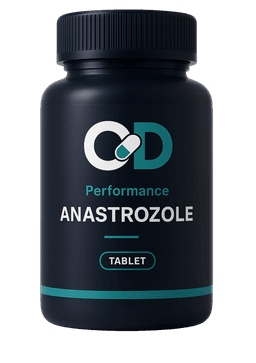 Discussed in this guideAnastrozolefrom $33.00
A neutral, mechanism-focused look at how anastrozole, a non-steroidal aromatase inhibitor, is understood to interact with the enzyme that converts androgens into estrogen.
On this page
What anastrozole is
Anastrozole is a prescription medication generally described as a non-steroidal aromatase inhibitor. The name points to its mechanism rather than to any result: it identifies the enzyme the molecule is designed to act on — aromatase — and the structural family it belongs to. As a small, synthetic, non-steroidal molecule, anastrozole does not share the steroid backbone of the androgens the enzyme normally works on, a distinction that becomes important when describing how it is understood to interact with that enzyme.
This article is educational only. It describes how anastrozole and its enzyme target are generally understood to work; it is not medical advice, a diagnosis, or a recommendation for any person. Anastrozole is prescription-only in the United States, and a licensed provider makes every clinical decision. When it is prepared by a compounding pharmacy, the resulting preparation is not an FDA-approved product, and statements about it have not been evaluated by the FDA.
The aromatase enzyme and where estrogen comes from
Estrogens are a family of steroid hormones present in everyone. In an androgen-dominant physiology, comparatively little estrogen is secreted directly by a gland; instead, much of it is generated from androgens — the hormone family that includes testosterone — through an enzymatic conversion that takes place in tissues throughout the body.
The enzyme responsible for that conversion is aromatase, encoded by the CYP19A1 gene. Aromatase carries out a reaction called aromatization, in which an androgen is chemically restructured into an estrogen: testosterone is converted into estradiol, and androstenedione into estrone. Aromatase is found in a range of tissues, including adipose (fat) tissue, the gonads, bone, and parts of the brain. Because this single enzymatic step accounts for so much of the circulating estrogen in that setting, the enzyme is a natural focal point for any molecule described as acting on the androgen-to-estrogen pathway.
At the heart of the enzyme sits a heme group — an iron-containing cofactor that aromatase, a member of the cytochrome P450 family, uses to carry out its chemistry. The heme iron and the surrounding active site are where the enzyme binds its androgen substrate, and they are also where a non-steroidal inhibitor like anastrozole is understood to act.
How anastrozole is understood to bind aromatase
Anastrozole is generally described as a reversible, competitive inhibitor of aromatase. "Competitive" refers to the way it is understood to occupy the enzyme's active site — the same pocket an androgen would otherwise enter — so that, while the inhibitor is bound, the natural substrate cannot dock there. In this framing the inhibitor and the substrate compete for the same location on the enzyme.
A defining feature of the non-steroidal group is how it is understood to engage the heme. Anastrozole carries a nitrogen-bearing chemical group — in its case a triazole ring — that is understood to coordinate with the iron atom at the center of the heme. By interacting with that iron and sitting in the active site, the molecule is understood to interrupt the enzyme's catalytic cycle for as long as it remains bound, so aromatase carries out less of the conversion of androgens into estrogen while the inhibitor is present. This describes an action on the aromatization step itself — not on estrogen receptors, and not on the androgens directly.
Why "reversible" and "non-steroidal" describe the mechanism
The word "reversible" describes the nature of the binding. Anastrozole is understood to associate with and then dissociate from the enzyme rather than attaching to it permanently, so an individual enzyme molecule is not consumed or destroyed by the interaction — it can return to its ordinary function once the inhibitor is no longer bound to it. This is the mechanistic contrast with the steroidal aromatase inhibitors, such as exemestane, which structurally resemble the enzyme's natural substrate and are understood to form a lasting, irreversible attachment that inactivates the enzyme molecule they bind.
Because anastrozole is understood to act on the enzyme rather than on any downstream tissue, it is often discussed in the context of the androgen-to-estrogen pathway, including in testosterone-related settings where a portion of testosterone is aromatized into estradiol by this same enzyme. Naming the pathway a medication engages is a mechanistic statement; it is not a promise of any particular result, and it carries no dosing guidance of any kind.
Forms and how it is prepared
Anastrozole is most familiar as an oral tablet, a form in which the molecule is absorbed and distributed through the bloodstream to reach aromatase in tissues throughout the body. In androgen-related and men's-health settings it is also frequently prepared by compounding pharmacies, sometimes at strengths different from the manufactured tablet or in alternative dosage forms tailored to an individual prescription.
Compounded preparations are not FDA-approved products, and this article gives no guidance on strength, quantity, or frequency — those determinations belong solely to the prescribing provider. The route and form a medication takes affect how it is absorbed and distributed, and weighing those factors for a specific person is part of the clinical judgment a licensed provider exercises during review.
How it works on OpenDoseRx
On OpenDoseRx, a licensed clinician — not the shopper — makes the medical decision. You choose a product and strength, then complete a medical intake with your health history. An independent, licensed U.S. provider reviews that intake and decides whether a prescription is appropriate for you.
If it is, a licensed U.S. pharmacy prepares and ships it; if the provider declines, you are not charged for the medication and receive a full refund. Compounded preparations are not FDA-approved drugs. This article is educational only and is not a substitute for a conversation with your own healthcare provider.
Common questions
- What kind of aromatase inhibitor is anastrozole?
- Anastrozole is generally described as a non-steroidal, reversible, competitive aromatase inhibitor. It is understood to occupy the enzyme's active site and coordinate with the iron at the center of the heme group, interrupting the enzyme's activity while it remains bound rather than permanently inactivating the enzyme. This is educational information, not medical advice.
- What does "reversible" mean for how anastrozole acts?
- It means anastrozole is understood to associate with and then dissociate from the aromatase enzyme rather than attaching permanently. The enzyme molecule is not consumed by the interaction and can return to its ordinary function once the inhibitor is no longer bound. This describes a binding mechanism, not a result for any person, and it is not a claim of superiority over other inhibitors.
- Does anastrozole require a prescription?
- Yes. In the United States anastrozole is prescription-only. On OpenDoseRx, an independent licensed U.S. provider reviews your medical intake, and a licensed U.S. pharmacy fills an order only if the provider determines it is appropriate for you. If the request is declined, you are not charged for the medication and receive a full refund. Compounded preparations are not FDA-approved products, and this is educational information, not medical advice.
Ready when you are
Anastrozolefrom $33.00
- Your exact strength
- Licensed provider review
- Full refund if declined
Browse performance & vitality
Exact strengths and prices up front — reviewed by a licensed U.S. provider.
Keep reading
More plain-language guides on this topic.
How testosterone works in the body: the androgen pathway
A plain-language look at testosterone as an androgen and how androgen-receptor signaling is understood to act on tissues across the body.
How enclomiphene is understood to act on the HPG axis
An educational overview of how enclomiphene is understood to interact with the hypothalamic-pituitary-gonadal axis through estrogen-receptor modulation.
How aromatase inhibitors are understood to work in estrogen management
A neutral, mechanism-focused look at the aromatase enzyme and how the medications known as aromatase inhibitors are understood to act on it.
This guide is for general education and is not medical advice. Compounded medications are not FDA-approved drugs, and statements on this site have not been evaluated by the FDA. A licensed provider reviews every prescription request.