Guide
How blood sugar is regulated: insulin, glucagon, and glucose homeostasis
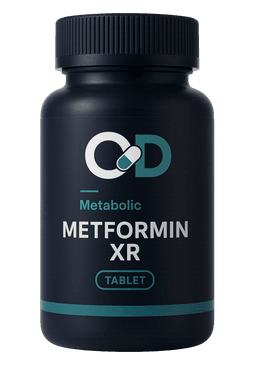 Discussed in this guideMetformin XRfrom $39.99
A neutral, mechanism-focused look at how the pancreas, liver, and the opposing hormones insulin and glucagon are understood to keep blood glucose within a narrow range.
On this page
What glucose homeostasis means
Glucose is the body's main circulating fuel, and the amount of it in the bloodstream at any moment is kept within a surprisingly narrow band. In the fasting state, blood glucose is often described as sitting roughly between 70 and 100 milligrams per deciliter, and even after a large meal the body works to return it toward that range within a few hours. The word homeostasis refers to this active maintenance of a stable internal setpoint despite constant swings in supply and demand.
The reason the body defends this range so carefully is that both too little and too much glucose are understood to be problematic. Some tissues, the brain in particular, rely heavily on a steady supply of glucose and cannot store much of their own, so a sharp drop is understood to matter quickly. At the same time, glucose that stays elevated for long periods is described in the research as interacting with proteins and blood vessels in ways the body is not built to tolerate indefinitely. Keeping the level in between is therefore a continuous balancing act.
That balancing act is carried out largely by two hormones that pull in opposite directions — insulin and glucagon — together with the organs that make them and respond to them. This article is educational only and is not medical advice; it describes how these systems are understood to work, not what any individual should do.
The pancreas: the body's glucose sensor
The organ at the center of glucose regulation is the pancreas. Scattered through it are clusters of hormone-producing cells called the islets of Langerhans, and two islet cell types do most of the work discussed here. Beta cells produce insulin, and alpha cells produce glucagon. These cells are understood to act as sensors: they continuously monitor the concentration of glucose in the blood flowing past them and adjust their hormone output in response.
When blood glucose rises — for example, after a carbohydrate-containing meal — beta cells are understood to detect the increase and release more insulin. When blood glucose falls — for example, during the hours between meals or overnight — alpha cells are understood to release more glucagon. Because the two cell types respond to the same signal in opposite directions, the pancreas can push blood glucose down or nudge it back up depending on which way it has drifted.
The islets also contain other cell types, including delta cells that release somatostatin, a signal understood to help fine-tune the output of both insulin and glucagon. The important idea is that this is not an on-off switch but a graded, moment-to-moment adjustment: hormone release rises and falls in proportion to the glucose signal the islet cells are sensing.
Insulin: the hormone that lowers blood glucose
Insulin is often described as the storage or anabolic hormone, and its release from beta cells is the body's main response to a rising blood glucose level. Circulating insulin binds to insulin receptors on the surface of cells throughout the body, and this binding is understood to set off a chain of internal signals that changes how those cells handle glucose.
One of the most studied effects is on muscle and fat cells. In response to insulin signaling, these cells are understood to move glucose transporters — chiefly a protein called GLUT4 — to their surface, which allows glucose to be drawn out of the bloodstream and into the cell. Inside the cell, that glucose can be used for energy or stored. In this way insulin is understood to lower blood glucose partly by increasing the rate at which tissues take it up.
Insulin also acts strongly on the liver. It is understood to promote the conversion of glucose into glycogen, a stored, branched form of glucose the liver can bank away, and at the same time to suppress the liver's own production and release of glucose. The combined picture is a coordinated shift toward storage: more glucose entering cells, more being stored as glycogen and fat, and less being newly produced. This describes how insulin is understood to act on glucose handling and is not a claim about any medication or outcome.
Glucagon: the hormone that raises blood glucose
Glucagon is insulin's functional opposite. Released by alpha cells when blood glucose falls, it is understood to act primarily on the liver, where its job is to raise the amount of glucose available in the bloodstream. Where insulin signals a well-fed state and favors storage, glucagon signals a fasting or between-meals state and favors mobilization of stored fuel.
Glucagon is understood to work through two main liver processes. The first is glycogenolysis: the breakdown of the liver's stored glycogen back into individual glucose molecules that can be released into the blood. The second is gluconeogenesis: the manufacture of new glucose from non-carbohydrate building blocks such as certain amino acids. Through both routes, glucagon is understood to push blood glucose upward when it has begun to drop.
During longer periods without food, glucagon's influence is understood to extend to fat metabolism as well, favoring the breakdown of stored fat and, over time, the liver's production of ketones as an alternative fuel. The through-line is that glucagon is the counterweight to insulin: one hormone lowers blood glucose and favors storage, the other raises it and favors release, and the balance between them shifts continuously with the body's fed and fasted states.
The liver, the feedback loop, and other players
If the pancreas is the sensor, the liver is the central hub where much of the regulation actually happens. It is uniquely positioned to both bank glucose as glycogen when insulin dominates and release glucose when glucagon dominates, which is why it responds to both hormones. This dual capacity is what lets the liver act as a buffer, smoothing out the peaks after meals and topping up the supply during fasting.
Together, insulin and glucagon form what physiologists describe as a negative feedback loop. A rise in blood glucose triggers insulin, which brings glucose back down; a fall in blood glucose triggers glucagon, which brings it back up. Each hormone's action tends to switch off the signal that released it, so the system self-corrects around its setpoint rather than overshooting in one direction. This opposing-hormone design is the core of how glucose homeostasis is understood to be maintained.
Several other signals feed into the same loop. Incretin hormones released by the gut after eating — chiefly GLP-1 and GIP — are understood to amplify glucose-dependent insulin release, and GLP-1 is also understood to blunt glucagon when glucose is high. Counter-regulatory hormones such as epinephrine, cortisol, and growth hormone are understood to raise blood glucose in situations like stress or prolonged fasting. When the balance is described as disrupted — for example, when tissues respond less readily to insulin, a state often called insulin resistance, or when beta cells produce less of it — blood glucose is understood to be harder to keep within the usual range. Describing these mechanisms is not a diagnosis or an assessment of any individual.
Educational context and how prescription review works on OpenDoseRx
This guide is educational and is not medical advice, a diagnosis, or a treatment recommendation. It describes how blood-sugar regulation is understood to work at the level of hormones and organs. It does not describe how to manage blood glucose, and it is not a substitute for evaluation by a qualified clinician who can consider your individual health. Whether any medication is appropriate for a given person is a clinical decision made by a licensed provider.
On OpenDoseRx, that clinical decision rests with a licensed clinician, not the shopper. You begin by choosing a product and strength, then complete a medical intake that collects your health history and other relevant information. Product listings indicate whether an item is an FDA-approved product or a compounded preparation; compounded medications are prepared by a licensed pharmacy for an individual prescription and are not themselves FDA-approved drugs, and statements about them have not been evaluated by the FDA.
That intake is routed to an independent, licensed U.S. provider who reviews it. If the provider determines a prescription is appropriate, it is sent to a licensed U.S. pharmacy to be filled and shipped to you. If the request is declined, you are not charged for the medication — you receive a full refund. Nothing here replaces a conversation with your own provider, and every product is dispensed only after that independent clinical review.
Common questions
- What is glucose homeostasis?
- It is the body's active maintenance of blood glucose within a narrow range — often described as roughly 70 to 100 milligrams per deciliter in the fasting state — despite constant changes in food intake and energy use. It is understood to be maintained mainly by the opposing hormones insulin and glucagon, together with the pancreas that makes them and the liver that responds to them.
- How do insulin and glucagon work together?
- They pull in opposite directions around the same setpoint. When blood glucose rises, beta cells release insulin, which is understood to lower it by increasing glucose uptake into cells and storage in the liver. When blood glucose falls, alpha cells release glucagon, which is understood to raise it by prompting the liver to release and produce glucose. This forms a self-correcting negative feedback loop.
- Where are insulin and glucagon made?
- Both are made in the pancreas, in clusters of cells called the islets of Langerhans. Beta cells produce insulin and alpha cells produce glucagon. These cells are understood to sense the glucose level in the blood passing them and to adjust their hormone output up or down in response.
- What role does the liver play in blood sugar regulation?
- The liver acts as a central storage and supply hub. Under insulin's influence it is understood to bank glucose as glycogen and reduce its own glucose production; under glucagon's influence it is understood to break glycogen back down and manufacture new glucose. Because it responds to both hormones, the liver buffers blood glucose after meals and during fasting.
Ready when you are
Metformin XRfrom $39.99
- Your exact strength
- Licensed provider review
- Full refund if declined
Also relevant
Exact strengths and prices up front — a licensed provider reviews every request.



Browse metabolic health
Exact strengths and prices up front — reviewed by a licensed U.S. provider.
Keep reading
More plain-language guides on this topic.
How metformin works: the biguanide mechanism
A neutral, mechanism-focused look at how metformin, a biguanide, is understood to act on the liver, insulin sensitivity, and AMPK signaling.
How acarbose is understood to work: the alpha-glucosidase inhibitor pathway
A neutral, mechanism-focused look at how acarbose, an alpha-glucosidase inhibitor, is understood to act on the enzymes that digest carbohydrates in the small intestine.
Extended-release vs. immediate-release metformin: how the formulations differ
A neutral, formulation-focused look at how extended-release and immediate-release metformin differ in the way each tablet releases the drug, and how that shapes absorption over time.
This guide is for general education and is not medical advice. Compounded medications are not FDA-approved drugs, and statements on this site have not been evaluated by the FDA. A licensed provider reviews every prescription request.