Guide
How cabergoline is understood to act on dopamine and prolactin
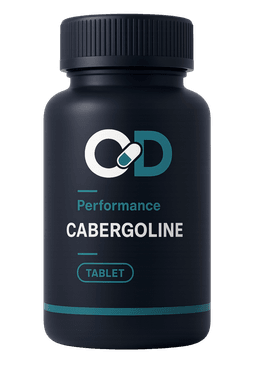 Discussed in this guideCabergolinefrom $22.00
A plain-language look at how a dopamine agonist is understood to engage the D2 receptor and reinforce the body's natural control of prolactin.
On this page
A prescription dopamine agonist
Cabergoline belongs to a class of prescription medications often described as dopamine agonists, or dopamine receptor agonists. Understanding it starts with two things: the receptor it is designed to engage, and the hormone that receptor helps regulate. More precisely, cabergoline is characterized as a dopamine D2 receptor agonist, meaning it is built to act on the same receptor that the body's own dopamine acts on.
The hormone most closely associated with this mechanism is prolactin, a signaling molecule produced in the pituitary gland. Cabergoline is studied in the context of how the body regulates prolactin, and its mechanism is usually explained by way of the dopamine-to-prolactin relationship rather than by any single downstream effect.
Cabergoline is prescription-only in the United States, and it is not available without review by a licensed provider. This article is educational only. It describes how the molecule is understood to work and is not medical advice, a statement of results, or a recommendation for any particular person.
How the body normally regulates prolactin
Prolactin is made by cells in the anterior pituitary gland called lactotrophs. Among the hormones the pituitary produces, prolactin is unusual: rather than being switched on by a stimulating signal from the brain, it sits under predominantly inhibitory control. In other words, the default tendency of these cells is to release prolactin, and the body works to hold that release in check.
The brake in this system is dopamine. The hypothalamus, a region at the base of the brain, releases dopamine that travels a short route to the pituitary — a connection often called the tuberoinfundibular pathway. There, dopamine is understood to continuously, or tonically, suppress prolactin release from the lactotroph cells. When dopamine signaling to those cells is strong, prolactin output tends to be restrained; when that signaling eases, prolactin tends to rise.
This inhibitory arrangement is the physiological backdrop for understanding any dopamine agonist. Because dopamine is the natural signal that keeps prolactin in check, a medication designed to imitate dopamine at its receptor is studied in relation to that same braking mechanism.
How cabergoline is understood to act on the D2 receptor
The lactotroph cells that make prolactin carry dopamine D2 receptors on their surface. Cabergoline is designed to bind to these D2 receptors, in effect standing in for the body's own dopamine at that site. Because the molecule engages the receptor that normally receives the inhibitory dopamine signal, its mechanism is generally described as reinforcing that natural brake rather than creating a new pathway.
Once bound to the D2 receptor, cabergoline is understood to trigger the same kind of intracellular signaling that dopamine would, which is associated in the research literature with reduced prolactin gene expression, synthesis, and release from the lactotroph. The framing that recurs across sources is straightforward: dopamine tonically suppresses prolactin, and a D2 agonist is designed to engage that suppression at the receptor level.
Whether this mechanism is relevant or appropriate for a given person is a clinical determination, not something an article can decide. A licensed provider evaluates an individual's health history and situation to judge whether a medication in this class is appropriate, and every prescription decision rests with that provider.
Receptor selectivity and a long duration of action
Two pharmacological features are commonly used to describe cabergoline. The first is selectivity. It is characterized as having high affinity for dopamine D2 receptors while showing comparatively low affinity for dopamine D1 receptors, for alpha-adrenergic receptors, and for several serotonin receptor subtypes. That relatively focused receptor profile is part of how the molecule is described in reference sources.
The second feature is its long duration of action. Cabergoline is described as long-acting, with an elimination half-life reported in the range of roughly 63 to 109 hours in study populations. This extended profile is generally attributed to a combination of factors:
- Slow release from pituitary tissue
- High-affinity binding at the receptor
- Extensive enterohepatic recycling as the compound passes through the liver and gut
These are descriptions of how the molecule behaves, not instructions for use. This article does not provide dosing guidance of any kind. Any schedule, quantity, or adjustment is defined by a prescribing provider for the individual, never by educational content.
Ergot origins and regulatory context
Chemically, cabergoline is an ergot derivative — it belongs to a family of molecules related to compounds originally derived from ergot, a fungus that historically yielded several dopamine-active substances. This ergot lineage is why cabergoline is often grouped alongside older dopamine agonists when the class is discussed, even though the individual molecules differ in their receptor profiles.
In terms of regulatory context, a branded cabergoline product has carried a U.S. Food and Drug Administration-approved indication for hyperprolactinemic disorders — that is, conditions involving elevated prolactin — whether idiopathic or associated with pituitary adenomas in adults. That approval applies to a specific manufactured product, its formulation, and its labeling.
Compounded preparations are a separate matter. A compounded medication is prepared by a licensed pharmacy to fit an individual prescription and is not itself FDA-approved, because the FDA approves finished manufactured products rather than the individualized preparations a pharmacy mixes. Where a listing describes a compounded product, that distinction applies, and whether any form is appropriate is a determination for the licensed provider who reviews an intake.
How prescription review works on OpenDoseRx
On OpenDoseRx, the process is built so that a clinician — not the shopper — makes the medical decision. You begin by choosing a product and strength, then complete a medical intake that collects your health history and other relevant information.
That intake is routed to an independent, licensed U.S. provider who reviews it and decides whether a prescription is appropriate for you. This is a clinical judgment, not an automatic one. If the provider determines a prescription is appropriate, it is prepared and dispensed by a licensed U.S. pharmacy and shipped to you. If the request is declined, your order does not proceed and you receive a full refund for the medication.
Every product is prescription-only and is dispensed only after independent clinical review. Nothing here is a substitute for a conversation with your own healthcare provider, and this article is intended to explain a mechanism, not to guide a treatment decision.
Common questions
- What kind of medication is cabergoline?
- Cabergoline is described as a dopamine receptor agonist and an ergot derivative. More specifically, it is characterized as a dopamine D2 receptor agonist, and it is studied in the context of how the body regulates the hormone prolactin. It is prescription-only in the United States.
- What is prolactin, and what does dopamine have to do with it?
- Prolactin is a hormone produced by lactotroph cells in the anterior pituitary gland. Unusually for a pituitary hormone, it sits under predominantly inhibitory control: dopamine released from the hypothalamus is understood to continuously suppress its release. In this system, dopamine acts as a brake on prolactin.
- How is cabergoline understood to influence prolactin?
- It is designed to bind dopamine D2 receptors on the pituitary lactotroph cells, in effect standing in for the body's own dopamine at that site. Engaging that receptor is understood to reinforce the natural inhibitory signal associated with reduced prolactin synthesis and release. Whether this mechanism is appropriate for a given person is a determination for a licensed provider.
- Is cabergoline FDA-approved?
- A branded, manufactured cabergoline product has carried an FDA-approved indication for hyperprolactinemic disorders in adults. Compounded preparations are a separate case: a compounded medication is not itself FDA-approved, because the FDA approves finished manufactured products rather than the individualized preparations a pharmacy compounds. Where a listing describes a compounded product, that distinction applies.
- Does cabergoline require a prescription?
- Yes. It is prescription-only in the United States. On OpenDoseRx, an independent licensed U.S. provider reviews your medical intake, and a product is dispensed by a licensed U.S. pharmacy only if the provider determines it is appropriate for you.
Ready when you are
Cabergolinefrom $22.00
- Your exact strength
- Licensed provider review
- Full refund if declined
Browse performance & vitality
Exact strengths and prices up front — reviewed by a licensed U.S. provider.
Keep reading
More plain-language guides on this topic.
How testosterone works in the body: the androgen pathway
A plain-language look at testosterone as an androgen and how androgen-receptor signaling is understood to act on tissues across the body.
How enclomiphene is understood to act on the HPG axis
An educational overview of how enclomiphene is understood to interact with the hypothalamic-pituitary-gonadal axis through estrogen-receptor modulation.
How aromatase inhibitors are understood to work in estrogen management
A neutral, mechanism-focused look at the aromatase enzyme and how the medications known as aromatase inhibitors are understood to act on it.
This guide is for general education and is not medical advice. Compounded medications are not FDA-approved drugs, and statements on this site have not been evaluated by the FDA. A licensed provider reviews every prescription request.