Guide
How cyclobenzaprine is understood to work as a muscle relaxant
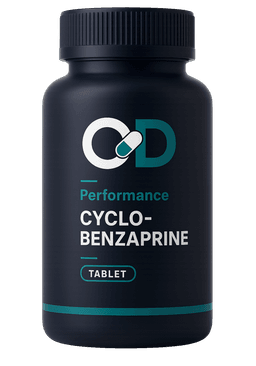 Discussed in this guideCyclobenzaprinefrom $9.99
A neutral, mechanism-focused look at how cyclobenzaprine, a centrally acting muscle relaxant related to the tricyclic antidepressants, is understood to act on motor pathways in the brainstem rather than on muscle itself.
On this page
- What cyclobenzaprine is and how it is understood to act
- A tricyclic relative that does not act on muscle directly
- The brainstem and the motor pathways it is understood to influence
- The serotonergic angle: 5-HT2 receptor antagonism
- Why "centrally acting" matters, and where the labeling draws lines
- How prescription review works on OpenDoseRx
- Common questions
What cyclobenzaprine is and how it is understood to act
Cyclobenzaprine is a prescription medication generally described as a centrally acting skeletal muscle relaxant that is structurally related to the tricyclic antidepressants. It is grouped with the muscle relaxants by use, but its chemistry places it alongside a well-known family of central nervous system molecules. This guide is educational and describes how the medication is understood to act at the level of the nervous system; it is not medical advice, and it does not recommend cyclobenzaprine for any particular person or purpose.
The phrase "muscle relaxant" covers more than one kind of molecule. Some agents in that broad category are understood to act at the muscle itself, while others are described as centrally acting, meaning they are understood to work on the nervous system rather than on muscle fibers directly. Cyclobenzaprine belongs to the centrally acting group. Understanding it therefore starts not with muscle tissue but with the parts of the central nervous system it is understood to influence, which the sections below describe.
Cyclobenzaprine was first approved by the U.S. Food and Drug Administration in 1977 and has long been available in immediate-release tablet form as well as an extended-release capsule. Its labeled use is short-term, as an adjunct to rest and physical therapy for muscle spasm associated with acute, painful musculoskeletal conditions. Where a product is a compounded preparation rather than an approved manufactured one, it is not an FDA-approved drug, and statements about it have not been evaluated by the FDA. This article describes mechanism only and makes no claim about outcomes.
A tricyclic relative that does not act on muscle directly
Cyclobenzaprine's structure is closely related to that of the tricyclic antidepressants, and in particular to amitriptyline: the two molecules share the same three-ring core, differing by a single double bond within that ring system, which is why cyclobenzaprine is sometimes described in the literature as 10,11-dehydroamitriptyline. Because of this kinship, it shares a number of receptor interactions characteristic of the tricyclic class. It is used and studied as a muscle relaxant rather than as an antidepressant, but its family resemblance to those molecules is central to how its mechanism is discussed.
Despite the name "muscle relaxant," cyclobenzaprine is not understood to act on skeletal muscle fibers or on the neuromuscular junction directly. Sources describe it as working within the central nervous system rather than at the muscle, without interfering with muscle function itself. This is the defining feature of a centrally acting relaxant: the molecule's activity is understood to be mediated through nerve pathways that influence muscle tone, not through a direct effect on the muscle tissue that a person contracts and relaxes.
That distinction is why the mechanism is described the way it is. If a relaxant acts centrally, then explaining it means looking upstream of the muscle, at the parts of the brain and spinal cord that regulate motor signaling. For cyclobenzaprine, the site most often identified is the brainstem, the topic of the next section.
The brainstem and the motor pathways it is understood to influence
Cyclobenzaprine is understood to act primarily within the central nervous system at the level of the brainstem, the stalk-like structure connecting the brain to the spinal cord that carries and coordinates a great deal of motor traffic. Rather than shutting muscle off, the medication is generally described as reducing what pharmacologists call tonic somatic motor activity, meaning the ongoing background level of signaling that keeps skeletal muscle in a state of readiness. It is this reduction in motor drive, described at the level of nerve pathways, that the class is characterized by.
Skeletal muscle tone is governed in part by two populations of motor neurons often labeled alpha and gamma. Alpha motor neurons connect to the muscle fibers that generate force, while gamma motor neurons help set the sensitivity of the stretch reflexes that regulate tone. Cyclobenzaprine's net effect is described as a decline in tonic activity affecting both the gamma and alpha motor systems. Its principal action is placed at the brainstem, though sources note that an overlapping action at the spinal cord may also contribute to how it is understood to work.
It is worth stating plainly that this is a mechanistic account of a drug class, not a statement that any individual will notice any particular effect. How prominent these actions are understood to be can vary with the amount present, which is one reason the amount is a matter for the prescribing provider. This guide provides no dosing figures, schedules, or titration guidance of any kind.
The serotonergic angle: 5-HT2 receptor antagonism
More recent characterizations of cyclobenzaprine point to activity at serotonin receptors as part of its mechanism. It is generally described as an antagonist at the 5-HT2 serotonin receptor, understood to act mainly in the brainstem, and this receptor activity is often discussed as being tied to the reduction in tonic motor activity described above. Laboratory work on cyclobenzaprine and its tricyclic relatives has examined how blocking 5-HT2 receptors is understood to dampen the descending serotonergic signaling that feeds into spinal motor reflexes.
Consistent with its tricyclic structure, cyclobenzaprine is also described as interacting with a broader set of receptors than 5-HT2 alone, including other serotonin receptor subtypes and, to varying degrees, the noradrenergic system. As with other members of the tricyclic family, it is generally described as having antagonist activity at histamine H1 receptors; antihistamine activity of this kind is commonly associated with drowsiness, which is why that part of the receptor profile is frequently mentioned when the molecule is discussed. These are descriptions of receptor pharmacology, not claims about what any person will experience.
The scientific picture here is still being characterized, and different sources emphasize different pieces of it. What the literature broadly agrees on is that cyclobenzaprine's action is understood to be central and to involve serotonergic signaling in the brainstem, rather than a direct effect on muscle. That framing is a mechanistic one; it does not establish that the medication is appropriate, effective, or safe for any given individual, which is a separate clinical question.
Why "centrally acting" matters, and where the labeling draws lines
The centrally acting nature of cyclobenzaprine is reflected in how it is labeled. Its approved use is short-term, as an adjunct to rest and physical therapy for muscle spasm from acute, painful musculoskeletal conditions of local origin. This labeling draws a specific line: cyclobenzaprine is described as being for acute spasm arising in the muscles themselves, and its labeling notes that it is not indicated for spasticity due to central nervous system disease, such as cerebral palsy or disease of the spinal cord. That boundary is consistent with the mechanism described here and is one reason the class is not treated as interchangeable across every situation involving muscle.
None of this is a determination a reader can make from an article. Whether cyclobenzaprine has any role for a particular person, which strength or form that might involve, and for how long, are clinical judgments that belong to an independent licensed provider who has reviewed that person's medical history and current medications. This matters especially for a molecule in the tricyclic family, where interactions and individual factors are part of the clinical picture. A patient can request a product; the clinical decision is not the patient's to make, and it is not made by this page.
This guide intentionally contains no dosing guidance and makes no promise of any result. It describes how a drug class is understood to act and where its labeling draws its limits. Where a product is a compounded preparation, it is not an FDA-approved drug, and statements about it have not been evaluated by the FDA. Educational material like this is not a substitute for an evaluation by a qualified clinician who can consider a person's full medical picture.
How prescription review works on OpenDoseRx
OpenDoseRx is a platform for requesting prescription products through a structured review process; it does not itself practice medicine. The steps are the same across the catalog. First, you choose a product and strength and complete a medical intake, a set of questions about your health history and current situation. That intake is then reviewed by an independent licensed U.S. provider.
The provider makes the clinical decision. If the provider determines a request is appropriate, the approved order is filled by a licensed U.S. pharmacy. If the provider declines the request, the order is refunded in full. Any decision about whether a medication fits your situation, and any dosing, is made by that provider, not selected by you and not determined by this guide.
This process is educational and is not a substitute for your own healthcare provider or for an in-person evaluation. Where a product is a compounded preparation, it is not an FDA-approved drug, and statements about it have not been evaluated by the FDA. Nothing here should be read as a promise of any particular outcome; it is a description of how the medication is understood to act and how a request is reviewed.
Common questions
- Does cyclobenzaprine relax muscles directly?
- It is not understood to act on muscle tissue or the neuromuscular junction directly. Cyclobenzaprine is described as a centrally acting relaxant, understood to work within the central nervous system, primarily at the brainstem, where it is described as reducing tonic somatic motor activity. This guide describes that mechanism only and makes no claim about results for any individual.
- Is cyclobenzaprine related to antidepressants?
- Structurally, yes. It is closely related to the tricyclic antidepressants and shares nearly the same core structure as amitriptyline, differing by a single double bond. It is used and studied as a muscle relaxant rather than as an antidepressant, but that family resemblance is part of how its receptor pharmacology, including 5-HT2 antagonism, is described. This is a statement about structure and mechanism, not about outcomes.
- What does "centrally acting" mean for a muscle relaxant?
- It means the molecule is understood to act on the nervous system that controls muscle, rather than on the muscle fibers themselves. For cyclobenzaprine, sources place the primary action in the brainstem, with a possible overlapping contribution at the spinal cord, affecting the alpha and gamma motor systems that help set muscle tone. It is a mechanistic label, not a description of what any person will experience.
- Do these descriptions mean cyclobenzaprine is right for me?
- No. This guide describes only how the medication is understood to act and where its labeling draws its limits, including that it is described as being for short-term use in acute local muscle spasm and not for spasticity from central nervous system disease. Whether it has any role for you, at what strength, and for how long is a clinical judgment for an independent licensed provider who has reviewed your medical information.
- Who decides whether cyclobenzaprine is appropriate and at what dose?
- That decision belongs to the independent licensed U.S. provider who reviews your medical intake, not to you and not to this page. You can request a product and strength; the provider determines whether the request is appropriate and determines any dosing. Approved orders are filled by a licensed U.S. pharmacy, and declined orders are refunded in full. Where a product is compounded, it is not FDA-approved, and this content is educational only.
Ready when you are
Cyclobenzaprinefrom $9.99
- Your exact strength
- Licensed provider review
- Full refund if declined
Browse performance & vitality
Exact strengths and prices up front — reviewed by a licensed U.S. provider.
Keep reading
More plain-language guides on this topic.
How testosterone works in the body: the androgen pathway
A plain-language look at testosterone as an androgen and how androgen-receptor signaling is understood to act on tissues across the body.
How enclomiphene is understood to act on the HPG axis
An educational overview of how enclomiphene is understood to interact with the hypothalamic-pituitary-gonadal axis through estrogen-receptor modulation.
How aromatase inhibitors are understood to work in estrogen management
A neutral, mechanism-focused look at the aromatase enzyme and how the medications known as aromatase inhibitors are understood to act on it.
This guide is for general education and is not medical advice. Compounded medications are not FDA-approved drugs, and statements on this site have not been evaluated by the FDA. A licensed provider reviews every prescription request.