Guide
How lisinopril works
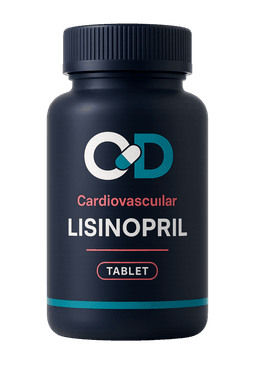 Discussed in this guideLisinoprilfrom $44.95
A plain-language, mechanism-focused look at how lisinopril is understood to act within the renin-angiotensin system and on the enzyme that also handles bradykinin.
On this page
Lisinopril and the renin-angiotensin system
Lisinopril is a long-established prescription medication categorized as an angiotensin-converting enzyme inhibitor, usually shortened to ACE inhibitor. To understand how it is designed to act, it helps to start with the biological pathway it targets: the renin-angiotensin system, a hormone cascade the body uses to help regulate blood pressure and fluid balance.
The pathway begins in the kidneys, which release an enzyme called renin in response to signals such as reduced blood flow or lower sodium levels. Renin acts on angiotensinogen, a protein made by the liver and circulating in the blood, converting it into a peptide called angiotensin I. Angiotensin I is largely inactive on its own, and the next step in the cascade is where lisinopril's mechanism is focused.
This article is educational and describes how the molecule is understood to act on the body's chemistry. It is not medical advice, does not recommend any product, and is not a substitute for guidance from a licensed clinician.
The angiotensin I to angiotensin II step
Angiotensin I is converted into angiotensin II by angiotensin-converting enzyme (ACE), which is found in high concentrations along the lining of blood vessels, particularly in the lungs. Angiotensin II is generally described as the principal active signal of the pathway.
Once formed, angiotensin II binds to receptors known as angiotensin II type 1 (AT1) receptors on blood vessels and other tissues. This binding is associated with narrowing of blood vessels. Angiotensin II also signals the adrenal glands to release aldosterone, a hormone understood to prompt the kidneys to retain sodium and water. Because the cascade influences both vessel tone and fluid volume, the ACE step is a common pharmacological target that a clinician may consider in blood-pressure management.
How lisinopril acts on the enzyme
Lisinopril is designed to inhibit angiotensin-converting enzyme. In pharmacology it is described as a lysine-containing analog shaped to fit into the enzyme's active site — the pocket where the conversion reaction normally takes place. By occupying that site, lisinopril is understood to slow the enzyme's usual conversion of angiotensin I into angiotensin II.
With less angiotensin II being formed, the downstream signals attributed to it — the AT1-receptor binding associated with vessel narrowing, and the aldosterone release associated with sodium and water retention — are understood to be diminished. In other words, the mechanism acts upstream, on the production of angiotensin II, rather than on the receptor where the peptide would otherwise deliver its signal. That upstream position is what defines the ACE-inhibitor class and distinguishes it from angiotensin-receptor blockers, which are designed to act at the receptor itself.
Lisinopril and bradykinin
Angiotensin-converting enzyme has a second role beyond the renin-angiotensin system: it also participates in the breakdown of a peptide called bradykinin. Because lisinopril slows this enzyme, bradykinin can accumulate rather than being cleared at its usual rate. This is why lisinopril's mechanism is often described as touching two pathways at once — the angiotensin cascade and bradykinin handling.
What sets lisinopril apart, and how it is taken
Lisinopril is one of several ACE inhibitors, and reference materials describe a few characteristics that place it within the class. Unlike some ACE inhibitors that are administered as a prodrug and require conversion in the liver to become active, lisinopril is described as active in the form that is taken. It is also described as being eliminated largely unchanged by the kidneys and as having a relatively long duration of action. These are descriptive pharmacologic characteristics, not instructions, and they are among the details a clinician weighs when deciding whether the class fits a given person.
In the products studied to date, lisinopril is typically formulated as an oral tablet taken on a regular schedule set by a prescriber. This article does not provide dosing figures or a schedule; the specifics of any prescription are determined by the prescribing clinician based on the individual. Reference materials also describe situations that call for caution and provider oversight — for example, ACE inhibitors are generally described as not appropriate during pregnancy, and providers commonly monitor kidney function and blood potassium in people taking them. The relevance of any of these to an individual is determined during a medical evaluation, not by a general article.
How it works on OpenDoseRx
On OpenDoseRx, a licensed clinician — not the shopper — makes the medical decision. You choose a product and strength, then complete a medical intake with your health history and other relevant information. Nothing is dispensed on the basis of the product page alone, because every product on the site is prescription-only.
An independent, licensed U.S. provider reviews that intake and decides whether a prescription is appropriate for you. If it is, a licensed U.S. pharmacy prepares and ships it; if the provider declines, you are not charged for the medication and receive a full refund.
This review is a clinical decision, not an automatic one. This article is educational only and is not a substitute for a conversation with your own healthcare provider — bring your questions to the licensed clinician who reviews your intake.
Common questions
- What does angiotensin-converting enzyme do?
- Angiotensin-converting enzyme (ACE) converts angiotensin I into angiotensin II, the peptide generally described as the principal active signal of the renin-angiotensin system. Angiotensin II binds AT1 receptors and is associated with narrowing of blood vessels and with the release of aldosterone. ACE also participates in breaking down a peptide called bradykinin. Lisinopril is designed to inhibit this enzyme, which is why its mechanism is described as acting on both of those functions.
- Why is a dry cough sometimes linked to lisinopril?
- Angiotensin-converting enzyme also breaks down a peptide called bradykinin. Because lisinopril slows that enzyme, bradykinin can accumulate, and this is the commonly cited explanation for the dry cough some people notice with ACE inhibitors. Angiotensin-receptor blockers do not slow the enzyme in the same way. Whether this is relevant to any individual is something to discuss with a prescribing provider.
- Does lisinopril require a prescription?
- Yes. Lisinopril is prescription-only in the United States. On OpenDoseRx, you choose a product and strength and complete a medical intake; an independent, licensed U.S. provider reviews it and decides whether a prescription is appropriate for you. If it is, a licensed U.S. pharmacy prepares and ships it; if the provider declines, you are not charged for the medication and receive a full refund.
Ready when you are
Lisinoprilfrom $44.95
- Your exact strength
- Licensed provider review
- Full refund if declined
Browse cardiovascular treatments
Exact strengths and prices up front — reviewed by a licensed U.S. provider.
Keep reading
More plain-language guides on this topic.
How statins work: the cholesterol synthesis pathway
A plain-language, mechanism-focused look at the cholesterol-synthesis pathway and how statins act on the enzyme that helps drive it.
ACE inhibitors and ARBs: how they are understood to act on the renin-angiotensin system
An educational overview of the renin-angiotensin system and how ACE inhibitors and angiotensin-receptor blockers are understood to act within it.
How beta blockers are understood to act on beta-adrenergic receptors
An educational, mechanism-focused overview of how beta blockers such as propranolol and nebivolol are understood to act on beta-adrenergic receptors within the sympathetic nervous system.
This guide is for general education and is not medical advice. Compounded medications are not FDA-approved drugs, and statements on this site have not been evaluated by the FDA. A licensed provider reviews every prescription request.