Guide
How neuropeptides signal: the body's slower, longer-range chemical messengers
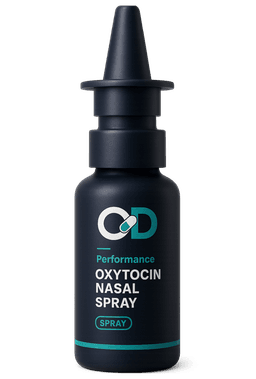 Discussed in this guideOxytocin Nasal Sprayfrom $89.00
A plain-language, mechanism-focused look at how neuropeptides are understood to signal differently from classical neurotransmitters, using oxytocin, orexin, and the melanocortins as examples.
On this page
What neuropeptides are
Neuropeptides are short chains of amino acids that the nervous system and body use as signaling molecules. They are generally described as a large and diverse family — dozens are recognized — and they sit alongside the small-molecule neurotransmitters, such as glutamate, GABA, dopamine, and serotonin, that most people first learn about. Rather than competing with those faster signals, neuropeptides are typically discussed as a parallel and complementary layer of communication.
One reason neuropeptides behave differently begins with how they are made. A neuron is understood to build them from a larger precursor protein, sometimes called a prepropeptide, which is then cut and processed into one or more active peptides and packaged into relatively large storage vesicles known as large dense-core vesicles. This is a slower, more resource-intensive route than the rapid local recycling used for classical transmitters, and it helps explain why neuropeptide signaling tends to unfold on a longer timescale.
This guide is educational and describes how neuropeptide signaling is understood to work at the level of cells and receptors. It is not medical advice, does not describe what any individual should expect, and does not recommend any product. Whether any prescription product that acts on these pathways is appropriate for a given person is a clinical decision that belongs to an independent licensed provider, not to this material.
Volume transmission: signaling beyond the synapse
Classical neurotransmitters are often described using the image of wiring: one neuron releases a transmitter into a narrow gap, the synapse, where it acts almost immediately on the cell directly across from it and is then cleared within milliseconds. This point-to-point pattern is sometimes called wiring transmission, and it is well suited to fast, precisely addressed signals.
Neuropeptides are understood to work differently. They are frequently released not only at synapses but from other parts of the neuron, including its cell body, dendrites, and swellings along the axon called varicosities. Once released, they can diffuse through the fluid-filled space between cells and, in some cases, into the wider extracellular environment, reaching receptors on cells some distance from the release site. This broader, less targeted pattern is generally called volume transmission.
Because neuropeptides are not rapidly pulled back by dedicated reuptake transporters the way many small-molecule transmitters are, and are instead broken down more gradually by enzymes called peptidases, a released neuropeptide is understood to persist and spread rather than being switched off almost instantly. The practical consequence often described in physiology is reach: a single burst of neuropeptide release can influence a population of cells over a wider area and a longer window than a classical synaptic signal.
G-protein-coupled receptors and slower, longer signals
A second major difference lies in the receptors these molecules act on. Many classical transmitters can bind ligand-gated ion channels, sometimes called ionotropic receptors, which are essentially receptor and channel combined: when the transmitter binds, the channel opens directly and ions flow within milliseconds. This is the fast, brief signaling that underlies rapid neural responses.
Neuropeptides, by contrast, are understood to act predominantly through G-protein-coupled receptors, also called GPCRs or metabotropic receptors. A GPCR does not open a pore itself. It is a receptor that threads back and forth through the cell membrane seven times, and when a neuropeptide binds to its outer surface, the receptor changes shape and activates an associated molecule inside the cell called a G protein. That G protein then sets off a chain of internal events rather than an immediate flow of ions.
Those internal events typically involve second messengers — intracellular signaling molecules such as cyclic AMP or calcium — that spread the signal onward and, importantly, amplify it, since one activated receptor can trigger many downstream molecules. This cascade takes longer to build than the direct opening of a channel, which is why GPCR signaling is generally described as slower in onset. It can also outlast the original binding event, because the downstream changes, which may include altered gene expression, persist after the neuropeptide is gone.
Put together, volume transmission and GPCR signaling give neuropeptides their characteristic profile: messages that arrive more slowly, reach farther, and last longer than the rapid, tightly localized signals of classical transmitters. Neuropeptide signaling is therefore often described as modulatory — setting the tone or gain of a circuit — rather than delivering the fast, discrete signals that carry point-to-point information.
Three neuropeptide systems: oxytocin, orexin, and the melanocortins
Oxytocin is a nine-amino-acid peptide made mainly in the hypothalamus. It is understood to act in two ways at once: released from the posterior pituitary into the bloodstream, where it behaves as a circulating hormone, and released within the brain itself, including from the dendrites of the neurons that make it, where it can spread by volume transmission. It acts on a single known receptor, the oxytocin receptor, which is a G-protein-coupled receptor. Research describes oxytocin signaling in the context of social and affiliative behavior as well as several peripheral roles, and it is a frequently cited example of a molecule that serves as both a neuropeptide and a hormone.
Orexins, also called hypocretins, are two related peptides (orexin-A and orexin-B) produced by a small cluster of neurons in the lateral hypothalamus. Despite that compact origin, those neurons project very widely across the brain, and the peptides act on two G-protein-coupled receptors, orexin receptor 1 and orexin receptor 2. Orexin signaling is studied in the context of arousal and the stability of the sleep-wake cycle; the loss of orexin-producing neurons is described in research on narcolepsy. The system is a clear illustration of how a small source can exert broad, tone-setting influence through wide projections and diffuse signaling.
The melanocortins are a family of peptides cut from a single large precursor called proopiomelanocortin, or POMC. This precursor gives rise to signaling molecules including the melanocyte-stimulating hormones and ACTH, which act on a set of five G-protein-coupled melanocortin receptors, MC1R through MC5R. These receptors are typically described as raising cyclic AMP inside their target cells, and different receptors are associated with different processes — for example, receptors in the brain are studied in relation to energy-balance signaling, while others are linked to pigmentation or adrenal signaling. Bremelanotide, the active molecule in some compounded products, is generally described as a melanocortin-receptor agonist, meaning it is designed to act on receptors in this family.
Across all three systems, the same underlying grammar appears: peptides that engage G-protein-coupled receptors, often spread beyond a single synapse, and shape the activity of broad circuits over an extended timescale. The specific behaviors and processes each system participates in differ, but the signaling logic is shared.
Why slower and longer-range signaling matters
The differences between neuropeptides and classical transmitters are not just technical details; they map onto different jobs. Fast ionotropic signaling is well suited to carrying precise, time-critical information — the moment-to-moment traffic of the nervous system. Slow, diffuse, GPCR-mediated neuropeptide signaling is better described as adjusting how that traffic behaves: raising or lowering the responsiveness of whole networks, biasing them toward one state or another, and holding that adjustment in place for a while.
This is why neuropeptides are so often described with words like modulation, tone, and gain. Rather than telling a single cell to fire right now, a neuropeptide is understood to shift the operating conditions of many cells at once, so that the fast signals arriving on top of it are interpreted differently. The orexin system's role in stabilizing states of arousal is a commonly cited example of this kind of background, state-setting influence.
Understanding this layer helps make sense of why molecules that act on neuropeptide pathways are studied the way they are, and why their mechanisms are described in terms of receptors and signaling rather than simple on-off switches. It also underscores the limits of any general description: how a given pathway behaves in a specific person depends on individual physiology, which is precisely why these are clinical questions for a licensed provider rather than conclusions that can be drawn from an educational overview.
How prescription review works on OpenDoseRx
On OpenDoseRx, the process begins when you choose a product and strength and then complete a medical intake that asks about your health history, current medications, and other relevant information. Submitting a request is not a prescription and is not a guarantee that anything will be dispensed; it is a request for an independent clinical review.
An independent licensed U.S. provider reviews each submitted intake and makes the clinical decision. If the provider determines a prescription is appropriate, the order is filled by a licensed U.S. pharmacy and shipped to you. If the provider declines the request, the order is refunded in full. Any decision about a product, formulation, or dose rests with that independent provider, not with the patient or with this material.
Some products discussed in general terms here may be compounded medications, which are not FDA-approved drugs, and statements in this guide have not been evaluated by the FDA. This material is educational only and is not medical advice. It does not replace the relationship with your own healthcare provider, and you should share your full medical history and any concerns with a licensed clinician who knows your care.
Common questions
- How are neuropeptides different from neurotransmitters?
- Both are signaling molecules, but classical neurotransmitters are typically small molecules that act fast and locally at the synapse, often on ligand-gated ion channels. Neuropeptides are short amino-acid chains that are understood to spread more widely by volume transmission, act mainly through G-protein-coupled receptors, and produce slower, longer-lasting signals. They are often described as modulatory rather than as carrying fast, point-to-point messages.
- What is volume transmission?
- Volume transmission describes signaling in which a molecule is released and diffuses through the fluid between cells to reach receptors some distance from the release site, rather than acting only across a narrow synaptic gap. Neuropeptides are understood to use this broader pattern, in contrast to the tightly targeted wiring transmission associated with many classical neurotransmitters.
- Why does it matter that neuropeptides act on G-protein-coupled receptors?
- G-protein-coupled receptors do not open an ion channel directly. When a neuropeptide binds, the receptor activates an internal signaling cascade using second messengers, which takes longer to build and can outlast the original binding event. This is a large part of why neuropeptide signaling is understood to be slower in onset and longer in duration than fast channel-mediated signaling.
- Are oxytocin, orexin, and the melanocortins the only neuropeptides?
- No. They are used here as illustrative examples because they show the shared signaling logic clearly. Neuropeptides are a large and diverse family with dozens of recognized members, and the same principles — synthesis from a larger precursor, release that can extend beyond the synapse, and action through G-protein-coupled receptors — recur across many of them.
Ready when you are
Oxytocin Nasal Sprayfrom $89.00
- Your exact strength
- Licensed provider review
- Full refund if declined
Also relevant
Exact strengths and prices up front — a licensed provider reviews every request.

Browse sexual health & intimacy
Exact strengths and prices up front — reviewed by a licensed U.S. provider.
Keep reading
More plain-language guides on this topic.
Sildenafil vs. tadalafil: how they compare
A neutral look at two PDE5 inhibitors — their shared mechanism, general differences in onset and duration of action, and the forms they come in.
How PT-141 (bremelanotide) works: the melanocortin pathway
A neutral, mechanism-focused look at the melanocortin system and how bremelanotide is understood to act on it, in contrast to the vascular route of PDE5 inhibitors.
How PDE5 inhibitors are understood to act in erectile physiology
An educational overview of the PDE5 inhibitor class and the nitric oxide and cGMP signaling pathway it is understood to act on.
This guide is for general education and is not medical advice. Compounded medications are not FDA-approved drugs, and statements on this site have not been evaluated by the FDA. A licensed provider reviews every prescription request.