Guide
How PT-141 (bremelanotide) works: the melanocortin pathway
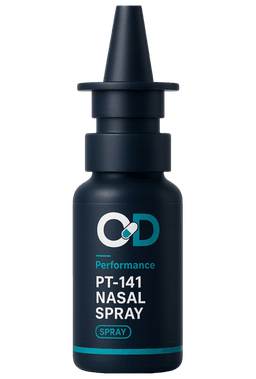 Discussed in this guidePT-141 Nasal Sprayfrom $87.50
A neutral, mechanism-focused look at the melanocortin system and how bremelanotide is understood to act on it, in contrast to the vascular route of PDE5 inhibitors.
On this page
A peptide that acts through a different pathway
PT-141, known generically as bremelanotide, is a prescription peptide discussed in the context of sexual desire and arousal. What sets it apart in most explanations is not any particular outcome but the route it is understood to take through the body: it is thought to act within the central nervous system on a family of receptors called melanocortin receptors, rather than on blood vessels themselves.
That distinction is the reason bremelanotide comes up so often alongside the more familiar prescription options in this area. The PDE5 inhibitors, such as sildenafil and tadalafil, act on a vascular pathway in the periphery. Bremelanotide's mechanism is described as sitting elsewhere entirely — in signaling networks of the brain. This article explains how the melanocortin pathway is understood to operate and why it is considered mechanistically distinct from the vascular route.
Bremelanotide is prescription-only in the United States, and a licensed provider evaluates whether it is appropriate for a given person. This article is educational only. It describes how a molecule is understood to act; it is not medical advice, a recommendation, or a statement about what any individual should expect.
The melanocortin system and its receptors
The melanocortin system is a signaling network built around a set of small hormones and the receptors they bind. One of its central messengers is alpha-melanocyte-stimulating hormone (alpha-MSH), a peptide the body cleaves from a larger precursor protein called proopiomelanocortin (POMC). Through this system the body relays signals involved in a range of physiological processes.
There are five melanocortin receptors, labeled MC1R through MC5R, and they are distributed across different tissues.
- MC1R is best known for its role in pigmentation — the "melano" in melanocortin — which is why early research in this family grew out of work on skin coloration.
- MC2R participates in the adrenal stress-hormone axis.
- The receptors most relevant to sexual signaling, MC3R and MC4R, are expressed within the central nervous system.
MC4R in particular is found in regions of the brain involved in appetite, energy balance, and sexual response. Because these central receptors sit within neural circuits rather than in the walls of blood vessels, a molecule that engages them is acting on brain signaling rather than on local blood flow. This map of where the receptors live is the key to understanding where bremelanotide is thought to act.
How bremelanotide is understood to act
Bremelanotide is a synthetic peptide — a short, cyclic chain of amino acids — that is structurally related to alpha-MSH, the natural melanocortin messenger. It was derived from an earlier research compound in the same family. Because it resembles the natural ligand, it is described as a melanocortin receptor agonist: a molecule built to bind and activate those receptors in a way similar to how the body's own alpha-MSH does.
Bremelanotide is a non-selective agonist, meaning it can engage more than one melanocortin receptor subtype. Its activity of interest for sexual signaling is generally attributed mainly to MC4R, with MC3R also part of the discussion. By activating these central receptors, it is understood to act on neural pathways associated with sexual desire and arousal, rather than on the peripheral mechanics of blood flow.
This central point of action is the defining feature of the molecule and the reason it is grouped separately from vascular agents. Whether this mechanism is appropriate for a given person is a clinical judgment. The description here explains how the pathway is understood to work; it does not tell anyone what to do or what to anticipate.
Central versus vascular: how it differs from PDE5 inhibitors
PDE5 inhibitors and melanocortin agonists are frequently mentioned together because both are discussed in the context of sexual health, yet they are understood to act at very different points. A PDE5 inhibitor works in the periphery: it acts on an enzyme in blood-vessel walls, slowing the breakdown of a signaling molecule called cyclic guanosine monophosphate (cGMP) so that smooth muscle relaxes and local blood flow increases in response to stimulation. Its mechanism is fundamentally vascular.
Bremelanotide's mechanism, by contrast, is described as fundamentally central. It is understood to act on melanocortin receptors in the brain, within the neural circuitry associated with desire and arousal, rather than on the vasculature. In broad terms, one pathway engages a physical, blood-flow step in the periphery, while the other engages signaling in the central nervous system that sits upstream of it.
Because of this difference, the two are not variations on a single theme; they describe distinct biological routes. This is why bremelanotide is often introduced specifically as a non-vascular mechanism in educational discussions — a description of where it acts, not a claim that one route is superior to another. Which mechanism, if any, is appropriate for an individual is a decision for a licensed provider, informed by that person's health history.
Forms, administration, and regulatory status
Bremelanotide is a peptide, and peptides are generally not well absorbed when swallowed, so it is prepared for administration by subcutaneous injection rather than as an oral tablet. The specifics of any given preparation — its concentration and configuration — vary, and the prescription defines how a product is to be used. This article does not provide dosing guidance; any schedule or amount is set by the prescribing provider, not by educational content.
Regulatory status is worth stating plainly. Bremelanotide is available as an FDA-approved product for a specific indication in a specific patient population. Compounded preparations of bremelanotide also exist. Compounded medications are prepared by a licensed pharmacy to fit an individual prescription and are not themselves FDA-approved — a neutral statement about the compounding pathway rather than a judgment about quality.
Because bremelanotide is prescription-only and can carry considerations that depend on a person's health history and other medications, evaluation by a licensed provider is central to the process. A medical intake is designed to surface those factors so the reviewing clinician has the context needed to make a decision. Nothing here is a substitute for that clinical review.
How prescription review works on OpenDoseRx
On OpenDoseRx, the process is built so that a clinician — not the shopper — makes the medical decision. You begin by choosing a product and strength, then complete a medical intake that collects your health history and other relevant information. That intake is routed to an independent, licensed U.S. provider who reviews it.
If the provider determines that a prescription is appropriate, it is sent to a licensed U.S. pharmacy for fulfillment and shipped to you. If the request is declined, your order does not proceed and you are not charged for the medication — you receive a full refund. Every product is prescription-only, so nothing is prepared or shipped without that independent review.
This overview is educational and procedural, not medical advice. It describes how a mechanism is understood to work and how the ordering workflow is structured; it does not recommend a treatment for any particular person. The reviewing clinician makes the clinical decision, and nothing here replaces a conversation with your own healthcare provider.
Common questions
- What kind of molecule is PT-141 (bremelanotide)?
- It is a synthetic peptide — a short, cyclic chain of amino acids — structurally related to alpha-melanocyte-stimulating hormone (alpha-MSH). It is described as a melanocortin receptor agonist, meaning it is built to bind and activate melanocortin receptors much as the body's own alpha-MSH does.
- How is bremelanotide's mechanism different from a PDE5 inhibitor like sildenafil?
- A PDE5 inhibitor acts in the periphery on an enzyme in blood-vessel walls, slowing the breakdown of cGMP so blood flow increases with stimulation — a vascular mechanism. Bremelanotide is understood to act centrally, on melanocortin receptors in the brain within circuitry associated with desire and arousal. They describe distinct biological routes.
- Which receptors is bremelanotide understood to act on?
- It is a non-selective melanocortin receptor agonist, but the activity of interest for sexual signaling is generally attributed mainly to MC4R, with MC3R also part of the discussion. These receptors are expressed within the central nervous system rather than in blood-vessel walls.
- Is bremelanotide FDA-approved?
- Bremelanotide is available as an FDA-approved product for a specific indication in a specific patient population. Compounded preparations of bremelanotide also exist; compounded medications are prepared by a licensed pharmacy to fit an individual prescription and are not themselves FDA-approved. Either way, it is prescription-only.
- Do I need a prescription to order bremelanotide?
- Yes. It is prescription-only. On OpenDoseRx, an independent, licensed U.S. provider reviews your medical intake and must determine that a prescription is appropriate before anything is dispensed, and a licensed U.S. pharmacy fulfills approved orders. If the provider declines, you receive a full refund.
Ready when you are
PT-141 Nasal Sprayfrom $87.50
- Your exact strength
- Licensed provider review
- Full refund if declined
Also relevant
Exact strengths and prices up front — a licensed provider reviews every request.
Browse sexual health & intimacy
Exact strengths and prices up front — reviewed by a licensed U.S. provider.
Keep reading
More plain-language guides on this topic.
Sildenafil vs. tadalafil: how they compare
A neutral look at two PDE5 inhibitors — their shared mechanism, general differences in onset and duration of action, and the forms they come in.
How PDE5 inhibitors are understood to act in erectile physiology
An educational overview of the PDE5 inhibitor class and the nitric oxide and cGMP signaling pathway it is understood to act on.
What oxytocin is: the neuropeptide and what research describes
A neutral, mechanism-focused look at oxytocin as a hypothalamic neuropeptide and the physiological and social-bonding roles researchers have studied.
This guide is for general education and is not medical advice. Compounded medications are not FDA-approved drugs, and statements on this site have not been evaluated by the FDA. A licensed provider reviews every prescription request.