Guide
How raloxifene works
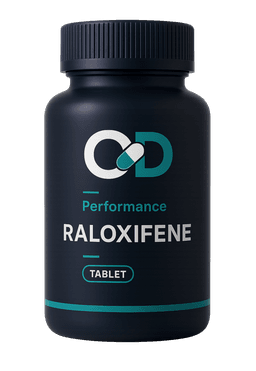 Discussed in this guideRaloxifenefrom $69.00
A neutral, mechanism-focused look at raloxifene as a SERM and how its character at the estrogen receptor is understood to differ from one tissue to the next.
On this page
A second-generation SERM
Raloxifene is a prescription medication generally described as a selective estrogen receptor modulator, a class often abbreviated as SERMs. Like others in the class, it is understood to bind the estrogen receptor and to modulate the signal that receptor carries rather than simply adding or removing estrogen. Raloxifene is frequently described as a second-generation SERM, and structurally it belongs to the benzothiophene family — a different chemical backbone from tamoxifen and the related triphenylethylene compounds. Understanding raloxifene starts with the receptor it is designed to engage and, in particular, with how its behavior at that receptor is understood to vary from tissue to tissue.
Raloxifene exists as a manufactured, FDA-approved product in the United States, marketed as Evista, and it is prescription-only; it is not available without review by a licensed provider. It received FDA approval in 1997 in connection with postmenopausal osteoporosis and, in 2007, an additional approved indication concerning invasive breast cancer risk in certain postmenopausal populations. These are regulatory facts about the labeling of a specific manufactured product; they describe where the molecule is established in medicine and are not a claim about any individual's results. When a compounding pharmacy prepares raloxifene for an individual prescription, the resulting preparation is not an FDA-approved drug, and statements about compounded preparations have not been evaluated by the FDA.
This article is educational only — a description of how raloxifene is understood to work — and is not medical advice, a diagnosis, or a recommendation of the product for any person.
How raloxifene is understood to bind the estrogen receptor
The estrogen receptor is generally described as a nuclear receptor — a protein that, once activated, is understood to act as a transcription factor that influences which genes a cell turns on or off. There are two principal forms, referred to as estrogen receptor alpha (ERα) and estrogen receptor beta (ERβ), and different tissues express them in different proportions. When the body's own estrogen binds the receptor, it is understood to shift the receptor into a shape that recruits partner proteins called coactivators, and that assembly is described as promoting the transcription of estrogen-responsive genes.
Raloxifene is understood to bind the same pocket on the receptor that estrogen occupies, but to induce a different conformational change once it is bound. The literature often points to a repositioning of a mobile part of the receptor sometimes called helix 12, and describes that altered shape as changing which partner proteins the receptor can recruit — in some settings still favoring coactivators, and in others favoring corepressor proteins that dampen transcription instead. In this model, a single molecule can read as estrogen-like or estrogen-blocking depending on which coregulator proteins are available where the receptor sits. That mixed, context-dependent character is what makes raloxifene a modulator rather than a uniform blocker or a uniform mimic.
Raloxifene's tissue-selectivity profile
The defining feature of raloxifene, and of the SERM class generally, is that the same molecule is understood to behave differently in different tissues. Raloxifene is discussed in terms of a particular profile across the tissues where its agonist or antagonist character has been examined:
- Breast — raloxifene is generally described as acting as an estrogen antagonist
- Bone — raloxifene is generally described as showing agonist (estrogen-like) activity
- Uterus (endometrium) — raloxifene is generally described as largely antagonistic or neutral, which is where it is most often contrasted with tamoxifen
That last row is the point of contrast most frequently drawn in the literature: tamoxifen is generally described as showing agonist, estrogen-like activity in the endometrial lining, whereas raloxifene is generally described as largely antagonistic or neutral there. This is a description of a mechanistic difference between two molecules, not a statement that either is preferable; that judgment belongs to a licensed provider. The word selective in the class name captures exactly this behavior — activity understood to point in one direction in one tissue and another direction in another.
Why the profile is understood to differ by tissue
Because the agonist-versus-antagonist character described above is understood to depend on which coregulator proteins and which receptor subtypes are present, and because that mix varies from tissue to tissue, the same compound can be understood to activate estrogen signaling in one location while blocking it in another. Raloxifene's own structure is part of this account: its benzothiophene core carries a flexible side chain that is understood to sit in the receptor's ligand pocket in a way that positions helix 12 differently than the body's estrogen would, and that positioning is described as shaping which coregulators the receptor surface can then recruit.
Framing raloxifene this way — by the tissues where its character is examined and by the receptor-level interactions understood to produce it — is intentional. It captures that a SERM is understood to modulate a signal rather than switch it entirely on or off, and that the direction of the interaction is context-dependent. None of this describes a specific outcome for a person; it describes how the molecule is characterized in the scientific literature, and whether any of it is relevant to a specific individual is a clinical question.
Forms and regulatory status
The manufactured, FDA-approved raloxifene product is prepared as an oral tablet. A compounded preparation, made by a licensed pharmacy for an individual prescription, is a distinct thing from that FDA-approved product: it is not an FDA-approved drug, and statements about it have not been evaluated by the FDA. Any use of raloxifene outside its FDA-approved labeling is considered off-label.
Because estrogen acts through these receptors in many tissues, estrogen-receptor modulation is also discussed in contexts beyond the ones where raloxifene is FDA-approved, including androgen-related and men's-health settings where estrogen-receptor signaling is a topic of interest. In those settings raloxifene is frequently prepared by compounding pharmacies, and such preparations are not FDA-approved. This article gives no dosing guidance of any kind — questions of strength, frequency, and duration are determined solely by a prescribing provider based on an independent evaluation of the individual.
How it works on OpenDoseRx
On OpenDoseRx, a licensed clinician — not the shopper — makes the medical decision. You choose a product and strength, then complete a medical intake with your health history. An independent, licensed U.S. provider reviews that intake and decides whether a prescription is appropriate for you.
If it is, a licensed U.S. pharmacy prepares and ships it; if the provider declines, you are not charged for the medication and receive a full refund. Compounded preparations are not FDA-approved drugs, and any dosing, if a prescription is written, is set by the prescribing provider rather than by OpenDoseRx or the patient. This article is educational only and is not a substitute for a conversation with your own healthcare provider.
Common questions
- What kind of SERM is raloxifene?
- Raloxifene is generally described as a second-generation selective estrogen receptor modulator built on a benzothiophene backbone, distinct from tamoxifen's triphenylethylene family. As a SERM, it is understood to bind the estrogen receptor and modulate the signal it carries in a tissue-selective way — generally described as an antagonist in breast tissue, as showing agonist activity in bone, and as largely antagonistic or neutral in the endometrium. This describes a mechanism, not a promise of any result, and it is educational only.
- How is raloxifene understood to differ from tamoxifen?
- Both are generally described as acting as estrogen antagonists in breast tissue and as estrogen agonists in bone, and they come from different chemical families — raloxifene a benzothiophene, tamoxifen a triphenylethylene. They are most often contrasted in the uterus: tamoxifen is generally described as showing agonist, estrogen-like activity in the endometrium, while raloxifene is generally described as largely antagonistic or neutral there. This is a description of a mechanistic difference, not a statement that either is preferable; that judgment belongs to a licensed provider.
- Does raloxifene require a prescription?
- Yes. Raloxifene is prescription-only in the United States, and it exists as a manufactured, FDA-approved product with defined labeling. A compounded preparation, made by a licensed pharmacy for an individual prescription, is not an FDA-approved drug, and statements about compounded preparations have not been evaluated by the FDA. On OpenDoseRx, an independent, licensed U.S. provider reviews your medical intake and decides whether a prescription is appropriate, and a licensed U.S. pharmacy fills an order only if the provider approves it; if the request is declined, you are not charged for the medication and receive a full refund. This is educational information, not medical advice.
Ready when you are
Raloxifenefrom $69.00
- Your exact strength
- Licensed provider review
- Full refund if declined
Browse performance & vitality
Exact strengths and prices up front — reviewed by a licensed U.S. provider.
Keep reading
More plain-language guides on this topic.
How testosterone works in the body: the androgen pathway
A plain-language look at testosterone as an androgen and how androgen-receptor signaling is understood to act on tissues across the body.
How enclomiphene is understood to act on the HPG axis
An educational overview of how enclomiphene is understood to interact with the hypothalamic-pituitary-gonadal axis through estrogen-receptor modulation.
How aromatase inhibitors are understood to work in estrogen management
A neutral, mechanism-focused look at the aromatase enzyme and how the medications known as aromatase inhibitors are understood to act on it.
This guide is for general education and is not medical advice. Compounded medications are not FDA-approved drugs, and statements on this site have not been evaluated by the FDA. A licensed provider reviews every prescription request.