Guide
How tadalafil works
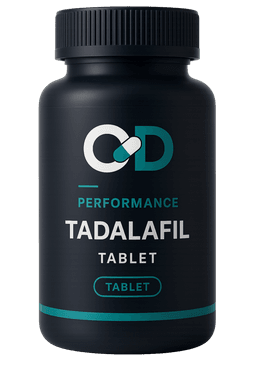 Discussed in this guideTadalafilfrom $25.00
A neutral, mechanism-focused look at how tadalafil is understood to act on PDE5 within the nitric oxide and cGMP pathway, and at its half-life as a molecular property.
On this page
What tadalafil is
Tadalafil is a prescription small-molecule compound that belongs to a class called phosphodiesterase type 5, or PDE5, inhibitors. It is most often discussed in the context of erectile dysfunction, though the same molecule is also studied and used, in different formulations, in the context of benign prostatic hyperplasia and pulmonary arterial hypertension. Whether it is appropriate for any individual is a clinical decision that belongs to an independent licensed provider, not to the patient or to this page.
Like other members of its class, tadalafil is generally described by its shared mechanism — the enzyme it is designed to bind — rather than by any promised result. What distinguishes the individual molecules within the class is their chemical structure and how long each is understood to remain active in the body. Tadalafil is frequently noted for the second of these: its comparatively long half-life.
This guide is educational only and is not medical advice. It describes how the molecule is understood to behave at the level of cell signaling and pharmacology, and it does not describe what any individual should expect or how a medication should be used.
The nitric oxide and cGMP pathway
The pathway tadalafil is understood to act on begins with a signaling molecule called nitric oxide. During sexual stimulation, nerve endings and the cells lining nearby blood vessels are understood to release nitric oxide into the surrounding tissue. This first step is generally described as depending on stimulation being present rather than occurring on its own.
Once released, nitric oxide is understood to diffuse into the smooth muscle cells that wrap around blood-vessel walls, where it activates an enzyme called guanylate cyclase. Guanylate cyclase is generally described as converting a molecule called GTP into cyclic guanosine monophosphate, abbreviated cGMP. cGMP then acts as what is often called a second messenger, meaning it is understood to carry the signal onward inside the cell.
cGMP itself is understood to relax the smooth muscle within blood-vessel walls. As that smooth muscle relaxes, the vessels are understood to widen, a process generally described as vasodilation and associated with increased local blood flow. The rise and fall of cGMP inside these cells is the signal that shapes how the surrounding muscle behaves.
How tadalafil acts on PDE5
cGMP does not remain in the cell indefinitely. The enzyme phosphodiesterase type 5, or PDE5, is generally described as the main route by which cGMP is broken down and cleared in this tissue. In that sense, PDE5 acts as a kind of off-switch for the signal cGMP carries, and the balance between how quickly cGMP is produced and how quickly PDE5 removes it is understood to determine how long the signal persists.
Tadalafil is understood to bind to PDE5 and slow the rate at which the enzyme breaks down cGMP. By slowing that breakdown, it is understood to allow cGMP to persist longer within the smooth muscle cell than it otherwise would. This is the central mechanism by which the molecule is described, and it is framed as an effect on a signaling molecule rather than as any promised outcome.
An important detail in this model is that tadalafil is understood to act downstream of nitric oxide rather than to create the nitric oxide signal itself. Because it slows the removal of cGMP rather than starting the pathway, the presence of an upstream nitric oxide signal is part of the mechanism as it is generally described. This is why the class is discussed as acting in relation to stimulation rather than independently of it.
Half-life as a molecular property
One property frequently noted about tadalafil is its comparatively long half-life. Half-life is a pharmacokinetic term describing the time it takes for the amount of a molecule in the body to fall by half. It is a physical characteristic of how a compound is absorbed, distributed, and cleared, and it is measured rather than chosen.
Among commonly discussed PDE5 inhibitors, tadalafil is generally described as having a longer half-life than molecules such as sildenafil, meaning the compound is understood to remain measurable in the body over a longer window after it is taken. This is a neutral description of the molecule's pharmacokinetics; it is not a statement that a longer half-life is preferable, and it says nothing about what any individual should do.
Because half-life influences how a molecule behaves over time, it is one of many factors a prescribing clinician weighs. How that property relates to any particular person — and whether the molecule is appropriate at all — is part of the clinical judgment that belongs to the independent licensed provider, not to this material. This guide does not provide dosing information of any kind, including amounts, timing, or frequency.
Forms tadalafil comes in
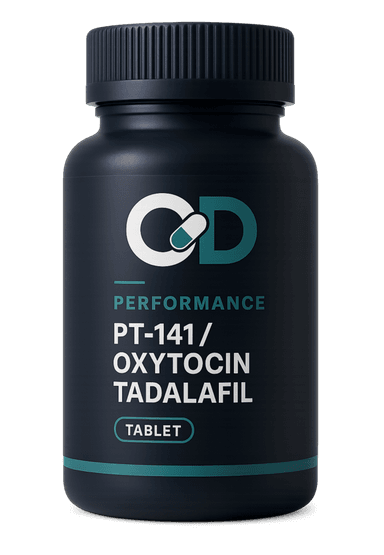
Tadalafil is most familiar as an oral tablet, and it is also prepared in other formats. In compounded practice it appears in sublingual preparations — placed under the tongue — sometimes on its own and sometimes combined with other compounded ingredients. One example discussed in this category is a sublingual preparation that pairs tadalafil with bremelanotide (PT-141) and oxytocin; such combinations are described by the ingredients they contain, not by any claim about them.
These formats differ in how a molecule is delivered rather than in the underlying mechanism described above. Which form, if any, is appropriate is determined by the provider who reviews a request.
How it works on OpenDoseRx
On OpenDoseRx, a licensed clinician — not the shopper — makes the medical decision. You choose a product and strength, then complete a medical intake with your health history. An independent, licensed U.S. provider reviews that intake and decides whether a prescription is appropriate for you.
If it is, a licensed U.S. pharmacy prepares and ships it; if the provider declines, you are not charged for the medication and receive a full refund. This article is educational only and is not a substitute for a conversation with your own healthcare provider.
Common questions
- Does tadalafil require a prescription?
- Yes. Tadalafil is a prescription-only medication. On OpenDoseRx you choose a product and strength and complete a medical intake with your health history; an independent, licensed U.S. provider then reviews that intake and decides whether a prescription is appropriate. If it is, a licensed U.S. pharmacy prepares and ships it. If the provider declines, you are not charged for the medication and receive a full refund.
- What does it mean that tadalafil has a long half-life?
- Half-life is a pharmacokinetic measure of the time it takes for the amount of a molecule in the body to fall by half. Tadalafil is generally described as having a longer half-life than some other PDE5 inhibitors, meaning it is understood to remain measurable in the body over a longer window after it is taken. This is a neutral description of the molecule's chemistry, not a recommendation or a statement about results, and it is not dosing guidance.
- Does tadalafil act on its own, without stimulation?
- The mechanism is generally described as acting within the nitric oxide and cGMP pathway, which is understood to begin with nitric oxide release that follows sexual stimulation. Tadalafil is understood to act downstream of that signal by slowing the breakdown of cGMP, so the mechanism is described as depending on stimulation being present rather than acting independently of it. This is an educational description of the pathway, not a statement about what any individual should expect.
Ready when you are
Tadalafilfrom $25.00
- Your exact strength
- Licensed provider review
- Full refund if declined
Also relevant
Exact strengths and prices up front — a licensed provider reviews every request.
Browse sexual health & intimacy
Exact strengths and prices up front — reviewed by a licensed U.S. provider.
Keep reading
More plain-language guides on this topic.
Sildenafil vs. tadalafil: how they compare
A neutral look at two PDE5 inhibitors — their shared mechanism, general differences in onset and duration of action, and the forms they come in.
How PT-141 (bremelanotide) works: the melanocortin pathway
A neutral, mechanism-focused look at the melanocortin system and how bremelanotide is understood to act on it, in contrast to the vascular route of PDE5 inhibitors.
How PDE5 inhibitors are understood to act in erectile physiology
An educational overview of the PDE5 inhibitor class and the nitric oxide and cGMP signaling pathway it is understood to act on.
This guide is for general education and is not medical advice. Compounded medications are not FDA-approved drugs, and statements on this site have not been evaluated by the FDA. A licensed provider reviews every prescription request.