Guide
How the body makes collagen: fibroblasts, procollagen, and vitamin C
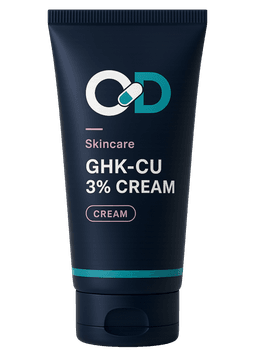 Discussed in this guideGHK-Cu 3% Creamfrom $119.00
A step-by-step, mechanism-focused walk through how collagen is synthesized in the dermis and the cofactors, including vitamin C and copper, the process is understood to depend on.
On this page
Where collagen is made: fibroblasts and the dermis
Collagen is the most abundant protein in the human body and the main structural material of skin, tendon, bone, and many other tissues. In the skin, most of it sits in the dermis, the deeper layer beneath the surface epidermis. The dermis is often described as a dense scaffold of collagen fibers embedded in a gel of other matrix molecules, and this scaffold is what the following steps assemble.
The cells that build this scaffold are fibroblasts. Fibroblasts are the resident connective-tissue cells of the dermis, and they are understood to be the primary producers of collagen along with other extracellular-matrix components such as elastin, proteoglycans, and glycosaminoglycans. When researchers describe collagen synthesis in skin, they are describing a manufacturing process that happens largely inside and around these cells.
It helps to picture the process in two halves: an intracellular half, in which the fibroblast reads a gene and assembles a precursor protein, and an extracellular half, in which that precursor is trimmed and cross-linked into mature fibers outside the cell. The cofactors this article discusses act at specific points across these two halves, which is why the sequence, rather than any single ingredient, is the useful thing to understand.
From gene to procollagen: building the triple helix
The process starts, like any protein, at the gene. Fibroblasts transcribe collagen genes into messenger RNA, which ribosomes translate into individual collagen chains called alpha chains. These chains are rich in the amino acids glycine, proline, and lysine arranged in a repeating pattern, and that repeating sequence is what allows three chains to later wind together into collagen's signature shape.
Before the chains can twist into that shape, specific proline and lysine residues along them are chemically modified in a step called hydroxylation, which converts them to hydroxyproline and hydroxylysine. This modification is carried out by enzymes known as prolyl hydroxylases and lysyl hydroxylases. Hydroxyproline in particular is understood to stabilize the folded structure, and this hydroxylation step is exactly where vitamin C enters the story, as the next section describes.
Once enough residues are hydroxylated, three alpha chains associate and wind around one another into a right-handed triple helix. This helical precursor, still carrying extra segments on each end that keep it soluble and prevent it from assembling too early, is called procollagen. Procollagen is the intermediate the cell will then export; it is not yet the finished fiber, but it already carries the essential triple-helical core of collagen.
Why vitamin C is described as a cofactor
Vitamin C, also called ascorbate or ascorbic acid, is repeatedly described in biochemistry as a cofactor for the prolyl and lysyl hydroxylase enzymes introduced above. A cofactor is a helper molecule an enzyme needs in order to work; it is not consumed as a building block of collagen itself, but the enzyme's chemistry depends on it. In this framing, vitamin C supports the hydroxylation step rather than becoming part of the finished protein.
The mechanism generally offered is that these hydroxylase enzymes use iron at their active site, and the reaction can leave that iron in an oxidized state that no longer functions. Ascorbate is understood to reduce the iron back to its active form, keeping the enzyme able to continue hydroxylating proline and lysine. This is why vitamin C is often called a reducing cofactor for collagen hydroxylation, and why the historical link between severe, prolonged vitamin C deficiency and impaired collagen-dependent tissue integrity is discussed in physiology texts as an illustration of the pathway's dependence on the cofactor.
It is worth stating clearly what this does and does not mean. Describing vitamin C as a required cofactor for an enzymatic step is a statement about biochemistry. It is not a claim that any particular supplement, cream, or product increases collagen in a person's skin, and this guide makes no such claim. Whether any product is appropriate for an individual is a medical question for a licensed provider, not something a mechanism description can answer.
Secretion, cross-linking, and the role of copper
After procollagen is assembled inside the fibroblast, it is packaged and secreted into the surrounding extracellular space. There, enzymes called procollagen peptidases cleave off the extra end segments that had been keeping the molecule soluble. The trimmed product is called tropocollagen, and removing those end pieces is understood to allow the molecules to begin aligning and packing together side by side.
Aligned tropocollagen molecules assemble into fibrils, and fibrils bundle into the larger collagen fibers that give the dermis its tensile strength. To make these assemblies durable, the molecules are linked to one another by covalent cross-links. The enzyme most associated with forming these cross-links is lysyl oxidase, which acts on lysine and hydroxylysine residues to initiate the bonds that hold the fibrillar network together.
Copper enters here as a required cofactor for lysyl oxidase, in the same cofactor sense that vitamin C serves the hydroxylases: the enzyme depends on copper to function. This is the general biochemical basis often cited for describing copper as important to connective-tissue integrity, and it is the same enzyme chemistry referenced when copper-peptide complexes such as GHK-Cu are discussed in the skincare literature. As always, the presence of a cofactor pathway is a description of mechanism and not a statement about what any product does in a given person.
Turnover, other cofactors, and what this article is
Collagen is not built once and left alone. The dermal matrix is continuously remodeled, with enzymes called matrix metalloproteinases breaking down existing collagen while fibroblasts synthesize new molecules to replace it. This balance between breakdown and rebuilding is what physiology texts mean by collagen turnover, and it is influenced by many factors researchers study, including sun exposure and the general changes described with aging. The synthesis steps in this article are one side of that ongoing balance.
The pathway also depends on more than the two cofactors highlighted here. Iron sits at the center of the hydroxylase enzymes, oxygen is a substrate for the hydroxylation reactions, and the amino acids glycine, proline, and lysine supply the raw sequence. Describing vitamin C and copper as cofactors is a way of pointing to specific, well-characterized steps, not a suggestion that collagen synthesis reduces to any single ingredient.
This article is educational only and is not medical advice, a diagnosis, or a recommendation to use any product or supplement. Compounded medications are not FDA-approved drugs, and statements in this guide have not been evaluated by the FDA. Nothing here should be read as a claim that a product builds collagen or changes skin. Decisions about products or treatments are made by a licensed provider based on an individual's health, not by educational content.
How prescription review works on OpenDoseRx
Some of the biology above overlaps with products discussed in a skincare context, such as copper-peptide preparations, whose chemistry references the copper-dependent cross-linking enzyme described earlier. On OpenDoseRx, you begin by choosing a product and strength and completing a medical intake, a set of health questions relevant to what you are requesting. The patient requests; the patient does not prescribe for themselves.
That intake is routed to an independent, licensed U.S. provider who reviews it and makes the clinical decision. If the provider determines a prescription is appropriate, the order is filled by a licensed U.S. pharmacy and shipped to you; if the request is declined, you are not charged for the medication and receive a full refund. This process is a prescribing review and does not replace the relationship you have with your own healthcare provider, and every product is dispensed only after independent clinical review.
Common questions
- What role do fibroblasts play in making collagen?
- Fibroblasts are the connective-tissue cells of the dermis and are understood to be the main producers of collagen. They transcribe collagen genes, assemble the individual chains, fold them into the procollagen triple helix inside the cell, and secrete that precursor into the surrounding matrix, where it is trimmed and cross-linked into mature fibers.
- Why is vitamin C connected to collagen synthesis?
- Vitamin C (ascorbate) is described as a cofactor for the prolyl and lysyl hydroxylase enzymes that modify proline and lysine during collagen assembly. These enzymes use iron, and vitamin C is understood to keep that iron in its active form. This is a statement about enzyme biochemistry, not a claim that any product increases collagen in a person; product decisions belong to a licensed provider.
- What is procollagen, and how is it different from collagen?
- Procollagen is the precursor form the fibroblast builds and secretes. It already contains the triple-helical core but carries extra end segments that keep it soluble. After secretion, enzymes cleave off those segments to form tropocollagen, which then assembles into fibrils and is cross-linked into the mature collagen fibers of the dermis.
- Why is copper mentioned alongside collagen?
- Copper is a required cofactor for lysyl oxidase, the enzyme that initiates the cross-links holding collagen fibers together outside the cell. This enzyme chemistry is the general basis for discussing copper in connection with connective tissue, and it is the same pathway referenced when copper-peptide complexes are described in skincare literature. It is a mechanism description, not a claim about any product's effect.
Ready when you are
GHK-Cu 3% Creamfrom $119.00
- Your exact strength
- Licensed provider review
- Full refund if declined
Also relevant
Exact strengths and prices up front — a licensed provider reviews every request.
Browse skincare & dermatology
Exact strengths and prices up front — reviewed by a licensed U.S. provider.
Keep reading
More plain-language guides on this topic.
How tretinoin works: retinoids and skin cell turnover
A plain-language look at the biology of retinoids — how tretinoin engages retinoic-acid receptors and is understood to influence how the skin renews itself.
Copper peptides (GHK-Cu): the tripeptide-copper complex in skin
GHK-Cu is a tripeptide bound to a copper ion; this guide describes the complex and the skin-signaling roles attributed to it in the scientific literature.
How bimatoprost is understood to affect eyelash growth: the prostaglandin analog pathway
A plain-language look at how bimatoprost, a prostaglandin analog first used in glaucoma care, is understood to act on the eyelash growth cycle.
This guide is for general education and is not medical advice. Compounded medications are not FDA-approved drugs, and statements on this site have not been evaluated by the FDA. A licensed provider reviews every prescription request.