Guide
How triglycerides are metabolized: dietary fat, chylomicrons, and VLDL
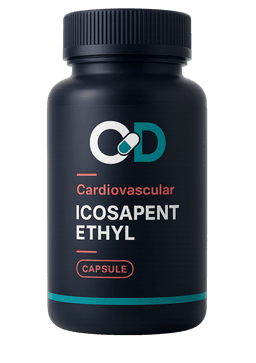 Discussed in this guideIcosapent Ethylfrom $54.99
A plain-language, mechanism-focused look at how the body absorbs, packages, transports, and unloads triglycerides — from dietary fat and chylomicrons to liver-made VLDL, lipoprotein lipase, and free fatty acid uptake.
On this page
- Why triglycerides travel in packages
- How dietary fat is absorbed and packed into chylomicrons
- How the liver makes and exports triglycerides in VLDL
- How lipoprotein lipase unloads triglycerides at the tissues
- What is left behind: remnants, IDL, and LDL
- Educational only — and how prescription review works on OpenDoseRx
- Common questions
Why triglycerides travel in packages
A triglyceride — also called a triacylglycerol — is the body's main storage and transport form of fat. Chemically it is a glycerol backbone with three fatty acid chains attached, and it is the molecule the body uses to hold and move large amounts of energy. The fatty acids on a triglyceride are where that energy is concentrated, which is why the way the body routes triglycerides is central to how it handles fuel between and during meals.
The problem the body has to solve is that triglycerides are hydrophobic: they do not dissolve in water, and blood plasma is mostly water. Fat cannot simply float freely through the bloodstream, so it is understood to be carried inside lipoprotein particles. A lipoprotein is a droplet with an oily core of triglycerides and cholesterol wrapped in a shell of phospholipids, some free cholesterol, and specialized proteins called apolipoproteins. Those surface proteins act like address labels and enzyme switches — they mark a particle for recognition and turn nearby enzymes on and off.
Triglycerides reach the blood from two broad sources, and the body uses a different carrier for each. Fat that comes from food is described as the exogenous route and is packaged into particles called chylomicrons. Fat that the liver assembles and exports is described as the endogenous route and is packaged into very-low-density lipoprotein, or VLDL. This article is educational and describes how these pathways are understood to work; it is not medical advice, makes no claim about any treatment or outcome, and is not a substitute for guidance from a licensed clinician.
How dietary fat is absorbed and packed into chylomicrons
The exogenous pathway begins in the small intestine after a fat-containing meal. Dietary triglycerides arrive as large fat globules, and the body first has to break them into pieces small enough to absorb. Bile salts released from the gallbladder emulsify the fat into fine droplets, and an enzyme called pancreatic lipase is understood to split each triglyceride into free fatty acids and monoglycerides. These smaller fragments are what the enterocytes — the cells lining the intestinal wall — are able to take up.
Once inside the enterocyte, the fragments are not left as they are. Research describes the cell re-assembling them — re-esterifying the fatty acids back onto a glycerol backbone — to rebuild triglycerides. Those rebuilt triglycerides are then packaged, together with cholesterol and a large structural protein called apolipoprotein B-48, into a chylomicron. A helper protein known as microsomal triglyceride transfer protein (MTP) is understood to load the lipid onto apoB-48 as the particle is assembled. The finished chylomicron is a triglyceride-rich delivery vehicle built specifically to move dietary fat.
Chylomicrons are large, and rather than entering blood capillaries directly, they are understood to pass first into the lymphatic vessels of the gut, called lacteals. They travel through the lymphatic system and enter the bloodstream near the heart by way of the thoracic duct. Once in circulation, a chylomicron picks up two more apolipoproteins from HDL particles it encounters: apolipoprotein C-II, which will act as an enzyme switch, and apolipoprotein E, which will later serve as a recognition tag for the liver. With those proteins on board, the particle is ready to be unloaded at the tissues.
How the liver makes and exports triglycerides in VLDL
The endogenous pathway runs largely out of the liver and operates around the clock, not just after a meal. The liver assembles triglycerides from fatty acids it receives from the blood and from fatty acids it synthesizes itself through a process called de novo lipogenesis. To export that fat, the liver packages it — again with the help of MTP — around a different structural protein, apolipoprotein B-100, forming a very-low-density lipoprotein particle. VLDL is essentially the liver's counterpart to the intestine's chylomicron: a triglyceride-rich particle built to carry fat out into the circulation.
After VLDL is secreted into the blood, it behaves much like a chylomicron. It acquires apolipoprotein C-II and apolipoprotein E from HDL, gaining the same enzyme switch and recognition tag. The body therefore ends up running two parallel delivery systems at once: chylomicrons carrying mostly dietary fat and marked with apoB-48, and VLDL carrying mostly liver-derived fat and marked with apoB-100. Each particle keeps its single copy of its B-type apolipoprotein for its entire lifespan, which is part of how researchers trace and distinguish the two routes.
The naming of these particles reflects their physics. Triglyceride is light and less dense than protein, so a particle stuffed with triglyceride is very low in density — hence 'very-low-density lipoprotein.' As you will see in the next sections, when a particle loses its triglyceride cargo it becomes proportionally denser, and that shift in density is exactly what the classification of lipoproteins is built around.
How lipoprotein lipase unloads triglycerides at the tissues
Both chylomicrons and VLDL are unloaded by the same key enzyme: lipoprotein lipase, usually abbreviated LPL. LPL is not free in the blood; it is understood to be anchored to the inner lining of the small capillaries in tissues that use or store fat, chiefly skeletal muscle, heart muscle, and adipose (fat) tissue. A protein called GPIHBP1 is described as holding LPL in place on the capillary wall and helping present it to passing lipoproteins.
When a triglyceride-rich particle drifts against the capillary wall, the apolipoprotein C-II on its surface acts as the switch that activates LPL. The activated enzyme then hydrolyzes the triglycerides in the particle's core, splitting them back into free fatty acids and glycerol — essentially reversing, at the delivery site, the packaging that happened in the gut or the liver. This is the central unloading step of triglyceride metabolism: the point at which stored fuel is released from its carrier right at the tissue that needs it.
The freed fatty acids are taken up locally by the surrounding cells. In muscle, they are largely directed into oxidation, the process cells use to extract energy. In adipose tissue, they are re-esterified back into triglycerides and held in storage for later. The glycerol released alongside them is water-soluble and travels back to the liver, which can reuse it. Hormonal signals are understood to tune this traffic: after a meal, for example, insulin is described as increasing LPL activity in adipose tissue, favoring uptake and storage. These are descriptions of how the pathway is regulated, not statements about any individual's metabolism.
What is left behind: remnants, IDL, and LDL
As lipoprotein lipase strips triglycerides out of a particle, the particle shrinks and its remaining contents become proportionally richer in cholesterol. A chylomicron that has given up most of its triglyceride becomes a smaller, cholesterol-enriched chylomicron remnant. The remnant is understood to be cleared from the blood by the liver, which recognizes the apolipoprotein E on its surface through receptors including the LDL receptor and a related receptor called LRP1. This returns the leftover cholesterol and particle components to the liver, closing the dietary-fat loop.
VLDL follows a parallel but longer path. As it loses triglyceride, it first becomes intermediate-density lipoprotein (IDL). Some IDL is taken up by the liver; the rest is processed further — an enzyme called hepatic lipase is understood to remove still more triglyceride — until it becomes low-density lipoprotein (LDL). LDL is the cholesterol-rich end product of the VLDL route, and it is recognized by the LDL receptor by way of its apolipoprotein B-100. This is the sequence often summarized as VLDL to IDL to LDL, and it is why the endogenous triglyceride pathway is closely tied to how the body distributes cholesterol.
One more stream of fatty acids runs alongside all of this. During fasting, the triglycerides stored inside fat cells are broken down by enzymes such as hormone-sensitive lipase, releasing free fatty acids directly into the blood. Because free fatty acids are not water-soluble either, they travel bound to the blood protein albumin rather than inside a lipoprotein, delivering fuel to tissues between meals.
Taken together, these routes form the continuous cycle by which the body moves triglyceride energy where it is needed:
- Chylomicrons for dietary fat
- VLDL for liver-made fat
- LPL unloading at the tissues
- Remnant clearance by the liver
- Albumin-bound fatty acids during fasting
Educational only — and how prescription review works on OpenDoseRx
This guide describes normal physiology: how triglycerides are understood to be absorbed, packaged, transported, and unloaded. It is educational and is not medical advice. It does not diagnose any condition, does not describe how any medication acts, and makes no claim about outcomes for any individual. Lipid metabolism is complex and varies from person to person, and how any lab result or health goal fits a specific situation is a clinical judgment that belongs to an independent licensed provider, not to a general article.
OpenDoseRx is built so that a clinician — not the shopper — makes any medical decision. If you are exploring a prescription product, you begin by choosing a product and strength, then complete a medical intake that collects your health history and other relevant information. Nothing is dispensed on the basis of a product page or an educational guide, because every product on the site is prescription-only. That intake is routed to an independent, licensed U.S. provider who reviews it and decides whether a prescription is appropriate for you.
If the provider determines a prescription is appropriate, it is prepared and dispensed by a licensed U.S. pharmacy and shipped to you; if the request is declined, you are not charged for the medication and receive a full refund. Where a product is a compounded preparation, it is not an FDA-approved drug, and statements about it have not been evaluated by the FDA. This review is a safeguard, not a substitute for your own healthcare provider or for in-person or emergency care. Use this guide to understand the biology, and bring your questions to a licensed clinician.
Common questions
- What is the difference between chylomicrons and VLDL?
- Both are triglyceride-rich lipoprotein particles, but they carry fat from different sources. Chylomicrons are assembled in the small intestine to transport fat that came from food (the exogenous route) and are built around apolipoprotein B-48. VLDL is assembled by the liver to export fat the body has made or processed itself (the endogenous route) and is built around apolipoprotein B-100. Both are unloaded by the same enzyme, lipoprotein lipase, at the tissues.
- What does lipoprotein lipase do?
- Lipoprotein lipase (LPL) is an enzyme anchored to the inner wall of capillaries in muscle and fat tissue. When a chylomicron or VLDL passes by, the apolipoprotein C-II on its surface activates LPL, which then splits the triglycerides in the particle's core into free fatty acids and glycerol. The freed fatty acids are taken up locally — used for energy in muscle or stored in fat tissue — which is how triglyceride fuel is delivered where it is needed.
- What happens to a triglyceride particle after its fat is removed?
- As lipoprotein lipase strips out the triglyceride, the particle shrinks and becomes proportionally richer in cholesterol. A chylomicron becomes a chylomicron remnant that the liver clears using receptors that recognize apolipoprotein E. VLDL becomes intermediate-density lipoprotein (IDL) and then low-density lipoprotein (LDL), the cholesterol-rich particle recognized by the LDL receptor. This is why the triglyceride and cholesterol pathways are closely connected.
- Is this article medical advice?
- No. It is an educational description of how triglyceride metabolism is understood to work — dietary fat, chylomicrons, VLDL, lipoprotein lipase, and free fatty acid uptake. It does not diagnose any condition, describe how any medication acts, or make claims about outcomes. Whether anything discussed here is relevant to a person's situation is a clinical judgment for an independent licensed provider. Every prescription product on OpenDoseRx is dispensed only after that provider reviews your medical intake.
Ready when you are
Icosapent Ethylfrom $54.99
- Your exact strength
- Licensed provider review
- Full refund if declined
Also relevant
Exact strengths and prices up front — a licensed provider reviews every request.
Browse cardiovascular treatments
Exact strengths and prices up front — reviewed by a licensed U.S. provider.
Keep reading
More plain-language guides on this topic.
How statins work: the cholesterol synthesis pathway
A plain-language, mechanism-focused look at the cholesterol-synthesis pathway and how statins act on the enzyme that helps drive it.
ACE inhibitors and ARBs: how they are understood to act on the renin-angiotensin system
An educational overview of the renin-angiotensin system and how ACE inhibitors and angiotensin-receptor blockers are understood to act within it.
How beta blockers are understood to act on beta-adrenergic receptors
An educational, mechanism-focused overview of how beta blockers such as propranolol and nebivolol are understood to act on beta-adrenergic receptors within the sympathetic nervous system.
This guide is for general education and is not medical advice. Compounded medications are not FDA-approved drugs, and statements on this site have not been evaluated by the FDA. A licensed provider reviews every prescription request.