Guide
The science of photoaging: how UV light changes skin over time
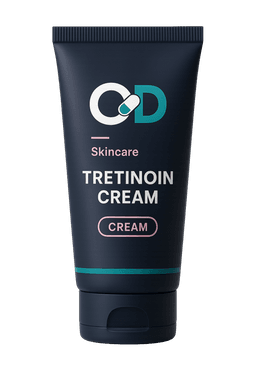 Discussed in this guideTretinoin Creamfrom $79.00
A neutral, mechanism-focused look at how ultraviolet light is understood to drive changes in the skin's collagen and elastin over time.
On this page
- What photoaging is, and how it differs from intrinsic aging
- UVA and UVB: two wavelengths, two depths
- How UV light is understood to generate reactive oxygen species
- The enzyme cascade that degrades collagen and elastin
- How the skin's matrix responds, and where antioxidants and retinoids are studied
- Educational information, not medical advice
- Common questions
What photoaging is, and how it differs from intrinsic aging
Skin changes with time through two overlapping processes that researchers usually describe separately. The first is intrinsic aging, sometimes called chronological aging: the slow, genetically influenced change that every tissue undergoes regardless of environment. The second is extrinsic aging, driven by outside exposures. Photoaging is the extrinsic component attributed largely to ultraviolet (UV) light from the sun, and it is layered on top of whatever intrinsic aging is already underway.
The distinction is easiest to see by comparing skin on habitually sun-exposed sites, such as the face and the backs of the hands, with skin on rarely exposed sites, such as the inner upper arm. Dermatologists describe photoaged skin using features like coarse and fine wrinkling, a leathery or thickened texture, uneven pigmentation, dilated small vessels, and a loss of firmness. Intrinsically aged skin that has been protected from sun tends to look smoother and more uniform by comparison. These are observed, descriptive patterns rather than a prediction for any individual.
This article describes the biology of photoaging as it is currently understood in the scientific literature. It walks through the pathway from a photon of UV light to changes in the skin's structural proteins. It is educational information about mechanism only, not a claim about what will happen to a particular person's skin and not medical advice.
UVA and UVB: two wavelengths, two depths
The ultraviolet light that reaches the ground is commonly divided into two bands by wavelength. UVB spans roughly 290 to 320 nanometers, and UVA spans roughly 320 to 400 nanometers. Wavelength matters because it strongly influences how deep the radiation penetrates skin. The shorter, higher-energy UVB is absorbed mostly in the epidermis, the outer cellular layer. The longer UVA penetrates further, reaching the dermis, the deeper layer where the collagen and elastin fibers that give skin its structure are located.
The two bands are also understood to act through somewhat different routes. UVB is absorbed directly by DNA and can produce characteristic molecular lesions, such as cyclobutane pyrimidine dimers, within skin-cell DNA. UVA is absorbed less directly by DNA and is thought to do much of its work indirectly: its energy is picked up by other light-absorbing molecules in the skin, which then set off chemical reactions involving oxygen. Both bands are described in the research as contributors to photoaging through overlapping but distinct chemistry.
Because UVA reaches into the dermis and is present throughout daylight hours, including through window glass, it is particularly implicated in the matrix changes discussed below. UVB, concentrated in the epidermis, is more associated with direct DNA effects and sunburn responses. The point for photoaging is that both wavelengths deliver energy into living skin, and it is what the skin does with that energy that drives the downstream changes.
How UV light is understood to generate reactive oxygen species
Reactive oxygen species, or ROS, are a family of highly reactive, oxygen-derived molecules that include superoxide, hydrogen peroxide, singlet oxygen, and the hydroxyl radical. Skin cells produce small amounts of them during normal metabolism, but UV exposure is understood to increase their production sharply. When UV energy is absorbed by naturally occurring light-sensitive molecules in skin, sometimes called endogenous chromophores, such as certain porphyrins, flavins, and urocanic acid, that energy can be transferred to nearby oxygen, converting it into these reactive forms.
Cells maintain an antioxidant defense system to keep ROS in check, including enzymes such as superoxide dismutase and catalase and non-enzymatic molecules such as glutathione and vitamins C and E. Oxidative stress is the term researchers use for the state in which ROS production outpaces this buffering capacity. In that state, ROS can chemically modify lipids in cell membranes, proteins, and DNA, and the accumulated modification is one of the ways UV exposure is thought to leave a lasting imprint on skin over many years.
ROS do not only cause direct chemical damage; they also act as signaling molecules. This is a central part of the photoaging story. Elevated ROS are understood to activate signaling cascades inside skin cells, including a group of enzymes called mitogen-activated protein (MAP) kinases. Those cascades converge on transcription factors, the proteins that switch genes on and off, most notably a factor called activator protein-1 (AP-1). This is the bridge between a burst of oxidative chemistry and a change in which genes the cell is expressing.
The enzyme cascade that degrades collagen and elastin
Once AP-1 is activated, it is understood to increase production of a group of enzymes called matrix metalloproteinases (MMPs). These are zinc-dependent enzymes whose job is to cut, or cleave, the structural proteins of the extracellular matrix. Different MMPs act on different targets: MMP-1, often called interstitial collagenase, initiates the breakdown of fibrillar type I and type III collagen; MMP-3 (stromelysin) and MMP-9 (a gelatinase) then act on collagen fragments and on elastin. Together they are described as capable of dismantling the fibers that give the dermis its tensile strength and resilience.
The same signaling that raises MMP levels is understood to work against repair at the same time. AP-1 activity is described as interfering with the transforming growth factor-beta (TGF-beta) pathway, which normally promotes the synthesis of new procollagen. The net picture that emerges from the research is a two-sided imbalance after UV exposure: more enzymatic breakdown of existing collagen and, simultaneously, less production of fresh collagen to replace it. Repeated over many exposures and many years, that imbalance is associated with a gradual thinning and disorganization of the collagen framework.
Elastin follows a related but distinct pattern. Rather than simply disappearing, photoaged dermis characteristically accumulates abnormal, disorganized elastic material, a finding pathologists call solar elastosis. The elastin network that normally lets skin snap back into shape becomes replaced over time by this dystrophic, tangled material. So the elastic fiber system is described as both degraded by enzymes and abnormally remodeled, which is part of why heavily photoaged skin can look and feel different from skin aged by time alone.
It is worth emphasizing that this cascade is driven by cumulative, repeated exposure. A single episode of UV triggers a wave of ROS, signaling, MMP activity, and imperfect repair. Individually, most of that is handled. The scientific interest in photoaging lies in the summation of countless such cycles over a lifetime, during which small amounts of unrepaired change to the dermal matrix are thought to add up.
How the skin's matrix responds, and where antioxidants and retinoids are studied
Skin is not passive in this process. It maintains layered defenses, including the antioxidant enzymes and molecules mentioned earlier, DNA repair machinery that recognizes and excises UV-induced lesions, and ongoing turnover that replaces damaged components. Glutathione, for example, is one of the most abundant intracellular antioxidants and is frequently studied as part of the cell's redox balance, the running tally between oxidants and antioxidants that determines whether oxidative stress takes hold.
Several ingredient classes are studied specifically in the context of these pathways, and it is important to describe them at the level of mechanism rather than outcome:
- Topical retinoids such as tretinoin are studied for how they interact with nuclear retinoic acid receptors, which influence gene transcription, including genes tied to the AP-1 signaling and collagen pathways described above.
- Copper peptides such as GHK-Cu are studied for their interactions with signals involved in extracellular-matrix remodeling.
- Antioxidant molecules, including vitamin C and glutathione, are studied for their role in buffering ROS.
Research describes these mechanisms; none of that is a statement here that any product prevents, reverses, or treats photoaging.
Some of the products in these categories are prescription items, and some are compounded preparations. Compounded medications are prepared by a licensed pharmacy for an individual and are not FDA-approved drugs; statements about them have not been evaluated by the FDA. Whether any such product is appropriate for a given person is a clinical judgment that depends on individual factors, and that judgment belongs to a licensed provider, not to an educational article.
Educational information, not medical advice
This guide is educational and is not medical advice, a diagnosis, or a recommendation for any specific product or course of action. It summarizes how UVA and UVB are currently understood to generate reactive oxygen species and activate enzymes that degrade dermal collagen and elastin. It does not predict results for any individual, and nothing here should replace a conversation with your own licensed clinician about your skin and health history.
On OpenDoseRx, the process is built so that a clinician, not the shopper, makes any medical decision. You choose a product and complete a medical intake with your relevant history. That intake is routed to an independent, licensed U.S. provider who reviews it and determines whether a prescription is appropriate. If it is, the prescription is sent to a licensed U.S. pharmacy for fulfillment; if the request is declined, you are not charged for the medication. Every product is dispensed only after independent clinical review.
Common questions
- What is the difference between UVA and UVB in photoaging?
- The two bands differ mainly by wavelength and how deep they penetrate. UVB (about 290 to 320 nm) is higher-energy and is absorbed mostly in the outer epidermis, where it can be absorbed directly by DNA. UVA (about 320 to 400 nm) is longer and reaches the deeper dermis, where collagen and elastin sit, and is understood to act largely by generating reactive oxygen species. Both are described in the research as contributors to photoaging through overlapping but distinct chemistry.
- How are reactive oxygen species thought to damage the skin's structure?
- Reactive oxygen species (ROS) are highly reactive oxygen-derived molecules that UV exposure is understood to increase. Beyond directly modifying lipids, proteins, and DNA, ROS act as signaling molecules: they are thought to switch on cascades that activate the transcription factor AP-1, which in turn raises production of matrix metalloproteinases, the enzymes that cleave collagen and elastin, while also dampening new collagen synthesis. This is described as a mechanism, not an outcome for any individual.
- Is photoaging the same as normal aging?
- No. Researchers distinguish intrinsic aging, the slow chronological change every tissue undergoes, from extrinsic aging, driven by outside exposures. Photoaging is the extrinsic portion attributed largely to UV light, layered on top of intrinsic aging. Comparing habitually sun-exposed skin with rarely exposed skin on the same person is a common way the difference is illustrated.
- Do any products stop or reverse photoaging?
- This article does not make that claim. Certain ingredient classes, such as retinoids, copper peptides, and antioxidants like glutathione and vitamin C, are studied at the level of the pathways described here, and research characterizes their mechanisms. Whether any product is appropriate for a given person is a clinical decision made by a licensed provider based on individual factors. Some products are compounded preparations, which are not FDA-approved drugs and whose statements have not been evaluated by the FDA.
Ready when you are
Tretinoin Creamfrom $79.00
- Your exact strength
- Licensed provider review
- Full refund if declined
Also relevant
Exact strengths and prices up front — a licensed provider reviews every request.
Browse skincare & dermatology
Exact strengths and prices up front — reviewed by a licensed U.S. provider.
Keep reading
More plain-language guides on this topic.
How tretinoin works: retinoids and skin cell turnover
A plain-language look at the biology of retinoids — how tretinoin engages retinoic-acid receptors and is understood to influence how the skin renews itself.
Copper peptides (GHK-Cu): the tripeptide-copper complex in skin
GHK-Cu is a tripeptide bound to a copper ion; this guide describes the complex and the skin-signaling roles attributed to it in the scientific literature.
How bimatoprost is understood to affect eyelash growth: the prostaglandin analog pathway
A plain-language look at how bimatoprost, a prostaglandin analog first used in glaucoma care, is understood to act on the eyelash growth cycle.
This guide is for general education and is not medical advice. Compounded medications are not FDA-approved drugs, and statements on this site have not been evaluated by the FDA. A licensed provider reviews every prescription request.