Guide
Nasal spray vs. injectable peptides: absorption routes
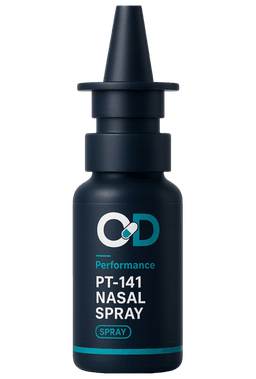 Discussed in this guidePT-141 Nasal Sprayfrom $87.50
A neutral, mechanism-focused look at how a nasal spray and a subcutaneous injection differ in the way a peptide travels from the point of administration into the bloodstream.
On this page
Two delivery routes, one class of molecule
Peptides are chains of amino acids, and when a peptide is prepared as a product it can be introduced to the body by more than one route. Two of the routes seen in compounded peptide preparations are intranasal delivery — a nasal spray — and subcutaneous injection, which places the preparation into the layer of fatty tissue just beneath the skin. Changing the route does not change the molecule itself or the receptor it is built to engage; it changes the path that molecule takes from the point of administration toward the bloodstream.
Some peptides are prepared in more than one of these forms. Bremelanotide, the peptide in PT-141, is seen both as a nasal spray and as a subcutaneous injection, and peptides such as oxytocin and vasoactive intestinal peptide (VIP) are among those seen in intranasal preparations. This article looks at how the intranasal and subcutaneous routes handle the same general class of molecule, with a focus on absorption and first-pass metabolism. It is educational only, is not medical advice, and does not recommend one route over another.
Both routes are prescription-only in the United States, and an independent licensed provider decides whether either is appropriate for a given person. Route is one of several considerations a clinician weighs alongside an individual's health history, so the comparison below is background for that conversation rather than guidance on what to do.
Why peptides are not usually swallowed
The digestive system is built to break proteins and peptides down into their component amino acids. Stomach acid and a range of digestive enzymes act on the bonds that hold a peptide together, so a peptide taken by mouth meets the same breakdown machinery that ordinary food proteins face. Without some form of protection, much of a swallowed peptide would be degraded before it could reach circulation.
Size and solubility add a second barrier. Many peptides are relatively large, water-soluble molecules, and the lining of the intestine is comparatively selective about what it allows across, tending to admit small, fat-soluble molecules more readily than large, water-loving ones. This combination of enzymatic breakdown and limited permeability is why peptide medications are frequently delivered by routes that avoid the digestive tract.
Both the nasal and the subcutaneous routes are, in different ways, attempts to introduce a peptide to the bloodstream without sending it through the stomach and intestine. How each route does that — and how much of the molecule it is understood to deliver — is the distinction the rest of this article describes.
How subcutaneous injection delivers the molecule
A subcutaneous injection places the preparation into the fatty tissue just beneath the skin, bypassing the stomach and intestines altogether. Because the molecule never passes through the digestive tract, it avoids the acid and enzymes that would otherwise degrade it, and it does not have to cross the selective intestinal lining.
From the subcutaneous tissue, the molecule is absorbed gradually into the bloodstream through small blood and lymphatic vessels. This route is generally understood to deliver a large and relatively predictable fraction of the administered molecule into circulation, which is one reason injection has historically been a common route for peptides. The molecule also enters the general circulation without first passing through the liver, a point the sections below return to.
The trade-off is the injection itself. Subcutaneous administration involves a needle, though the devices used are designed to make it a shallow injection into fatty tissue rather than a deep one. Whether this route suits a particular person is part of what an independent licensed provider considers, and the prescription defines how any product is to be used.
How a nasal spray is absorbed across the mucosa
A nasal spray deposits the preparation onto the mucous membrane lining the inside of the nose. That surface is thin and richly supplied with small blood vessels, and the intent is for the molecule to diffuse across the nasal mucosa and enter the network of vessels beneath it, rather than being swallowed and digested. The veins draining the nasal lining empty into the body's systemic circulation, so a molecule absorbed this way is understood to reach the bloodstream without first passing through the liver. How completely a peptide takes that path is less straightforward, and several features of the nose shape it:
- Molecular size — nasal absorption tends to be most efficient for small molecules, and many peptides are comparatively large, so they are understood to cross the mucosa less readily.
- Enzymes in the nasal lining — the mucosa contains peptidases that can break peptides down, much as digestive enzymes do elsewhere in the body.
- Mucociliary clearance — the nose continuously moves mucus toward the throat, which limits how long a molecule stays in contact with the absorbing surface.
For these reasons, a portion of an intranasally administered peptide is often swallowed and then subject to the same digestion described earlier, and the fraction that crosses the mucosa into the blood is generally understood to be smaller and more variable than what injection delivers. The nasal route is also studied as a possible path along the olfactory and trigeminal nerves — a separate area of ongoing research rather than an established outcome. The specifics of any given preparation vary, and the prescription defines how a product is to be used.
First-pass metabolism and bioavailability
First-pass metabolism refers to a step that substances absorbed from the gut normally undergo: they travel first to the liver, where a fraction can be broken down before reaching general circulation. Both of the routes discussed here largely sidestep that step — subcutaneous injection because the molecule enters tissue and then systemic circulation directly, and intranasal delivery because the nasal veins drain into the systemic circulation rather than into the portal vein that carries blood from the gut to the liver. In that respect the two routes differ from a swallowed dose, which does travel through the liver first.
Bioavailability describes the fraction of an administered amount that reaches the bloodstream in active form. On this measure the two routes are not equivalent: subcutaneous injection is generally understood to place a higher and more predictable fraction of a peptide into circulation than a nasal spray, because it avoids the mucosal barrier, the nasal enzymes, and the mucociliary clearance that limit intranasal absorption. Reported figures for intranasal peptide bioavailability tend to be low and to vary between molecules and formulations, which is itself a reason to treat any single number with caution.
Because the two routes deliver different proportions of what is administered, the amount of peptide in a nasal preparation and in an injectable one is not directly comparable, and a strength set for one route cannot simply be converted to the other. This is one reason route and strength are decided together by a prescriber rather than translated between forms. Many of these peptide preparations are also compounded rather than FDA-approved products — a neutral fact an independent provider can explain during review.
How it works on OpenDoseRx
On OpenDoseRx, a licensed clinician — not the shopper — makes the medical decision. You choose a product and strength, including the route you are interested in, then complete a medical intake with your health history and other relevant information.
An independent, licensed U.S. provider reviews that intake and decides whether a prescription is appropriate for you. If it is, a licensed U.S. pharmacy prepares and ships it; if the provider declines, you are not charged for the medication and receive a full refund. This article is educational only and is not a substitute for a conversation with your own healthcare provider.
Common questions
- What is the main difference between a nasal spray and an injectable peptide?
- The difference is the path the molecule takes to the bloodstream, not the molecule itself. A subcutaneous injection places the peptide into the tissue beneath the skin, from which it is absorbed into circulation, while a nasal spray relies on absorption across the thin, vascular lining of the nose. Both routes avoid the digestive tract, but they differ in how much of the molecule is understood to reach the blood and how predictable that fraction is.
- Do both routes avoid first-pass metabolism?
- In large part, yes. Substances swallowed and absorbed from the gut normally pass through the liver first, where some is broken down before reaching general circulation. A subcutaneous injection enters tissue and then the systemic circulation directly, and a nasal spray drains into veins that reach the systemic circulation rather than the liver, so both routes are understood to bypass much of that first-pass step. They differ mainly in how efficiently and predictably each delivers a peptide across its respective barrier.
- Do nasal spray and injectable peptides require a prescription?
- Yes. These peptide preparations are prescription-only in the United States, whatever the route. On OpenDoseRx you choose a product and strength and complete a medical intake; an independent, licensed U.S. provider reviews it and decides whether a prescription is appropriate for you. If it is, a licensed U.S. pharmacy prepares and ships it; if the provider declines, you are not charged for the medication and receive a full refund.
Ready when you are
PT-141 Nasal Sprayfrom $87.50
- Your exact strength
- Licensed provider review
- Full refund if declined
Also relevant
Exact strengths and prices up front — a licensed provider reviews every request.
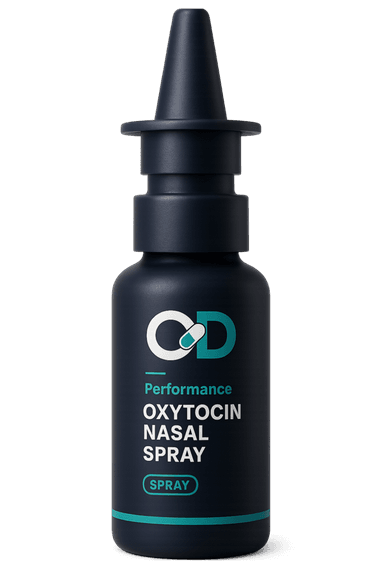
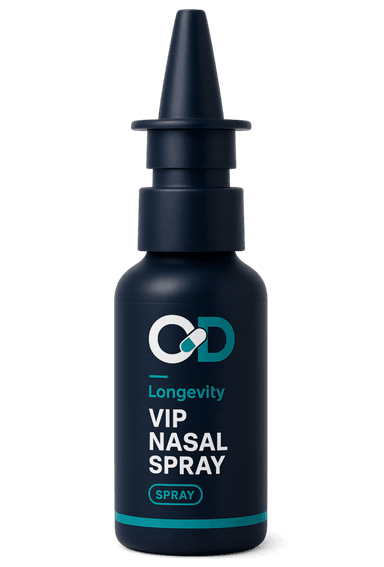
Browse performance & vitality
Exact strengths and prices up front — reviewed by a licensed U.S. provider.
Keep reading
More plain-language guides on this topic.
How testosterone works in the body: the androgen pathway
A plain-language look at testosterone as an androgen and how androgen-receptor signaling is understood to act on tissues across the body.
How enclomiphene is understood to act on the HPG axis
An educational overview of how enclomiphene is understood to interact with the hypothalamic-pituitary-gonadal axis through estrogen-receptor modulation.
How aromatase inhibitors are understood to work in estrogen management
A neutral, mechanism-focused look at the aromatase enzyme and how the medications known as aromatase inhibitors are understood to act on it.
This guide is for general education and is not medical advice. Compounded medications are not FDA-approved drugs, and statements on this site have not been evaluated by the FDA. A licensed provider reviews every prescription request.