Guide
Rosuvastatin vs. atorvastatin: how they differ
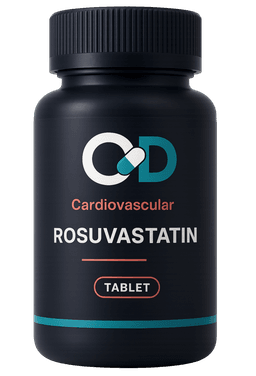 Discussed in this guideRosuvastatinfrom $29.00
A plain-language, pharmacology-focused comparison of two statins that share the same enzyme target but differ in solubility, how the liver processes them, and how long they circulate.
On this page
Solubility: hydrophilic versus lipophilic
One well-described difference between the two is how readily each dissolves in water versus fat. Atorvastatin is characterized as lipophilic, meaning it mixes more easily with fatty, oily environments. Rosuvastatin is characterized as relatively hydrophilic, meaning it is more at home in water-based surroundings. This is a statement about molecular chemistry, not about effect.
Solubility matters because statins act mainly inside liver cells, so a molecule first has to get there. Lipophilic statins such as atorvastatin are understood to cross cell membranes partly by passive diffusion, since membranes themselves are fatty. More hydrophilic statins such as rosuvastatin are understood to rely more heavily on dedicated transport proteins, particularly one called OATP1B1, that actively carry the molecule from the bloodstream into hepatocytes, the liver's working cells. This transporter-dependence is a frequently noted feature of rosuvastatin's distribution.
The practical framing pharmacologists use is that solubility influences how broadly a molecule distributes into tissues beyond the liver and how it enters its main site of action. It is a difference in route and distribution, described neutrally, and not a ranking of one route against the other.
How the liver processes each: CYP involvement
The liver clears most drugs with the help of a family of enzymes called cytochrome P450, usually abbreviated CYP. Different CYP enzymes handle different molecules, and which enzyme a drug depends on shapes the kinds of interactions it can have with other medications. This is where rosuvastatin and atorvastatin diverge noticeably.
Atorvastatin is understood to be metabolized substantially by CYP3A4, one of the busiest enzymes in the liver and gut. Because CYP3A4 also processes many other common medications and some foods, substances that slow down or speed up CYP3A4 can change how much atorvastatin remains in circulation. Rosuvastatin, by contrast, is described as undergoing relatively little CYP metabolism; a modest fraction involves the enzyme CYP2C9, and a large portion is understood to be eliminated largely unchanged. Its interactions instead center more on transporter proteins such as OATP1B1 and BCRP than on the CYP3A4 route.
Half-life: how long each circulates
Half-life is the pharmacology term for how long it takes the amount of a drug in the bloodstream to fall by half. It is one way to describe how quickly a molecule is cleared and, loosely, how long its presence persists between exposures. Compared with some earlier statins, both rosuvastatin and atorvastatin are generally described as having relatively long plasma half-lives.
Within that shared feature there is a difference of degree. Rosuvastatin is understood to have a somewhat longer plasma half-life than atorvastatin. Atorvastatin's own picture is complicated by the fact that it forms active metabolites, breakdown products that themselves retain HMG-CoA reductase activity, so its overall pharmacological presence is understood to extend beyond what the parent molecule's half-life alone would suggest. These are descriptions of pharmacokinetics, the study of a drug's movement through the body over time, and not statements about dosing schedules, which are set by a prescriber and not by educational content.
Forms, brand names, and routes
Both molecules are typically formulated as oral tablets taken on a schedule determined by a prescriber. Rosuvastatin is marketed under the brand name Crestor, and atorvastatin under the brand name Lipitor; both are also available in generic form. They are named as neutral category examples here, not as recommendations.
This article does not provide dosing figures, strengths, or a schedule. All statins are prescription-only in the United States, and whether either molecule is appropriate for a given person, and how the solubility, metabolism, and half-life differences described above apply to that person, depends on medical history, other medications, tolerability, and lab findings. Those factors belong to an independent licensed provider's judgment rather than to a general article or a product page.
How it works on OpenDoseRx
On OpenDoseRx, a licensed clinician, not the shopper, makes the medical decision. You choose a product and strength, then complete a medical intake with your health history. An independent, licensed U.S. provider reviews that intake and decides whether a prescription is appropriate for you.
If it is, a licensed U.S. pharmacy prepares and ships it; if the provider declines, you are not charged for the medication and receive a full refund. This article is educational only and is not a substitute for a conversation with your own healthcare provider.
Common questions
- What is the main pharmacological difference between rosuvastatin and atorvastatin?
- Both are HMG-CoA reductase inhibitors and share the same enzyme target, so the differences are in their pharmacology rather than their mechanism. Atorvastatin is more lipophilic (fat-soluble) and is metabolized substantially by the liver enzyme CYP3A4, while rosuvastatin is relatively hydrophilic (water-soluble), undergoes little CYP metabolism, relies more on transport proteins such as OATP1B1 to enter liver cells, and is understood to have a somewhat longer plasma half-life.
- Does the route of liver metabolism rank one statin above another?
- No. Describing that atorvastatin depends more on CYP3A4 while rosuvastatin depends more on transporter proteins is a statement about how each is processed and what kinds of drug interactions each can have, not a ranking. Which considerations matter for a particular person depends on their other medications and health history, and that assessment belongs to an independent licensed provider.
- Does rosuvastatin require a prescription?
- Yes. Rosuvastatin, like all statins, is prescription-only in the United States. On OpenDoseRx, it is dispensed only after you complete a medical intake and an independent, licensed U.S. provider reviews it and decides a prescription is appropriate for you. If it is, a licensed U.S. pharmacy prepares and ships it; if the provider declines, you are not charged for the medication and receive a full refund.
Ready when you are
Rosuvastatinfrom $29.00
- Your exact strength
- Licensed provider review
- Full refund if declined
Browse cardiovascular treatments
Exact strengths and prices up front — reviewed by a licensed U.S. provider.
Keep reading
More plain-language guides on this topic.
How statins work: the cholesterol synthesis pathway
A plain-language, mechanism-focused look at the cholesterol-synthesis pathway and how statins act on the enzyme that helps drive it.
ACE inhibitors and ARBs: how they are understood to act on the renin-angiotensin system
An educational overview of the renin-angiotensin system and how ACE inhibitors and angiotensin-receptor blockers are understood to act within it.
How beta blockers are understood to act on beta-adrenergic receptors
An educational, mechanism-focused overview of how beta blockers such as propranolol and nebivolol are understood to act on beta-adrenergic receptors within the sympathetic nervous system.
This guide is for general education and is not medical advice. Compounded medications are not FDA-approved drugs, and statements on this site have not been evaluated by the FDA. A licensed provider reviews every prescription request.