Guide
Vitamin C and collagen synthesis
 Discussed in this guideVitality Creamfrom $119.00
A neutral, mechanism-focused look at why the hydroxylase enzymes of collagen assembly are understood to depend on vitamin C as a reducing cofactor.
On this page
Vitamin C, ascorbate, and the collagen story
Collagen is the main structural protein of the dermis, the deeper layer of skin, and its assembly inside connective-tissue cells involves a specific chemical modification step: certain amino acids on the newly made collagen chains are hydroxylated, meaning a hydroxyl group is attached to them. A companion guide walks through that entire synthesis pathway from gene to fiber. This article narrows in on one molecule the enzymes performing that hydroxylation step are understood to depend on — vitamin C — and describes the chemistry rather than the whole assembly line.
Vitamin C is also called ascorbate or ascorbic acid. It is a small, water-soluble molecule, and unlike most animals humans do not make their own because the gene for one enzyme in its synthesis pathway is inactive, so the molecule must come from the diet. In biochemistry it is classically described as a reducing agent, meaning a molecule that readily donates electrons to other molecules. That electron-donating behavior is the thread that runs through everything below.
The enzymes that depend on ascorbate
The hydroxylation of collagen is carried out by a small set of enzymes: prolyl-4-hydroxylase and prolyl-3-hydroxylase, which act on the amino acid proline, and lysyl hydroxylase, which acts on lysine. These belong to a broader family known as the iron(II) and 2-oxoglutarate-dependent dioxygenases. The names are technical, but the shared idea is simple: each enzyme holds an iron atom at its active site and uses molecular oxygen, together with a helper molecule called 2-oxoglutarate, to attach a hydroxyl group to its target residue.
These enzymes work on the individual collagen chains while they are still inside the cell, before three chains wind together into collagen's signature triple helix. Because the iron at the active site is central to the reaction, and because that iron can be left in a form that no longer works, the enzymes are understood to need a way to keep their iron in the correct state. That is where ascorbate enters the picture.
What hydroxyproline and hydroxylysine contribute
The product of proline hydroxylation is hydroxyproline. The extra hydroxyl group changes the local chemistry of the chain in a way that is understood to stabilize the triple helix through additional hydrogen bonding and favorable geometry. Biochemistry texts generally describe hydroxyproline as raising the temperature at which the helix stays wound; without enough of it, the helix is understood to be less stable at body temperature. In this framing, hydroxyproline is what makes the folded collagen molecule hold its shape.
The product of lysine hydroxylation is hydroxylysine. These residues serve as attachment points for sugar groups and, relevant to the theme of cross-linking, they provide some of the specific sites where covalent cross-links between collagen molecules later form. It is worth separating two similarly named enzymes here: lysyl hydroxylase, described in this guide, is the ascorbate-associated enzyme that creates hydroxylysine inside the cell, while lysyl oxidase, a separate copper-dependent enzyme discussed elsewhere, is the one that later initiates the cross-links outside the cell. Ascorbate is connected to the first of these, not the second.
How ascorbate acts as a reducing cofactor
During normal catalysis the active-site iron cycles through different oxidation states. In a fraction of reaction cycles the chemistry becomes uncoupled and leaves the iron in an oxidized iron(III) state that can no longer carry out the hydroxylation, effectively stalling the enzyme. Ascorbate is understood to reduce that iron back to its active iron(II) form, donating an electron so the enzyme can resume working. This is why vitamin C is described as a reducing cofactor for collagen hydroxylation: it is a helper molecule that keeps the enzyme functional rather than a building block that becomes part of the finished protein.
Physiology texts often illustrate this dependence with the history of scurvy, in which prolonged, severe vitamin C deficiency is associated with impaired collagen-dependent tissue integrity. That association is offered as evidence that the hydroxylation pathway relies on the cofactor — it is a description of what happens to the enzymatic step when ascorbate is absent, not a statement about what any product does for a person who is not deficient.
Forms of vitamin C and how the molecule behaves
The form of vitamin C that participates in the enzyme chemistry above is L-ascorbic acid. A practical feature of this molecule is that it is easily oxidized: in water, air, and light it tends to lose electrons and convert to dehydroascorbic acid, which is why formulation chemists discuss it in terms of stability. Various derivatives, such as ascorbyl phosphate salts and ascorbyl glucoside, are studied as more stable forms that are understood to convert back toward ascorbate, and vitamin C is discussed across both oral and topical routes.
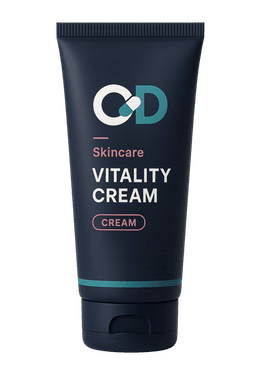
In a topical skincare context, some creams — Vitality Cream is one neutral example of that product category — are among the places where ascorbate chemistry is discussed alongside other ingredients. Describing the molecule's tendency to oxidize helps explain why formulation and packaging are treated as chemistry choices. None of this implies that a cream builds collagen in the skin; it simply describes how the molecule behaves outside the body.
How it works on OpenDoseRx
On OpenDoseRx, a licensed clinician — not the shopper — makes the medical decision. You choose a product and strength, then complete a medical intake with your health history. An independent, licensed U.S. provider reviews that intake and decides whether a prescription is appropriate for you.
If it is, a licensed U.S. pharmacy prepares and ships it; if the provider declines, you are not charged for the medication and receive a full refund. This article is educational only and is not a substitute for a conversation with your own healthcare provider.
Common questions
- Does vitamin C become part of the collagen molecule itself?
- No. Ascorbate is described as a cofactor for the prolyl and lysyl hydroxylase enzymes, which use iron at their active site. Vitamin C is understood to keep that iron in its active, reduced form so the enzymes can attach hydroxyl groups to proline and lysine. It is a helper that enables the reaction, not a raw material built into the finished protein.
- Do I need a prescription for a product discussed in this guide?
- Prescription products on OpenDoseRx are dispensed only after review. You choose a product and strength and complete a medical intake, which is routed to an independent, licensed U.S. provider who decides whether a prescription is appropriate for you. If it is, a licensed U.S. pharmacy prepares and ships it; if the provider declines, you are not charged for the medication and receive a full refund.
- Why is scurvy mentioned when people discuss vitamin C and collagen?
- Scurvy is used in physiology texts as an illustration of how the collagen hydroxylation pathway depends on ascorbate: prolonged, severe deficiency is associated with impaired collagen-dependent tissue integrity. It is cited to show the enzyme step's reliance on the cofactor, not as a claim that any product treats a condition or changes a person's skin.
Ready when you are
Vitality Creamfrom $119.00
- Your exact strength
- Licensed provider review
- Full refund if declined
Browse skincare & dermatology
Exact strengths and prices up front — reviewed by a licensed U.S. provider.
Keep reading
More plain-language guides on this topic.
How tretinoin works: retinoids and skin cell turnover
A plain-language look at the biology of retinoids — how tretinoin engages retinoic-acid receptors and is understood to influence how the skin renews itself.
Copper peptides (GHK-Cu): the tripeptide-copper complex in skin
GHK-Cu is a tripeptide bound to a copper ion; this guide describes the complex and the skin-signaling roles attributed to it in the scientific literature.
How bimatoprost is understood to affect eyelash growth: the prostaglandin analog pathway
A plain-language look at how bimatoprost, a prostaglandin analog first used in glaucoma care, is understood to act on the eyelash growth cycle.
This guide is for general education and is not medical advice. Compounded medications are not FDA-approved drugs, and statements on this site have not been evaluated by the FDA. A licensed provider reviews every prescription request.