Guide
What is lipoprotein(a)?
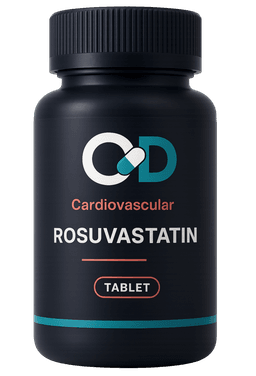 Discussed in this guideRosuvastatinfrom $29.00
A plain-language, mechanism-focused look at what gives lipoprotein(a) its structure — an LDL-like particle joined to the apo(a) protein — and why laboratories measure it separately from LDL.
On this page
What lipoprotein(a) is
Lipoprotein(a), usually written Lp(a) and spoken as 'L-P-little-a,' is one of the particles the body uses to carry fats through the blood. It is a close relative of low-density lipoprotein — the LDL that appears on a standard cholesterol report — but it carries one extra component that LDL does not. That single addition is what gives Lp(a) its own name, its own laboratory test, and the reason it is discussed separately from ordinary LDL.
Like the other lipoproteins, Lp(a) is a microscopic sphere built to move water-repelling fats through watery blood. It belongs to the apoB-containing family of particles — the group that also includes VLDL, IDL, and LDL and that shares a common structural protein described later in this guide. What distinguishes Lp(a) is not the fatty cargo it carries, which is much like LDL's, but a large protein fastened to its surface.
This article is educational and describes how Lp(a) is understood to be built at the level of biology. It does not diagnose anything, does not interpret anyone's lab results, provides no dosing, and makes no claim about any medication or outcome. What Lp(a) means for a particular person is a clinical question a licensed provider answers, not something an article can determine.
The LDL-like particle at its core
To picture Lp(a), start with an LDL particle. LDL is a roughly spherical droplet with an oily core of cholesteryl esters and triglycerides, wrapped in an outer shell of phospholipids, some free cholesterol, and a single large structural protein called apolipoprotein B-100 (apoB-100). Each LDL particle carries exactly one copy of apoB-100, and that protein stays with the particle throughout its life. This is the cholesterol-rich particle that the LDL receptor recognizes and pulls out of the blood.
Lp(a) is understood to be, at its foundation, an LDL-like particle of just this kind. It has the same style of lipid core, the same phospholipid shell, and the same single copy of apoB-100. Because of this, Lp(a) carries cholesterol in much the way an LDL particle does. If nothing else were attached, someone looking only at the lipid core and apoB-100 would have trouble telling the base of an Lp(a) particle apart from ordinary LDL.
The difference is a second protein. Fastened onto the apoB-100 of that LDL-like particle is a distinctive molecule called apolipoprotein(a), abbreviated apo(a). It is the presence of apo(a) — not the lipid cargo — that turns an otherwise LDL-like particle into lipoprotein(a).
The apo(a) protein that sets it apart
Apolipoprotein(a) is a large glycoprotein attached to apoB-100 by a disulfide bond — a strong covalent link between two sulfur-containing amino acids. This covalent attachment is a defining feature: apo(a) is not simply resting on the surface the way some apolipoproteins exchange between particles, but is chemically bonded to the apoB-100 of its host particle.
The shape of apo(a) is unusual. It is built largely from repeating looped structures called kringle domains, named for a looped Scandinavian pastry because of their coiled appearance. Apo(a) contains many copies of one kringle type together with a single copy of another and an inactive protease-like region at its end. This looping, chain-like architecture makes apo(a) a long, flexible protein draped over the LDL-like particle it is bonded to.
A frequently noted point is that apo(a) closely resembles plasminogen, a protein involved in the body's system for dissolving blood clots. The two share the kringle-domain design, and researchers study apo(a) partly because of this structural similarity to a clotting-related protein. Describing that resemblance is a statement about molecular structure; it is not a claim about what Lp(a) does in any individual.
Why apo(a) differs in size from person to person
One of the most studied features of apo(a) is that its size is not the same in everyone. The gene that encodes apo(a), called LPA, contains a variable number of copies of one particular kringle segment — usually described as the kringle IV type 2 repeat. Some people inherit a version of the gene with only a few of these repeats, producing a short apo(a); others inherit many repeats, producing a long one. This inherited variation is known as a size polymorphism.
Because Lp(a) is set largely by the LPA gene a person inherits, the amount of Lp(a) in the blood is understood to be to a large degree genetically determined and relatively stable across life — generally less responsive to diet and everyday lifestyle changes than LDL cholesterol is. Researchers also describe an inverse association between apo(a) size and concentration: shorter apo(a) isoforms tend to be found alongside higher plasma Lp(a) levels, and longer ones alongside lower levels. These are descriptions of patterns studied in populations, not predictions about any one person.
Why Lp(a) is measured separately from LDL
Because the base of an Lp(a) particle is LDL-like and carries apoB-100 and cholesterol, the cholesterol inside Lp(a) can be counted within the LDL-cholesterol figure on a standard lipid panel. In other words, ordinary LDL-C does not cleanly separate Lp(a) from the rest of LDL; a person's Lp(a) can sit hidden inside a conventional cholesterol result. To know how much Lp(a) is present, it has to be measured on its own.
The feature that makes a separate test possible is apo(a) itself, which is unique to Lp(a). Laboratory assays target apo(a) to quantify the particle. Results are commonly reported either as a particle number, in nanomoles per liter (nmol/L), or as a mass, in milligrams per deciliter (mg/dL). The size polymorphism of apo(a) complicates mass-based measurement — a particle with a longer apo(a) weighs more — which is part of why particle-number reporting is often preferred and why standardizing the assay has been an area of active work.
Reference materials commonly describe Lp(a) as a distinct, largely inherited marker that researchers study in relation to cardiovascular risk, and because it is genetically set and stable, it is often described as something measured once rather than tracked repeatedly. This guide notes those descriptive points without interpreting any value. Whether a given Lp(a) result matters for a specific person, alongside their history and other findings, is a clinical judgment for a licensed provider — not a conclusion this article can reach.
How it works on OpenDoseRx
On OpenDoseRx, a licensed clinician — not the shopper — makes the medical decision. You choose a product and strength, then complete a medical intake with your health history. An independent, licensed U.S. provider reviews that intake and decides whether a prescription is appropriate for you. If it is, a licensed U.S. pharmacy prepares and ships it; if the provider declines, you are not charged for the medication and receive a full refund.
Other guides in this learn center discuss prescription products used in cardiovascular care, each acting through its own separate mechanism — for example, statins such as rosuvastatin are understood to act on cholesterol synthesis in the liver, and icosapent ethyl is understood to act within the triglyceride pathway. Those mechanisms are distinct topics from Lp(a) structure, and any decision to use such a product rests with the reviewing provider. Where a product is a compounded preparation, it is not an FDA-approved drug, and statements about it have not been evaluated by the FDA.
This article is educational only and is not a substitute for a conversation with your own healthcare provider.
Common questions
- How is lipoprotein(a) different from LDL?
- Lp(a) is built on an LDL-like particle — the same style of cholesterol-rich lipid core wrapped around a single apoB-100 protein — but it carries one extra component: a large protein called apolipoprotein(a), or apo(a), fastened to the apoB-100 by a disulfide bond. That attached apo(a) is what distinguishes Lp(a) from ordinary LDL. This is a description of structure, not a judgment about anyone's results.
- Why is lipoprotein(a) measured separately from regular cholesterol?
- Because the base of an Lp(a) particle is LDL-like, the cholesterol it carries can be counted within the standard LDL-cholesterol number, so ordinary LDL-C does not isolate it. The apo(a) protein is unique to Lp(a), so a dedicated assay targets apo(a) to quantify the particle, reported as a particle number (nmol/L) or a mass (mg/dL). Lp(a) is also largely inherited and relatively stable, which is why it is often described as measured on its own. Interpreting any result is a matter for a licensed provider.
- Do the products mentioned in this article require a prescription?
- Yes. Every product on OpenDoseRx is prescription-only. You choose a product and strength and complete a medical intake with your health history; an independent, licensed U.S. provider reviews that intake and decides whether a prescription is appropriate for you. If it is, a licensed U.S. pharmacy prepares and ships it; if the provider declines, you are not charged for the medication and receive a full refund. This article is educational and does not recommend any product.
Ready when you are
Rosuvastatinfrom $29.00
- Your exact strength
- Licensed provider review
- Full refund if declined
Also relevant
Exact strengths and prices up front — a licensed provider reviews every request.
Browse cardiovascular treatments
Exact strengths and prices up front — reviewed by a licensed U.S. provider.
Keep reading
More plain-language guides on this topic.
How statins work: the cholesterol synthesis pathway
A plain-language, mechanism-focused look at the cholesterol-synthesis pathway and how statins act on the enzyme that helps drive it.
ACE inhibitors and ARBs: how they are understood to act on the renin-angiotensin system
An educational overview of the renin-angiotensin system and how ACE inhibitors and angiotensin-receptor blockers are understood to act within it.
How beta blockers are understood to act on beta-adrenergic receptors
An educational, mechanism-focused overview of how beta blockers such as propranolol and nebivolol are understood to act on beta-adrenergic receptors within the sympathetic nervous system.
This guide is for general education and is not medical advice. Compounded medications are not FDA-approved drugs, and statements on this site have not been evaluated by the FDA. A licensed provider reviews every prescription request.