Guide
What is the skin acid mantle?
 Discussed in this guideCalming Creamfrom $180.00
A plain-language look at the thin acidic film on the stratum corneum — where its acidity comes from and how skin pH is understood to relate to barrier function.
On this page
What the acid mantle is
The "acid mantle" is a common name for the thin, slightly acidic film that sits on the outermost surface of the skin. It rests on top of the stratum corneum, the topmost layer of flattened dead cells that does most of the skin's barrier work, rather than forming a separate anatomical layer of its own. What makes it notable is chemistry: while blood and most of the body's internal fluids are close to neutral, the surface of healthy skin is measurably more acidic, with a pH frequently cited in the rough range of 4.5 to 5.5.
The film itself is a mixture. It combines water and water-soluble substances delivered by sweat, lipids from sebum and the skin barrier, and small breakdown products of skin proteins, blended together into a surface layer sometimes described alongside the skin's hydrolipid film. The "mantle" in the name captures the idea of a covering draped over the barrier — a chemical environment sitting on top of a physical structure.
This article is educational and describes how the acid mantle and skin pH are understood to work at the level of chemistry and biology. It is not medical advice, does not diagnose or address any skin condition, and is not a recommendation of any product. Whether a particular skin concern warrants care, and what that care should be, is a decision for a licensed provider who can evaluate an individual.
Where the skin's surface acidity comes from
The acidity of the surface does not come from a single source. Researchers describe it as the combined result of several processes, some produced by the skin's own living cells and some contributed by material that reaches the surface. No one of them accounts for the whole; the measured surface pH reflects their overlap. The most commonly cited contributors are:
- Sweat, which carries lactic acid and amino acids onto the surface
- Free fatty acids released when enzymes break down the triglycerides in sebum, a step that involves microbes living in the follicle
- Urocanic acid and amino acids produced when a skin protein called filaggrin is broken down as surface cells mature — the same breakdown that supplies part of the skin's natural moisturizing factor
- Hydrogen ions actively pumped outward by a membrane transporter, the sodium–hydrogen exchanger NHE1, in the outer living cells of the epidermis
That last mechanism is often highlighted because it is generated by the skin itself rather than delivered from outside. By exchanging sodium for hydrogen ions, NHE1 is understood to acidify the narrow spaces around the cells at the base of the stratum corneum, helping establish an acidic gradient that runs from the deeper, near-neutral living layers toward the acidic surface. In other words, the skin is understood to actively build part of its own surface acidity, not merely inherit it from sweat and oil.
Why acidity is understood to matter for the barrier
The reason skin pH draws so much interest is that several of the enzymes that build and maintain the barrier are sensitive to it. Enzymes generally have a pH at which they operate most efficiently, and two groups relevant to the stratum corneum have acidic optima. Beta-glucocerebrosidase and acid sphingomyelinase are enzymes that convert precursor lipids into the ceramides that fill the spaces between corneocytes, and they are understood to work best in an acidic environment. On this view, the surface acidity is tied to the ordered assembly of the lipid "mortar" that the barrier depends on.
Acidity is also linked to how the skin sheds its outermost cells. The corneocytes at the surface are held to their neighbors by protein rivets called corneodesmosomes, and enzymes known as kallikreins gradually dissolve these so cells can flake away in a controlled process called desquamation. These particular enzymes tend to be more active as pH rises toward neutral, so an acidic surface is understood to keep their activity restrained. In that framing, the acid mantle is associated with shedding that proceeds gradually rather than all at once.
Because both lipid processing and controlled shedding are pH-sensitive, dermatology research often discusses surface acidity and barrier integrity together. It is worth stating plainly that this is a description of mechanism: the presence of these pH-dependent pathways explains why acidity is studied in relation to the barrier, and it is not a claim about what any product does for a person.
The acid mantle and surface microbes
The acidic surface is also discussed in relation to the community of microorganisms that live on skin. Many of the resident microbes that ordinarily populate healthy skin are understood to tolerate — and in some cases prefer — mildly acidic conditions, whereas a number of transient organisms are less suited to them. For this reason the surface acidity is often described as one factor among several that shape which microbes settle on the skin.
Acidity is not the skin's only chemical feature at the surface. The skin also produces antimicrobial peptides, small molecules studied for their interaction with microbes, and the resident microbiome itself is understood to occupy space and resources on the surface. These chemical and biological elements are described as working alongside the physical brick-and-mortar wall of corneocytes and lipids — layers that are understood to operate together rather than any single one acting on its own.
Surface pH and topical products
Because the acid mantle is a chemical film sitting exactly where any topical product is applied, formulators frequently consider surface pH when they design what goes on skin. Cleansers are a common example: traditional soaps are alkaline, and washing with a high-pH surfactant is understood to raise the skin's surface pH temporarily, after which the acidic film gradually re-establishes itself over a period of time. Leave-on products, in turn, carry their own pH, which is one of the properties a formulation is built around.
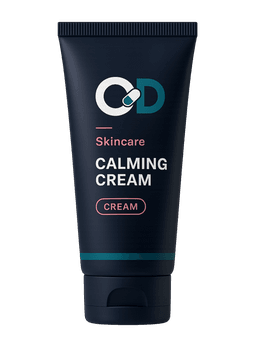
A leave-on compounded cream — Calming Cream is one neutral example in this catalog — is the kind of topical whose surface chemistry, including its pH, is part of the formulation rather than an afterthought. Referencing it here is descriptive only: nothing in this article claims that it, or any product, restores, repairs, or changes the acid mantle or the barrier. Some topical preparations available through this site are compounded — prepared by a licensed pharmacy for an individual patient rather than mass-manufactured — and compounded medications are not FDA-approved products; the statements in this guide have not been evaluated by the FDA.
How it works on OpenDoseRx
On OpenDoseRx, a licensed clinician — not the shopper — makes the medical decision. You begin by choosing a product and the strength or formulation you are interested in, so the exact preparation and its price are clear up front, and you then complete a medical intake covering your health history, current medications, and other relevant information. An independent, licensed U.S. provider reviews that intake and decides whether a prescription is appropriate for you. If it is, a licensed U.S. pharmacy prepares and ships it; if the provider declines, you are not charged for the medication and receive a full refund. This article is educational only and is not a substitute for a conversation with your own healthcare provider.
Common questions
- What is the skin's acid mantle?
- The acid mantle is the thin, slightly acidic film on the outermost surface of the skin, sitting on top of the stratum corneum. Its pH is frequently cited in the rough range of 4.5 to 5.5, more acidic than the body's near-neutral internal fluids. It is a chemical environment formed from sweat, surface lipids, and protein breakdown products, not a separate anatomical layer.
- Why is the surface of skin slightly acidic?
- Surface acidity is understood to come from several overlapping sources: lactic acid and amino acids from sweat, free fatty acids released as sebum is broken down, urocanic acid and amino acids from the breakdown of the protein filaggrin, and hydrogen ions actively pumped outward by a transporter called NHE1 in the outer living skin cells. The measured surface pH reflects the combination of these processes rather than any one of them.
- Do the skincare products discussed here require a prescription?
- Yes. Compounded topical creams such as the calming cream referenced above are prescription products. On OpenDoseRx you choose a product and complete a medical intake, which an independent, licensed U.S. provider reviews to decide whether a prescription is appropriate for you. If it is, a licensed U.S. pharmacy prepares and ships it; if the provider declines, you are not charged for the medication and receive a full refund. Compounded medications are not FDA-approved products.
Ready when you are
Calming Creamfrom $180.00
- Your exact strength
- Licensed provider review
- Full refund if declined
Browse skincare & dermatology
Exact strengths and prices up front — reviewed by a licensed U.S. provider.
Keep reading
More plain-language guides on this topic.
How tretinoin works: retinoids and skin cell turnover
A plain-language look at the biology of retinoids — how tretinoin engages retinoic-acid receptors and is understood to influence how the skin renews itself.
Copper peptides (GHK-Cu): the tripeptide-copper complex in skin
GHK-Cu is a tripeptide bound to a copper ion; this guide describes the complex and the skin-signaling roles attributed to it in the scientific literature.
How bimatoprost is understood to affect eyelash growth: the prostaglandin analog pathway
A plain-language look at how bimatoprost, a prostaglandin analog first used in glaucoma care, is understood to act on the eyelash growth cycle.
This guide is for general education and is not medical advice. Compounded medications are not FDA-approved drugs, and statements on this site have not been evaluated by the FDA. A licensed provider reviews every prescription request.