Guide
Dutasteride vs. finasteride: how the two 5-alpha-reductase inhibitors differ
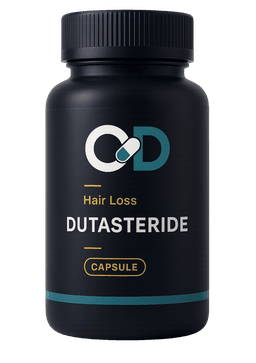 Discussed in this guideDutasteridefrom $44.99
A neutral, mechanism-focused comparison of two 5-alpha-reductase inhibitors and the enzyme isoenzymes each one is understood to act on.
On this page
Two medications that act on the same enzyme
Finasteride and dutasteride belong to a class of prescription medications called 5-alpha-reductase inhibitors, sometimes abbreviated 5-ARIs. As the class name suggests, both are designed to act on 5-alpha-reductase, the enzyme that converts testosterone into dihydrotestosterone (DHT). Because they share that target, the two are frequently discussed side by side, and the natural way to understand them is to start with what they have in common and then look at where they diverge.
The central difference between the two is not the enzyme they engage but which forms of that enzyme they engage. Human 5-alpha-reductase exists as more than one isoenzyme, and finasteride and dutasteride are understood to differ in how many of those isoenzymes they act on. Finasteride is generally described as selective for one form, while dutasteride is described as a dual inhibitor that acts on two. That single distinction — selective versus dual inhibition — is the thread this article follows.
This guide is educational only. It describes how these molecules and the enzyme they target are understood to work; it is not medical advice, a dosing guide, or a recommendation of one product over the other. Both medications are prescription-only in the United States, and whether either is appropriate for a particular person is a clinical judgment made by an independent licensed provider, not something an article can decide.
The 5-alpha-reductase enzyme and its isoenzymes
5-alpha-reductase is the enzyme that carries out the conversion of testosterone into DHT, a more potent androgen. Rather than existing as a single protein, it occurs in the body as distinct isoenzymes — closely related forms encoded by different genes. The two most often discussed in this context are type I and type II; researchers also describe a type III isoenzyme, though the classic pharmacology of finasteride and dutasteride is framed mainly around type I and type II.
The isoenzymes are understood to differ in where they are concentrated. Type I is described as present in tissues such as the sebaceous (oil) glands, sweat glands, liver, and certain cells of the skin and scalp, including keratinocytes and the dermal papilla. Type II is described as concentrated in the outer root sheaths of hair follicles, the prostate, seminal vesicles, epididymis, and genital skin, as well as the liver. Because the two forms are distributed differently across tissues, the question of which isoenzyme a medication acts on is part of what distinguishes one 5-alpha-reductase inhibitor from another.
This tissue-by-tissue picture is a description of enzyme biology, not a prediction about any individual. Local DHT is generated where these isoenzymes are active, which is one reason androgen effects can differ from tissue to tissue. How that biology applies to a specific person — and whether acting on it is appropriate — is a matter for a licensed provider who can weigh that person's history.
How finasteride is understood to act
Finasteride is a 4-azasteroid molecule — a synthetic compound structurally related to steroids — that binds 5-alpha-reductase and is understood to interfere with its ability to convert testosterone into DHT. Its defining characteristic within the class is selectivity: it is generally described as acting predominantly on the type II isoenzyme, with comparatively little effect on type I at typical concentrations. Pharmacology references often describe it as a competitive, mechanism-based inhibitor of that form of the enzyme.
In terms of pharmacokinetics, finasteride is described as having a relatively short elimination half-life, on the order of several hours in adults. Half-life refers to how long the body takes to clear roughly half of a substance and is a property of the molecule itself, separate from any question of how it is used.
Finasteride has an established regulatory history in the United States. It was first FDA-approved in 1992 as a 5 mg product for benign prostatic hyperplasia (an enlarged prostate) and later, in 1997, as a 1 mg product for male pattern hair loss (androgenetic alopecia) in men. Those approvals define the contexts in which the manufactured product has been reviewed; whether it is appropriate for a given person, and in what form, remains a clinical decision for the prescribing provider.
How dutasteride is understood to act
Dutasteride is also a 4-azasteroid molecule, and like finasteride it binds 5-alpha-reductase to interfere with the conversion of testosterone into DHT. Its defining difference is breadth of enzyme engagement: dutasteride is generally described as a dual inhibitor, understood to act on both the type I and the type II isoenzymes rather than on type II alone. Pharmacology references describe it as a potent inhibitor of both forms, sometimes characterized as a mechanism-based inhibitor.
Dutasteride is also described as having a much longer elimination half-life than finasteride — on the order of several weeks rather than hours — which means the molecule persists in the body considerably longer, with references noting that steady-state levels build over a period of months. This is a pharmacokinetic property of the compound and, again, is a separate matter from how any product is used, which is determined by a provider.
The regulatory picture for dutasteride differs from finasteride's in an important way. In the United States, dutasteride received FDA approval in 2001 as a 0.5 mg product for benign prostatic hyperplasia; it is not FDA-approved for hair loss, and use in that context is considered off-label. (Some other countries, such as South Korea and Japan, have separately approved dutasteride for androgenetic alopecia.) In addition, where a 5-alpha-reductase inhibitor is prepared by a compounding pharmacy — for example as a topical formulation — that compounded preparation is not an FDA-approved product. None of this speaks to appropriateness for any individual, which is a clinician's judgment.
How the two mechanisms differ
The most useful way to frame the contrast is by enzyme selectivity rather than by any claim of superiority. Finasteride is generally described as a selective inhibitor acting predominantly on the type II isoenzyme, while dutasteride is described as a dual inhibitor acting on both type I and type II. Both molecules belong to the same 4-azasteroid class and both target 5-alpha-reductase; they differ in how many of the enzyme's forms they are understood to engage, and in how long each persists in the body.
Whether selective or dual inhibition is appropriate for a given individual — and how the difference in half-life, regulatory status, and formulation factors in — is a clinical judgment, not a conclusion this article draws. Individual health history, other medications, and tolerability all bear on it, which is why the decision belongs to an independent licensed provider rather than to educational content. This guide describes the mechanisms; it does not recommend one over the other.
How prescription review works on OpenDoseRx
This article is educational and describes the enzyme and the mechanisms of the medications that act on it; it is not medical advice and does not recommend any product for you. On OpenDoseRx, medications in this class are prescription-only, and the process is built so that a clinician — not the shopper — makes the medical decision. You begin by choosing a product and strength, then complete a medical intake that collects your health history and other relevant information.
That intake is routed to an independent, licensed U.S. provider who reviews it and decides whether a prescription is appropriate for you — a clinical judgment, not an automatic one. If the provider determines it is appropriate, the order is sent to a licensed U.S. pharmacy to be filled and shipped to you. If the request is declined, you are not charged for the medication and you receive a full refund.
Where a product is a compounded preparation, it is not an FDA-approved drug; it is prepared by a licensed pharmacy to fill an individual prescription. Every product offered through OpenDoseRx is prescription-only and is dispensed only after that independent clinical review, and nothing here replaces a conversation with your own healthcare provider, who knows your full history and can address questions this kind of general education cannot.
Common questions
- What is the core difference between finasteride and dutasteride?
- Both are 5-alpha-reductase inhibitors that act on the enzyme converting testosterone into DHT, and both are 4-azasteroid molecules. The main difference is enzyme selectivity: finasteride is generally described as acting predominantly on the type II isoenzyme, while dutasteride is described as a dual inhibitor understood to act on both the type I and type II isoenzymes. They also differ in how long each persists in the body.
- What is 5-alpha-reductase, and what are its isoenzymes?
- 5-alpha-reductase is the enzyme that converts testosterone into dihydrotestosterone (DHT), a more potent androgen. It exists as more than one isoenzyme — most commonly discussed as type I and type II (a type III is also described) — encoded by different genes and concentrated in different tissues. Type I is described in tissues such as skin and sebaceous glands, and type II in tissues such as hair-follicle root sheaths and the prostate.
- Is dutasteride FDA-approved for hair loss?
- No. In the United States, dutasteride is FDA-approved for benign prostatic hyperplasia (an enlarged prostate); it is not FDA-approved for hair loss, and use in that context is considered off-label. Finasteride, by contrast, has an FDA-approved product for male pattern hair loss. Compounded preparations of either medication are not FDA-approved. Whether any of this is appropriate for a person is a decision for a licensed provider.
- Does dual inhibition mean dutasteride is stronger or better than finasteride?
- This article does not make that comparison. Pharmacology references note that dual inhibition is associated with a larger reduction in circulating DHT than selective type II inhibition, but that is a description of a blood-level measure of enzyme activity, not a statement about hair, about any clinical outcome, or about one product being superior. Which mechanism, if either, is appropriate for a given person is a clinical judgment for an independent licensed provider.
- Do these medications require a prescription, and how does OpenDoseRx handle that?
- Yes. Both are prescription-only in the United States. On OpenDoseRx, an independent, licensed U.S. provider reviews your medical intake and a product is dispensed by a licensed U.S. pharmacy only if the provider determines it is appropriate. If the request is declined, you receive a full refund. This is educational information, not medical advice, and nothing here replaces a conversation with your own healthcare provider.
Ready when you are
Dutasteridefrom $44.99
- Your exact strength
- Licensed provider review
- Full refund if declined
Also relevant
Exact strengths and prices up front — a licensed provider reviews every request.
Browse hair loss treatments
Exact strengths and prices up front — reviewed by a licensed U.S. provider.
Keep reading
More plain-language guides on this topic.
How finasteride and minoxidil work for hair loss
A plain-language look at the biology of pattern hair loss and how these two prescription ingredients act on different parts of the process.
DHT and the hair growth cycle explained
A neutral, mechanism-focused look at the androgen dihydrotestosterone and how it is understood to relate to the follicle's growth, transition, and rest phases.
How ketoconazole shampoo is understood to work: the antifungal mechanism on the scalp
A plain-language look at how an azole antifungal is designed to interrupt ergosterol synthesis in fungal cells, and why that mechanism is studied in the context of the scalp.
This guide is for general education and is not medical advice. Compounded medications are not FDA-approved drugs, and statements on this site have not been evaluated by the FDA. A licensed provider reviews every prescription request.