Guide
How ketoconazole shampoo is understood to work: the antifungal mechanism on the scalp
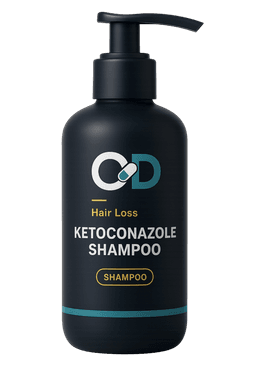 Discussed in this guideKetoconazole Shampoofrom $39.00
A plain-language look at how an azole antifungal is designed to interrupt ergosterol synthesis in fungal cells, and why that mechanism is studied in the context of the scalp.
On this page
What ketoconazole is
Ketoconazole is a synthetic antifungal medication that belongs to a class known as the azoles. It was developed by Janssen Pharmaceutica and introduced for medical use in the early 1980s, making it one of the first broadly acting azole antifungals to be used clinically. Within the azole family it is specifically an imidazole, a name that refers to the nitrogen-containing ring at the core of its molecular structure.
Over the years ketoconazole has been formulated for different routes of administration, including oral tablets historically, topical creams, and the shampoo formulations most familiar in a scalp context. This article focuses on the shampoo and on the mechanism the molecule is understood to share across its forms. It is educational only and is not medical advice or a recommendation of any particular product.
The azole class is often divided into two groups by the structure of that central ring: imidazoles, which have two nitrogen atoms and include ketoconazole and miconazole, and triazoles, which have three and include fluconazole and itraconazole. Different as these agents are, they are all built around the same core antifungal strategy, which the next sections describe.
The enzyme it is designed to act on
The mechanism attributed to azole antifungals centers on a single fungal enzyme: lanosterol 14-alpha-demethylase, part of the fungal cytochrome P450 system and often abbreviated CYP51. This enzyme carries out a step in the pathway fungi use to build ergosterol, a sterol they depend on for their cell membranes. Interrupt that step, and the pathway that supplies ergosterol stalls.
Ketoconazole is understood to bind to the iron atom at the heart of this enzyme, within its heme group, which blocks the demethylation reaction the enzyme normally performs. With that reaction interrupted, the fungal cell cannot finish assembling ergosterol, and partially built precursor sterols — described in the literature as accumulated methylated sterols — build up in its place.
The outcome described in the literature is a fungal cell membrane that lacks its normal ergosterol and is burdened with these abnormal sterols instead. Those changes are associated with altered membrane permeability and rigidity and with the inhibition of fungal growth. This disruption of ergosterol synthesis is the core action the molecule is designed around, rather than any direct effect on human cells.
Why ergosterol matters to a fungal cell
Ergosterol is frequently described as the fungal counterpart to cholesterol in human cells. It sits within the fungal cell membrane and is associated with maintaining that membrane's fluidity and structural integrity, as well as the proper function of enzymes embedded in it. A fungal cell that cannot produce enough ergosterol is, in effect, trying to operate with a compromised outer envelope.
Because ergosterol is specific to fungi and is not a building block of human cell membranes, the enzyme that makes it is generally considered a relatively selective target for a medication. Azoles are understood to bind the fungal version of this P450 enzyme far more tightly than they bind the related enzymes in human cells, which is the basis usually given for their selectivity. Selectivity is never absolute, however, which is one reason the appropriateness of any medication is a clinical judgment rather than a general rule.
At the concentrations typical of these agents, azoles such as ketoconazole are usually described as fungistatic — understood to inhibit fungal growth and reproduction rather than to destroy fungal cells outright — although higher concentrations have been described as fungicidal in some settings. This is a description of the mechanism as it has been studied, not a statement about what any specific product will do for a particular person.
Why it is studied in the scalp context
The scalp carries a normal population of microorganisms, among them a lipid-dependent yeast called Malassezia, which older literature refers to as Pityrosporum. Malassezia is a routine part of healthy skin flora, but it is studied in connection with common scalp conditions such as dandruff and seborrheic dermatitis, where its activity at the skin surface is one of the factors researchers examine.
Because Malassezia relies on the same ergosterol-based membrane biology as other fungi, it is sensitive to the mechanism described above. Ketoconazole shampoo is used and studied in the context of dandruff and seborrheic dermatitis, where the antifungal action is understood to reduce the yeast's activity on the scalp. Delivering the ingredient in a shampoo is a way to concentrate that action at the skin surface, where these organisms live, rather than throughout the body.
Ketoconazole also appears as a component in some compounded scalp and hair formulations, which is part of why it is studied more broadly in the context of hair care. This article makes no claim about any effect on hair growth or hair loss; whether an antifungal ingredient is relevant to a given person's situation is a question for a licensed provider, and the science here is described only at the level of mechanism.
Formulations, strengths, and regulatory status
In the United States, ketoconazole shampoo exists in more than one strength. A 1% shampoo is available over the counter for dandruff, while a 2% shampoo is a prescription product. The active ingredient is the same across the two; the concentration and the regulatory pathway differ, and which strength — if either — is appropriate for a person is a clinical decision rather than something to determine from a label alone.
Ketoconazole is also one of the ingredients that can appear in compounded formulations, including combination preparations made for the scalp. A compounded medication is prepared by a licensed pharmacy to fit an individual prescription and is not itself FDA-approved, even when its individual ingredients are well characterized and long studied. That distinction is worth keeping in mind when reading any product that lists ketoconazole alongside other active ingredients.
None of this is a recommendation of one strength, product, or formulation over another. The purpose here is to explain what the molecule is understood to do at a mechanistic level. Decisions about strength, formulation, and whether a product is suitable at all belong to the licensed provider who reviews an individual's information.
How it works on OpenDoseRx
On OpenDoseRx, you start by choosing the product, strength, or formulation you are interested in. You then complete a medical intake that collects your health history and other relevant information. An independent, licensed U.S. provider reviews that intake to decide whether a prescription is appropriate for you — a clinical decision, not an automatic one.
If the provider determines a prescription is appropriate, it is prepared and dispensed by a licensed U.S. pharmacy and shipped to you. If the provider decides the product is not appropriate, your order does not proceed and you receive a full refund for the medication. Where a formulation is compounded, it is prepared by a licensed pharmacy against that individual prescription and is not itself FDA-approved. Nothing here is a substitute for a conversation with your own healthcare provider.
Common questions
- How is ketoconazole understood to act on fungi?
- It is understood to inhibit a fungal enzyme called lanosterol 14-alpha-demethylase (CYP51), which fungi use to make ergosterol for their cell membranes. With that step blocked, ergosterol synthesis stalls and abnormal sterols accumulate, changes associated with inhibited fungal growth. This describes the mechanism as studied, not an outcome for any person.
- What is ergosterol, and why does it matter here?
- Ergosterol is a sterol in fungal cell membranes, often described as the fungal counterpart to cholesterol in human cells. It is associated with membrane integrity and fluidity. Because it is specific to fungi and not found in human cell membranes, the enzyme that produces it is generally considered a relatively selective target for antifungal medications.
- Why is ketoconazole studied in the context of the scalp?
- The scalp hosts a lipid-dependent yeast called Malassezia, which is studied in connection with dandruff and seborrheic dermatitis. Because Malassezia relies on the same ergosterol-based membrane biology as other fungi, it is sensitive to the mechanism described here, which is why ketoconazole shampoo is used and studied in that context.
- Is ketoconazole shampoo prescription-only?
- It depends on the strength. In the United States a 1% shampoo is available over the counter for dandruff, while a 2% shampoo is a prescription product. Ketoconazole can also appear in compounded formulations, which are prepared by a licensed pharmacy against an individual prescription and are not themselves FDA-approved. Which option, if any, is appropriate is a provider's decision.
- Does this article mean ketoconazole treats hair loss?
- No. This guide describes an antifungal mechanism at the level of how the molecule is understood to work and makes no claim about hair growth, hair loss, or any treatment outcome. Whether an ingredient is relevant to a particular person is a clinical judgment for a licensed provider, and this content is educational only, not medical advice.
Ready when you are
Ketoconazole Shampoofrom $39.00
- Your exact strength
- Licensed provider review
- Full refund if declined
Browse hair loss treatments
Exact strengths and prices up front — reviewed by a licensed U.S. provider.
Keep reading
More plain-language guides on this topic.
How finasteride and minoxidil work for hair loss
A plain-language look at the biology of pattern hair loss and how these two prescription ingredients act on different parts of the process.
DHT and the hair growth cycle explained
A neutral, mechanism-focused look at the androgen dihydrotestosterone and how it is understood to relate to the follicle's growth, transition, and rest phases.
Dutasteride vs. finasteride: how the two 5-alpha-reductase inhibitors differ
A neutral, mechanism-focused comparison of two 5-alpha-reductase inhibitors and the enzyme isoenzymes each one is understood to act on.
This guide is for general education and is not medical advice. Compounded medications are not FDA-approved drugs, and statements on this site have not been evaluated by the FDA. A licensed provider reviews every prescription request.