Guide
How finasteride and minoxidil work for hair loss
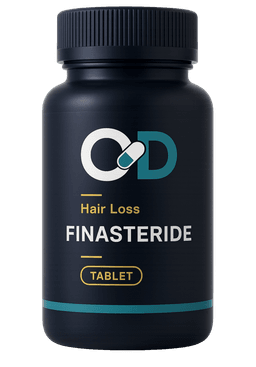 Discussed in this guideFinasteridefrom $32.00
A plain-language look at the biology of pattern hair loss and how these two prescription ingredients act on different parts of the process.
On this page
Understanding pattern hair loss
Androgenetic alopecia, commonly called male or female pattern hair loss, is a common form of progressive hair thinning. Scalp hair grows in repeating cycles of active growth, transition, and rest. A key factor studied in this condition is dihydrotestosterone (DHT), an androgen the body converts from testosterone.
In people with a genetic sensitivity, DHT binds to receptors in scalp follicles and is associated with a process called follicle miniaturization. Over successive cycles, affected follicles tend to produce finer, shorter hairs and spend less time in the active growth phase. Understanding this biology helps explain why two commonly discussed prescription ingredients, finasteride and minoxidil, act at different points in the process.
How finasteride acts on DHT
Finasteride is studied for its effect on 5-alpha-reductase, the enzyme that converts testosterone into DHT. By inhibiting this enzyme, particularly the type concentrated in hair follicles, finasteride is associated with reducing the amount of DHT the body produces.
Because DHT is central to follicle miniaturization in genetically susceptible individuals, this mechanism acts on a hormonal step upstream rather than on the follicle directly. Finasteride is prescribed only to specific populations, and a licensed provider evaluates whether this mechanism is appropriate for a given person as part of their review.
How minoxidil acts on the follicle
Minoxidil works through a different pathway. Originally developed in another therapeutic context, it was later observed to affect hair and is now studied for pattern hair loss. Minoxidil is a vasodilator, meaning it widens small blood vessels and may increase blood flow to the scalp.
It is thought to act at the level of the follicle and its surrounding environment, and it is associated with shifting follicles into and prolonging the active growth phase. Unlike finasteride, minoxidil does not act on hormones or DHT. This is why the two ingredients are often discussed together: they address different parts of the same biological picture.
Oral and topical routes
Both ingredients can be formulated for different routes of administration. Topical minoxidil is applied directly to the scalp, concentrating its action at the site, while oral minoxidil is taken systemically and reaches follicles through the bloodstream. Finasteride is most often oral, though topical formulations are also compounded to concentrate action on the scalp with less systemic exposure. Route affects how a medication is absorbed and distributed, and weighing those trade-offs is a clinical judgment a licensed provider makes based on an individual's health history.
Why compounded combinations exist
Because finasteride and minoxidil act on separate mechanisms — one on the hormonal conversion of DHT, the other on the follicle and local blood flow — they are sometimes prepared together in a single compounded formulation. Compounding is the preparation of a medication tailored to a specific prescription, which can allow multiple active ingredients or a particular strength to be delivered together, for example as one topical solution instead of two separate products. A compounded combination is dispensed only when an independent provider determines it is appropriate for the individual.
How it works on OpenDoseRx
On OpenDoseRx, you start by choosing the strength or formulation you are interested in. You then complete a medical intake that collects your health history and other relevant information. An independent, licensed U.S. provider reviews your intake to decide whether a prescription is appropriate for you — a clinical decision, not an automatic one.
If it is approved, your prescription is prepared and dispensed by a licensed U.S. pharmacy and shipped to you. If the provider determines the product is not appropriate, your order does not proceed and you receive a full refund. Every product is prescription-only, and nothing here is a substitute for a conversation with your own healthcare provider.
Common questions
- Are finasteride and minoxidil prescription products?
- Yes. On OpenDoseRx both are prescription-only and are dispensed only after an independent, licensed U.S. provider reviews your medical intake and determines that a prescription is appropriate for you.
- How does the way finasteride works differ from minoxidil?
- Finasteride is studied for its effect on 5-alpha-reductase, the enzyme that converts testosterone to DHT, while minoxidil acts on the follicle and local blood flow. They address different parts of the same process.
- Why are finasteride and minoxidil sometimes combined?
- Because they act on separate mechanisms, they are sometimes prepared together in a single compounded formulation when an independent provider determines that combination is appropriate for the individual.
Ready when you are
Finasteridefrom $32.00
- Your exact strength
- Licensed provider review
- Full refund if declined
Also relevant
Exact strengths and prices up front — a licensed provider reviews every request.
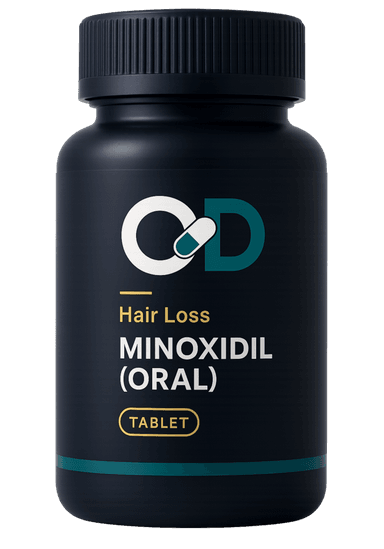
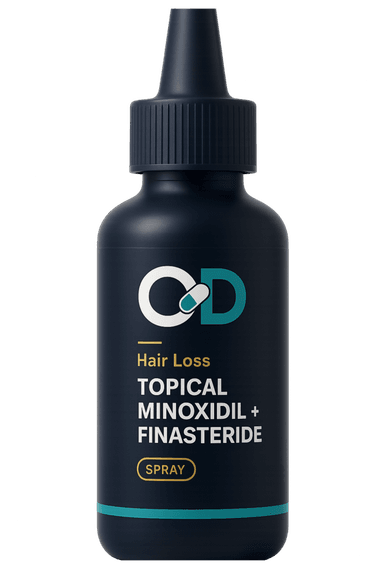
Browse hair loss treatments
Exact strengths and prices up front — reviewed by a licensed U.S. provider.
Keep reading
More plain-language guides on this topic.
DHT and the hair growth cycle explained
A neutral, mechanism-focused look at the androgen dihydrotestosterone and how it is understood to relate to the follicle's growth, transition, and rest phases.
How ketoconazole shampoo is understood to work: the antifungal mechanism on the scalp
A plain-language look at how an azole antifungal is designed to interrupt ergosterol synthesis in fungal cells, and why that mechanism is studied in the context of the scalp.
Dutasteride vs. finasteride: how the two 5-alpha-reductase inhibitors differ
A neutral, mechanism-focused comparison of two 5-alpha-reductase inhibitors and the enzyme isoenzymes each one is understood to act on.
This guide is for general education and is not medical advice. Compounded medications are not FDA-approved drugs, and statements on this site have not been evaluated by the FDA. A licensed provider reviews every prescription request.