Guide
How L-carnitine works
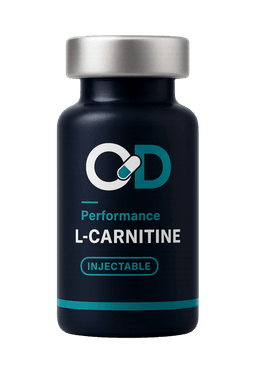 Discussed in this guideL-Carnitinefrom $35.60
A plain-language look at the carnitine shuttle — the transport system that moves long-chain fatty acids across the inner mitochondrial membrane so they can enter beta-oxidation.
On this page
What L-carnitine is
L-carnitine is a small, water-soluble compound that the body assembles from two amino acids, lysine and methionine, mainly in the liver and kidneys. It is also obtained from the diet, with red meat and dairy among the richer sources — the name itself traces to the Latin carnis, meaning flesh. Chemically it is a quaternary ammonium compound, and it is present in nearly every tissue, with the highest concentrations in skeletal and cardiac muscle. Its most studied biochemical role is as the carrier molecule at the center of what biochemists call the carnitine shuttle.
This article describes that shuttle — the transport machinery carnitine participates in — at a general, mechanistic level. It is educational only. It does not describe L-carnitine as a treatment for any condition, and it does not make claims about what taking it does for a given person. Injectable L-carnitine is a prescription-only preparation, and whether it is appropriate for anyone is a decision an independent licensed provider makes after reviewing a medical intake.
Why long-chain fatty acids need a shuttle
Fatty acids are a dense fuel molecule, and the enzymatic machinery that breaks them down — a process called beta-oxidation — sits inside the mitochondrial matrix, the innermost compartment of the mitochondrion. Before a fatty acid can be processed, it is first "activated" in the cytosol by being attached to a carrier called coenzyme A, forming a fatty acyl-CoA. The difficulty is one of geography: the inner mitochondrial membrane is essentially impermeable to long-chain fatty acyl-CoA molecules, so they cannot simply cross into the matrix on their own.
Short- and medium-chain fatty acids can diffuse across the membrane without assistance, but the long-chain fatty acids that make up most dietary and stored fat cannot. This is where carnitine enters the picture. It provides a controlled, carrier-based route across the inner membrane, and this gatekeeping step is understood to be one of the main regulated points in the entire pathway of long-chain fat breakdown.
The carnitine shuttle, step by step
The shuttle is a three-enzyme relay that swaps the fatty acid between coenzyme A and carnitine as it crosses the membrane:
- Carnitine palmitoyltransferase I (CPT1), on the outer mitochondrial membrane, transfers the fatty acyl group from CoA onto carnitine, forming acylcarnitine.
- Carnitine-acylcarnitine translocase (CACT), embedded in the inner membrane, moves the acylcarnitine into the matrix while carrying a free carnitine molecule back out in exchange.
- Carnitine palmitoyltransferase II (CPT2), on the inner face of the inner membrane, transfers the fatty acyl group from carnitine back onto a CoA molecule in the matrix, regenerating fatty acyl-CoA and releasing free carnitine.
The net effect is that a long-chain fatty acid is carried from the cytosol into the matrix, and the carnitine that ferried it is recycled to repeat the process. CPT1 is the step most associated with regulation: it is inhibited by malonyl-CoA, a molecule the body raises when it is building fat rather than breaking it down, which ties the shuttle to the cell's broader fuel-handling state.
What happens after the shuttle
Once fatty acyl-CoA is reassembled inside the matrix, it enters beta-oxidation, a repeating cycle that trims two carbons from the fatty acid at a time and releases them as acetyl-CoA. Acetyl-CoA then feeds into the citric acid cycle and the electron transport chain, the mitochondrion's main machinery for extracting chemical energy from fuel. In this sense the carnitine shuttle is a delivery step: it does not itself break down fat, but it determines whether long-chain fatty acids reach the compartment where breakdown occurs.
Carnitine has a second, related role. By moving acyl groups on and off coenzyme A, it also influences the balance between free CoA and acyl-CoA inside the mitochondrion. Because CoA is required by many reactions, this buffering function is studied as one way the cell keeps a supply of free CoA available, and carnitine is likewise involved in exporting certain shorter acyl groups out of the mitochondrion. These are descriptions of well-characterized biochemistry, not statements about what any preparation does in a particular person.
Forms and routes
Carnitine appears in more than one chemical form. Beyond L-carnitine itself, related molecules include acetyl-L-carnitine and propionyl-L-carnitine, which differ in the small acyl group attached and are studied in somewhat different tissue contexts. The D-isomer is not the biologically used form; the body's enzymes work with the L-form, which is why preparations specify L-carnitine.
Preparations are also made for different routes. Oral forms pass through the digestive tract, while injectable L-carnitine — the neutral category example referenced here — is formulated to be given by injection, bypassing intestinal absorption. Which form or route is relevant, if any, is not something an educational article decides; a compounded injectable is prescription-only, and the prescription defines how a given product is used. This guide does not provide dosing information of any kind.
How it works on OpenDoseRx
On OpenDoseRx, a licensed clinician — not the shopper — makes the medical decision. You choose a product and strength, then complete a medical intake with your health history. An independent, licensed U.S. provider reviews that intake and decides whether a prescription is appropriate for you.
If it is, a licensed U.S. pharmacy prepares and ships it; if the provider declines, you are not charged for the medication and receive a full refund. This article is educational only and is not a substitute for a conversation with your own healthcare provider.
Common questions
- What is the carnitine shuttle?
- It is the transport system that moves long-chain fatty acids from the cell's cytosol into the mitochondrial matrix, where they can undergo beta-oxidation. It relies on three enzymes — CPT1, the translocase CACT, and CPT2 — that hand the fatty acid back and forth between coenzyme A and carnitine as it crosses the inner mitochondrial membrane. L-carnitine is the carrier molecule in that relay.
- Why can't long-chain fatty acids enter mitochondria on their own?
- The inner mitochondrial membrane is essentially impermeable to long-chain fatty acyl-CoA molecules, so they cannot diffuse into the matrix where beta-oxidation takes place. Short- and medium-chain fatty acids can cross without help, but long-chain ones depend on the carnitine shuttle to carry them across. That carrier-based step is understood to be one of the main regulated points in long-chain fat breakdown.
- Does injectable L-carnitine require a prescription?
- Yes. Injectable L-carnitine is a prescription-only, compounded preparation. On OpenDoseRx you choose a product and complete a medical intake, which is reviewed by an independent, licensed U.S. provider who decides whether a prescription is appropriate for you. If it is, a licensed U.S. pharmacy prepares and ships it; if the provider declines, you are not charged for the medication and receive a full refund. This article is educational only and does not make claims about outcomes.
Ready when you are
L-Carnitinefrom $35.60
- Your exact strength
- Licensed provider review
- Full refund if declined
Browse performance & vitality
Exact strengths and prices up front — reviewed by a licensed U.S. provider.
Keep reading
More plain-language guides on this topic.
How testosterone works in the body: the androgen pathway
A plain-language look at testosterone as an androgen and how androgen-receptor signaling is understood to act on tissues across the body.
How enclomiphene is understood to act on the HPG axis
An educational overview of how enclomiphene is understood to interact with the hypothalamic-pituitary-gonadal axis through estrogen-receptor modulation.
How aromatase inhibitors are understood to work in estrogen management
A neutral, mechanism-focused look at the aromatase enzyme and how the medications known as aromatase inhibitors are understood to act on it.
This guide is for general education and is not medical advice. Compounded medications are not FDA-approved drugs, and statements on this site have not been evaluated by the FDA. A licensed provider reviews every prescription request.