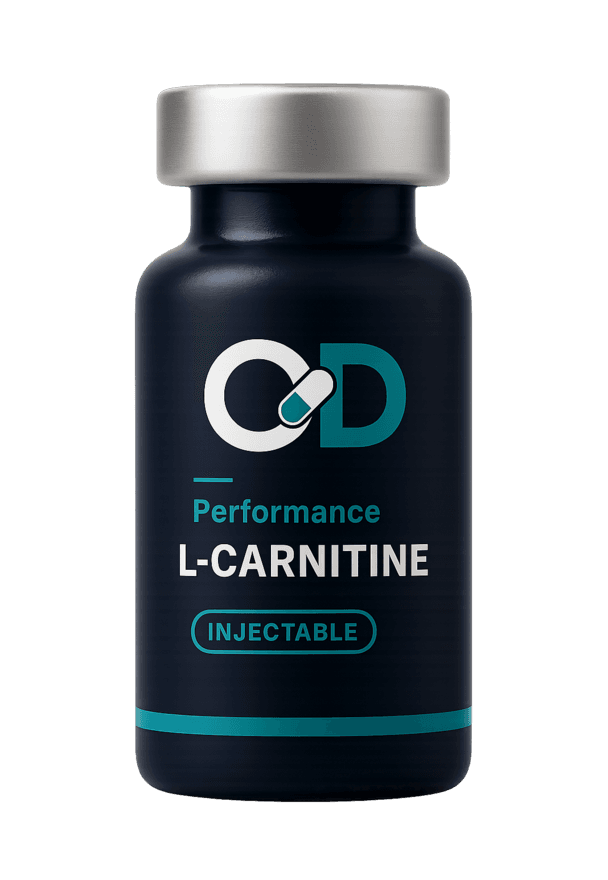
L-Carnitine
Injectable 500 mg/mL — 30 mL
Injectable L-Carnitine delivers the compound your body uses to move fat into cells for energy. A supportive therapy for training and body composition goals.
Rx only — requires provider review
Save $10.00
Included in this price
- Provider review of your intake
- Licensed U.S. pharmacy fulfillment
- No membership or visit fees — ever
- Support from a real person
5 mL · $35.6050 mL · $148.33
Purchase option
- A licensed U.S. provider reviews your intake before anything ships.
- No charge if a provider declines — refunded in full.
- Filled by a licensed U.S. pharmacy.
- Typically ships within 1–2 business days of approval, then 3–5 business days in transit — shipping details.
- Free shipping on orders $200+.
L-Carnitine · 30 mL
$99.00$89.00
Not available in CA, MS, AR, IN, MN, SC — checkout enforces state eligibility.
The science
About L-Carnitine
L-Carnitine is a naturally occurring compound your body uses to shuttle fatty acids into mitochondria, where they're burned for energy. The injectable form delivers it directly into circulation, bypassing the digestive absorption limits of oral supplements.
It's typically used by people pursuing body composition, training, and energy goals — often alongside a structured exercise and nutrition plan — and by those on medically supervised weight management programs looking to support fat metabolism. It's a supportive therapy, not a substitute for the fundamentals.
OpenDoseRx treatments are dispensed only after a licensed provider reviews your health intake and determines a prescription is appropriate for you.
How ordering works
From your dose to your door
- 1
Choose your strength
Pick the exact dose and pack size. You see the price before you commit — nothing is hidden until checkout.
- 2
A provider reviews your intake
Complete a short medical intake. An independent, licensed U.S. provider decides if it's appropriate — and if they decline, you're refunded in full.
- 3
Compounded and shipped
Approved orders are prepared by a licensed U.S. pharmacy — typically shipped within 1–2 business days of approval, then 3–5 business days in transit to your door.
Common questions
Your questions, answered
Pairs well with
Related treatments
Keep learning
Related guides
How the body stores and burns fat: lipogenesis and lipolysis
A plain-language look at the two opposing processes the body is understood to use to store energy as fat and release it again, and the hormones that tip the balance between them.
Brown fat and thermogenesis: how the body generates heat
A plain-language look at how brown adipose tissue and the UCP1 protein are understood to turn stored fuel into body heat, distinct from white fat's storage role.
How mitochondria produce energy: the Krebs cycle and electron transport chain
A plain-language, mechanism-focused look at how mitochondria turn the food we eat into ATP, the chemical energy that powers the cell.