Guide
How mitochondria produce energy: the Krebs cycle and electron transport chain
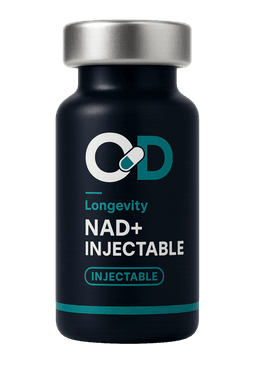 Discussed in this guideNAD+ Injectablefrom $87.60
A plain-language, mechanism-focused look at how mitochondria turn the food we eat into ATP, the chemical energy that powers the cell.
On this page
- Mitochondria: the cell's power plants
- From food to fuel: getting nutrients into the mitochondria
- The Krebs cycle: harvesting electrons from fuel
- The electron transport chain and how ATP is made
- The redox carriers that connect the pathway
- Educational only: how provider review works on OpenDoseRx
- Common questions
Mitochondria: the cell's power plants
Mitochondria are small compartments, called organelles, found inside almost every cell in the body. They are often described as the cell's power plants because they carry out the final and most productive steps of turning nutrients into usable energy. A single cell may hold anywhere from a handful to many thousands of mitochondria, and tissues with high energy demands — such as heart muscle, skeletal muscle, and the brain — tend to be especially rich in them.
Structurally, a mitochondrion has two membranes. The smooth outer membrane surrounds the organelle, while the inner membrane is deeply folded into ridges called cristae, which greatly increase its surface area. The space enclosed by the inner membrane is the matrix. This architecture matters because different stages of energy production are physically located in different places: some reactions run in the matrix, while others are built into the highly folded inner membrane. Mitochondria also carry a small amount of their own DNA, separate from the DNA in the cell's nucleus.
The molecule that all of this activity is organized around is ATP, short for adenosine triphosphate. ATP is frequently called the cell's energy currency because cells spend it to power nearly everything they do — contracting muscle fibers, pumping ions across membranes, transmitting nerve signals, and building new molecules. When ATP releases energy, it becomes ADP (adenosine diphosphate), and the mitochondria's job is to recharge ADP back into ATP over and over. This article describes that biology at a general level. It is educational only, is not medical advice, and does not describe any product as a treatment for any condition.
From food to fuel: getting nutrients into the mitochondria
Before the mitochondria can extract most of the energy from food, the food has to be broken down into simpler pieces. For carbohydrates, the first step happens outside the mitochondria, in the fluid of the cell called the cytosol, through a pathway called glycolysis. Glycolysis splits a molecule of glucose into two smaller molecules of pyruvate, producing a small amount of ATP and loading electrons onto a carrier molecule called NAD+ (turning it into NADH) along the way. The pyruvate is then transported into the mitochondrial matrix, where an enzyme complex converts it into a two-carbon molecule called acetyl-CoA, releasing carbon dioxide and generating more NADH in the process.
Fats are handled differently but arrive at the same destination. Fatty acids are broken down inside the matrix by a process called beta-oxidation, which chops them into two-carbon units of acetyl-CoA while also loading electrons onto the carriers NAD+ and FAD. Longer fatty acids cannot cross the inner mitochondrial membrane on their own, so cells use a molecular ferry known as the carnitine shuttle, in which the compound carnitine helps carry fatty acids into the matrix where beta-oxidation takes place. This is the mechanistic reason carnitine is studied in the context of fatty-acid metabolism.
Protein can also contribute: amino acids left over from protein breakdown can be converted into pyruvate, acetyl-CoA, or other intermediates that feed the same machinery. The important idea is that carbohydrates, fats, and proteins all funnel toward a common currency — acetyl-CoA — which is the two-carbon fuel that the next stage, the Krebs cycle, is built to accept.
The Krebs cycle: harvesting electrons from fuel
The Krebs cycle, also known as the citric acid cycle or the tricarboxylic acid (TCA) cycle, takes place in the mitochondrial matrix. It begins when a molecule of acetyl-CoA (two carbons) combines with a four-carbon molecule called oxaloacetate to form a six-carbon molecule called citrate — the citric acid that gives the cycle one of its names. From there, a series of about eight enzyme-catalyzed reactions gradually rearranges and breaks down the molecule.
As the cycle turns, it releases two molecules of carbon dioxide — the same carbon dioxide that is eventually carried to the lungs and exhaled — and it regenerates oxaloacetate at the end so the cycle can begin again with the next acetyl-CoA. Each full turn also produces a small amount of direct chemical energy in the form of one molecule of GTP or ATP. On its own, that direct yield is modest.
The cycle's most important output is not that small amount of ATP but the electrons it captures. With each turn, the Krebs cycle loads high-energy electrons onto the carrier molecules NAD+ and FAD, converting them into NADH and FADH2 — typically three NADH and one FADH2 per turn. These loaded carriers act like shuttles, ferrying electrons stripped from food over to the inner mitochondrial membrane. In this sense, the Krebs cycle is best understood as an electron-harvesting hub: its main purpose is to strip electrons from fuel and hand them to the machinery that does the heavy lifting of ATP production.
The electron transport chain and how ATP is made
The final and most productive stage is built into the folded inner mitochondrial membrane, in a set of proteins collectively called the electron transport chain. This chain is usually described as four large complexes, numbered I through IV. NADH delivers its electrons to Complex I, and FADH2 delivers its electrons to Complex II. From there, the electrons are handed step by step down the chain, ferried between complexes by two mobile carriers — a fat-soluble molecule called ubiquinone (also known as coenzyme Q10) and a small protein called cytochrome c.
As electrons move down the chain, they release energy in a controlled, stepwise fashion. Three of the complexes (I, III, and IV) use that energy to pump protons — hydrogen ions — out of the matrix and into the narrow space between the inner and outer membranes. This builds up a difference in proton concentration and electrical charge across the inner membrane, a stored form of energy often called the proton-motive force. A useful mental picture is water held back behind a dam: the gradient represents potential energy waiting to be released.
That stored energy is cashed in by a remarkable enzyme called ATP synthase, sometimes labeled Complex V. Protons flow back into the matrix through a channel in ATP synthase, and this flow spins part of the enzyme like a turbine. The mechanical motion drives the chemical reaction that attaches a phosphate group to ADP, producing ATP. This coupling of proton flow to ATP production is called chemiosmosis, and the overall process of making ATP this way is known as oxidative phosphorylation.
Oxygen is what keeps the whole chain moving. At the end of the line, Complex IV hands the spent electrons to oxygen, which combines with protons to form water. Oxygen is described as the final electron acceptor, and this is a core reason humans need to breathe: without oxygen to receive the electrons, the chain backs up and ATP production through this route slows dramatically. Because this aerobic pathway extracts so much more from each fuel molecule, it is understood to yield roughly thirty or more ATP per molecule of glucose, compared with only a couple from glycolysis alone.
The redox carriers that connect the pathway
Running through every stage of this story is a theme of moving electrons, and a few carrier molecules make that movement possible. The most central is NAD+, which alternates between an oxidized form (NAD+) that can pick up electrons and a reduced form (NADH) that carries them. NAD+ collects electrons during glycolysis, the conversion of pyruvate, and the Krebs cycle, then delivers them to Complex I of the electron transport chain. For the pathway to keep running, the cell must continuously regenerate NAD+ from NADH, which is one reason NAD+ is described as a hub of energy metabolism. NAD+ and its precursors are studied by researchers interested in metabolism and aging; NAD+ preparations, including compounded forms, are not FDA-approved drugs, and statements about them have not been evaluated by the FDA.
Other carriers are built directly into the transport chain itself. Coenzyme Q10 (ubiquinone) and cytochrome c are the mobile shuttles that pass electrons between the large complexes. Methylene blue is another redox-active molecule that laboratory research describes as able to cycle between an oxidized and a reduced form; because of that chemistry, it is studied in the context of the mitochondrial electron transport chain, where researchers have described it interacting with electron flow. Describing this laboratory biology is not a claim that methylene blue, NAD+, carnitine, or any other compound improves energy or changes mitochondrial function in a given person.
Taken together, these molecules illustrate that mitochondrial energy production is fundamentally an electron-handling operation: fuel is broken down, electrons are stripped off and loaded onto carriers, and those electrons are marched down a chain whose ultimate purpose is to build a proton gradient and turn ATP synthase. Some of the molecules involved have drawn scientific attention in the study of metabolism and longevity, but the presence of a molecule in a pathway is a description of biology, not evidence of an effect, and compounded preparations are not FDA-approved products.
Educational only: how provider review works on OpenDoseRx
This article is educational and is intended to explain how a well-studied biological pathway is understood to work. It is not medical advice, it does not diagnose or treat any condition, and it does not recommend any product. Any decision about whether a particular product is appropriate is a clinical judgment that belongs to a licensed provider, not to a website or an article, and nothing here replaces a conversation with your own healthcare provider.
OpenDoseRx is built so that a licensed clinician makes any medical decision. You begin by choosing a product and the specific strength or option you are interested in, then complete a structured medical intake covering your health history, current medications, and other relevant information. That intake is routed to an independent, licensed U.S. provider who reviews it and decides whether a prescription is appropriate for you. If the provider determines it is, the order is sent to a licensed U.S. pharmacy that fills and ships it; if the provider declines, the order does not proceed, and you are not charged for the medication.
Common questions
- Where in the cell do the Krebs cycle and electron transport chain take place?
- Both occur inside the mitochondria. The Krebs cycle runs in the mitochondrial matrix, the fluid-filled space enclosed by the inner membrane. The electron transport chain is built into the inner mitochondrial membrane itself, which is folded into ridges called cristae to increase its surface area. An earlier step, glycolysis, happens outside the mitochondria in the cell's cytosol.
- What is ATP, and why is it called the cell's energy currency?
- ATP, or adenosine triphosphate, is the molecule cells use to store and spend energy for tasks like muscle contraction, nerve signaling, and building new molecules. It is called an energy currency because cells continuously spend it — turning it into ADP — and then recharge ADP back into ATP. The mitochondria's main job is running the reactions that regenerate ATP from ADP.
- Why do mitochondria need oxygen to make energy efficiently?
- Oxygen serves as the final electron acceptor at the end of the electron transport chain. After electrons are passed down the chain, Complex IV hands them to oxygen, which combines with protons to form water. Without oxygen to receive the spent electrons, the chain backs up and this high-yield route to ATP slows dramatically, which is a core reason the body needs a steady oxygen supply.
- What role does NAD+ play in how mitochondria produce energy?
- NAD+ is an electron-carrier coenzyme. It picks up high-energy electrons during glycolysis, the conversion of pyruvate, and the Krebs cycle — becoming NADH — and then delivers those electrons to Complex I of the electron transport chain. The cell must continually regenerate NAD+ for the pathway to keep running. NAD+ is studied in the context of metabolism and aging, and this is an educational description, not a claim about any product.
Ready when you are
NAD+ Injectablefrom $87.60
- Your exact strength
- Licensed provider review
- Full refund if declined
Also relevant
Exact strengths and prices up front — a licensed provider reviews every request.
Browse longevity & healthy aging
Exact strengths and prices up front — reviewed by a licensed U.S. provider.
Keep reading
More plain-language guides on this topic.
NAD+ precursors: what NMN and NR are and how they work
A mechanism-focused look at NAD+ as a cellular coenzyme and how the precursors NMN and NR feed the salvage pathway that regenerates it.
How rapamycin (sirolimus) is understood to act on the mTOR pathway
A mechanism-focused overview of rapamycin (sirolimus), the mTOR signaling pathway, and why mTORC1 and autophagy are areas of research interest.
NAD+ injectable vs. sublingual: how the delivery routes differ
A neutral, mechanism-focused look at how injecting NAD+ and absorbing it under the tongue differ in how the coenzyme travels from the point of administration into the bloodstream.
This guide is for general education and is not medical advice. Compounded medications are not FDA-approved drugs, and statements on this site have not been evaluated by the FDA. A licensed provider reviews every prescription request.