Guide
NAD+ injectable vs. sublingual: how the delivery routes differ
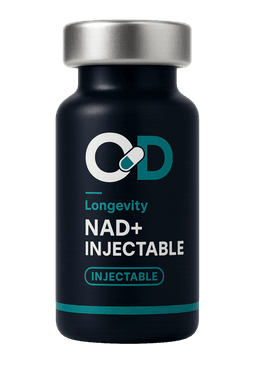 Discussed in this guideNAD+ Injectablefrom $87.60
A neutral, mechanism-focused look at how injecting NAD+ and absorbing it under the tongue differ in how the coenzyme travels from the point of administration into the bloodstream.
On this page
Two delivery routes, one molecule
NAD+, short for nicotinamide adenine dinucleotide, is a coenzyme found in every living cell, where it participates in energy metabolism and serves as a substrate that certain enzymes consume. When NAD+ itself is prepared as a product, it can be administered by more than one route — among them injection and sublingual, meaning under the tongue. Changing the route does not change what the molecule is; it changes how that molecule travels from the point of administration toward the bloodstream.
This article is about delivering NAD+ itself, which is a separate topic from the NAD+ precursors NMN and NR covered elsewhere in this hub. Precursors are building blocks the body converts into NAD+ through the salvage pathway; here the subject is the coenzyme as the administered substance and the two routes used to introduce it. The focus is on absorption — how much of an administered amount is understood to reach circulation, and by what path — rather than on any effect in the body.
NAD+ is not an FDA-approved drug for these uses, and preparations offered through compounding pharmacies are not FDA-approved products. This article is educational only, is not medical advice, and does not recommend one route over another. Whether any preparation or route is appropriate for a given person is a clinical decision for an independent licensed provider, informed by that person's health history rather than by a general explainer.
Why NAD+ is a difficult molecule to deliver
NAD+ is a dinucleotide: two nucleotide units joined through a pyrophosphate linkage. In chemical terms it is a relatively large, water-soluble molecule that carries electrical charge, and molecules with those properties do not cross biological membranes easily. The lining of the digestive tract is comparatively selective, tending to admit small, fat-soluble molecules more readily than large, water-loving ones, so a molecule like NAD+ faces a real barrier at the gut wall.
The molecule is also chemically fragile. In evaluating NAD+ for pharmacy compounding, U.S. regulators described it as a reactive substance whose pyrophosphate bond is susceptible to breakdown with heat, changes in acidity, and exposure to light. A molecule swallowed and carried through the stomach and intestine encounters acid and digestive enzymes that can break it apart before it is absorbed, much as they would break down the components of food.
These two features — limited membrane permeability and chemical fragility — are why the route of administration matters for NAD+, and why simply swallowing it is generally understood to be an inefficient way to deliver the intact coenzyme. Every delivery route is, in effect, an attempt to get the molecule into the bloodstream while limiting how much is degraded or lost along the way. Injectable and sublingual delivery approach that problem differently, which is the distinction the rest of this article describes.
How injectable NAD+ reaches circulation
Injectable delivery places NAD+ past the digestive tract entirely. Depending on the preparation, an injection may be given:
- Under the skin (subcutaneous)
- Into muscle (intramuscular)
- Into a vein (intravenous, the form often associated with clinic-administered infusions)
In each case the molecule does not travel through the stomach and intestine, so it avoids the acid and enzymes that would otherwise degrade it and does not have to cross the selective intestinal lining.
Substances absorbed from the gut normally pass through the liver before reaching general circulation — a step known as first-pass metabolism that can reduce how much of an administered substance remains active. Injected NAD+ enters the systemic circulation without that initial pass through the liver. Intravenous administration places the molecule directly into the bloodstream, so essentially the full administered amount is in circulation; subcutaneous and intramuscular injections deposit it into tissue, from which it is absorbed more gradually through small blood and lymphatic vessels. For these reasons injection is generally understood to deliver a large and relatively predictable fraction of what is administered into the blood.
The trade-off is the administration itself: injection involves a needle, and intravenous infusions in particular are typically performed in a clinical setting over a period of time. Whether an injectable route suits a particular person, and in what form, is part of what an independent licensed provider evaluates, and the prescription defines how any product is to be used.
How sublingual NAD+ is absorbed
Sublingual delivery places NAD+ under the tongue, where the tissue is thin and richly supplied with small blood vessels. The intent is for the molecule to diffuse across that mucous membrane and enter the network of veins beneath it, rather than being swallowed and digested. Buccal delivery, held against the inside of the cheek, works on the same general principle.
The veins draining the floor of the mouth empty into the body's systemic venous return rather than into the portal vein that carries blood from the gut to the liver. A substance absorbed this way is understood to reach the general circulation without first passing through the liver — the same principle behind long-established sublingual medications such as nitroglycerin. In that respect, sublingual delivery is designed to sidestep both the digestive breakdown and the first-pass metabolism that face a swallowed molecule.
How completely NAD+ takes that path is less straightforward. Sublingual absorption tends to be most efficient for small, fat-soluble molecules, and NAD+ is a large, charged one, so it is understood to cross the oral mucosa less readily than the drugs most often given this way. In practice, some portion of a sublingual dose is also swallowed and then subject to the same digestion and first-pass metabolism as any oral form. Sublingual delivery is therefore generally described as an approach designed to improve on swallowing, rather than one understood to match the exposure achieved by injection.
Bioavailability and what reaching the blood does not settle
Bioavailability describes the fraction of an administered amount that reaches the bloodstream in usable form. Comparing routes for NAD+ on this measure, injection — and intravenous injection most of all — is generally understood to place a higher and more predictable fraction into circulation than sublingual delivery, because it bypasses both the mucosal barrier a sublingual dose must cross and the digestion a swallowed portion meets. Published figures for sublingual NAD+ vary widely between sources and formulations, which is itself a reason to treat any single number with caution.
Because the routes deliver different proportions of what is administered, the amount of NAD+ in an injectable preparation and in a sublingual one is not directly comparable, and a strength set for one route cannot simply be converted to the other. This is one reason route and strength are decided together by a prescriber rather than translated between forms, and it is a clinical judgment rather than something to determine from a product page.
Reaching the bloodstream is also only part of the biological question. How cells take up NAD+ from outside is an active area of research: several studies suggest that extracellular NAD+ is largely broken down by enzymes on the cell surface into smaller intermediates — including precursors and nicotinamide that feed the salvage pathway — rather than being imported whole. Describing how a route delivers NAD+ into circulation is therefore not the same as claiming what happens to it afterward, a distinction this article does not attempt to resolve. It is also worth stating plainly that NAD+ is not an FDA-approved drug for these uses and that compounded NAD+ preparations, by whatever route, are not FDA-approved products — neutral facts an independent provider can explain during review.
How prescription review works on OpenDoseRx
On OpenDoseRx, the process is built so that a clinician — not the shopper — makes the medical decision. You begin by choosing a product and strength, including the route you are interested in, then complete a structured medical intake covering your health history, current medications, and other relevant information.
That intake is routed to an independent, licensed U.S. provider who reviews it and decides whether a prescription is appropriate for you. If the provider determines it is, the prescription is sent to a licensed U.S. pharmacy for fulfillment and shipped to you. If the request is declined, you are not charged for the medication and receive a full refund. Every product is prescription-only and is dispensed only after that independent clinical review, and nothing here replaces a conversation with your own healthcare provider.
Common questions
- What is the main difference between injectable and sublingual NAD+?
- The difference is the path the molecule takes to the bloodstream, not the molecule itself. Injectable delivery places NAD+ past the digestive tract — under the skin, into muscle, or into a vein — while sublingual delivery relies on absorption across the thin, vascular tissue under the tongue. Each route is a different way of trying to limit how much of the coenzyme is degraded or lost before it reaches circulation.
- Why isn't NAD+ simply swallowed as a standard pill?
- NAD+ is a large, water-soluble, charged molecule, and it is also chemically fragile. Swallowed and carried through the stomach and intestine, it meets acid and digestive enzymes that can break it apart, and its size and charge make it slow to cross the selective intestinal lining. Those properties are why other routes are used to introduce the intact coenzyme, though how much any route delivers is a scientific question that continues to be studied.
- Does sublingual delivery bypass first-pass metabolism?
- In principle, substances absorbed under the tongue drain into the systemic circulation rather than through the liver first, so sublingual delivery is designed to bypass much of the first-pass metabolism a swallowed dose undergoes — the same principle behind sublingual nitroglycerin. In practice, NAD+ is a large, charged molecule that is understood to cross the oral mucosa less readily than the small molecules usually given this way, and any portion that is swallowed remains subject to digestion and first-pass metabolism. It is best described as an approach designed to reduce those losses, not eliminate them.
- Are injectable and sublingual NAD+ strengths interchangeable?
- No. Because the two routes deliver different proportions of an administered amount into circulation, a strength set for one route is not directly comparable to the other and cannot simply be converted between forms. Route and strength are decided together by a prescribing provider based on the individual, not translated from one form to another.
- Is NAD+ an FDA-approved medication?
- NAD+ is not an FDA-approved drug for these uses, and NAD+ preparations made by compounding pharmacies — injectable or sublingual — are not FDA-approved products. On OpenDoseRx, every product is prescription-only: you complete a medical intake, an independent licensed U.S. provider reviews it, and a licensed U.S. pharmacy fulfills the order only if the provider determines it is appropriate. If the provider declines, you are not charged and receive a full refund.
Ready when you are
NAD+ Injectablefrom $87.60
- Your exact strength
- Licensed provider review
- Full refund if declined
Also relevant
Exact strengths and prices up front — a licensed provider reviews every request.
Browse longevity & healthy aging
Exact strengths and prices up front — reviewed by a licensed U.S. provider.
Keep reading
More plain-language guides on this topic.
NAD+ precursors: what NMN and NR are and how they work
A mechanism-focused look at NAD+ as a cellular coenzyme and how the precursors NMN and NR feed the salvage pathway that regenerates it.
How rapamycin (sirolimus) is understood to act on the mTOR pathway
A mechanism-focused overview of rapamycin (sirolimus), the mTOR signaling pathway, and why mTORC1 and autophagy are areas of research interest.
What glutathione is: the antioxidant tripeptide and its delivery forms
A mechanism-focused look at glutathione — the tripeptide built from glutamate, cysteine, and glycine — and how its reactive thiol, redox cycle, and delivery forms are understood to work.
This guide is for general education and is not medical advice. Compounded medications are not FDA-approved drugs, and statements on this site have not been evaluated by the FDA. A licensed provider reviews every prescription request.