Guide
What glutathione is: the antioxidant tripeptide and its delivery forms
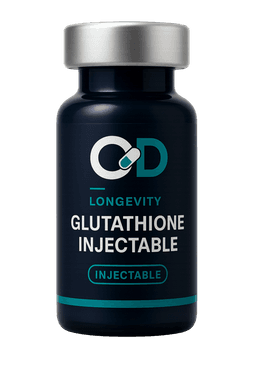 Discussed in this guideGlutathione Injectablefrom $51.60
A mechanism-focused look at glutathione — the tripeptide built from glutamate, cysteine, and glycine — and how its reactive thiol, redox cycle, and delivery forms are understood to work.
On this page
What glutathione is
Glutathione, often abbreviated GSH, is a small molecule found in virtually every cell in the body. It is a tripeptide — a chain of three amino acids — assembled from glutamate (glutamic acid), cysteine, and glycine. Chemically it is written as L-gamma-glutamyl-L-cysteinyl-glycine, a name that captures both its components and one unusual feature of how they are joined. Glutathione is generally described as the most abundant non-protein thiol inside cells, where it is present at relatively high (millimolar) concentrations, which is part of why it is studied so heavily in cellular biochemistry.
What sets glutathione apart from an ordinary peptide is the bond between its first two amino acids. Most peptide bonds form between the standard (alpha) carboxyl group of one amino acid and the amino group of the next. In glutathione, glutamate is instead linked to cysteine through its side-chain (gamma) carboxyl group — a gamma peptide bond. This gamma linkage is understood to make the molecule resistant to the ordinary peptidase enzymes that would otherwise clip a normal peptide apart, which is one reason the intact tripeptide can persist inside cells.
The functional heart of the molecule is the cysteine residue, which carries a reactive sulfur-containing group called a thiol (or sulfhydryl, written as -SH). Much of the chemistry glutathione is known for traces back to this single thiol group. This article describes that structure and the biochemistry around it at a general level. It is educational only, is not medical advice, and does not describe glutathione as a treatment for any condition or predict any result in a given person.
The reactive thiol and two forms of glutathione
Because the cysteine thiol is chemically reactive, glutathione exists in two interconverting forms. In its reduced form (GSH), the thiol is intact and available to react. When two GSH molecules react together, their thiol groups join to form a sulfur-to-sulfur (disulfide) bond, producing a single oxidized molecule called glutathione disulfide (GSSG). This reaction is reversible, so the two forms can cycle back and forth.
The pairing of GSH and GSSG is often described as a redox couple — a system that can either give up or accept electrons depending on conditions. Under normal circumstances, cells are understood to keep the great majority of their glutathione in the reduced GSH form, with only a small fraction present as GSSG; the ratio between the two is frequently cited as roughly 100 to 1. Because that balance shifts when a cell is under oxidative stress, the GSH-to-GSSG ratio is often used by researchers as an indicator of a cell's overall redox state.
This is the context in which glutathione is described as an antioxidant. The reduced thiol can react with reactive oxygen species and other oxidizing molecules, and in doing so it is understood to help buffer the cell's redox environment while itself becoming oxidized to GSSG. Describing this chemistry is not the same as claiming that any particular product raises glutathione, reduces oxidative stress, or produces a health outcome in a person — those are separate questions this article does not address.
The glutathione redox cycle
Glutathione does not work in isolation; it operates within a cycle run by dedicated enzymes. A family of enzymes called glutathione peroxidases (GPx) is understood to use GSH to reduce hydrogen peroxide and related peroxides to water, and in the process the GSH is oxidized to GSSG. This is one of the well-studied routes by which cells are understood to handle peroxides.
For the system to keep working, the oxidized GSSG must be converted back to GSH. That regeneration is carried out by the enzyme glutathione reductase, which uses NADPH — a reducing molecule supplied largely by the pentose phosphate pathway — to restore two GSH molecules from each GSSG. A peroxidase consuming GSH on one side and a reductase regenerating it on the other together form what is generally called the glutathione redox cycle, a continuous loop that draws on the cell's NADPH supply.
The reactive thiol also participates in chemistry beyond peroxide handling. Enzymes called glutathione S-transferases (GSTs) catalyze the joining, or conjugation, of glutathione to certain electrophilic compounds — a described enzymatic step in how cells process a range of internal and foreign substances. Separately, glutathione can be reversibly attached to specific cysteine residues on proteins, a modification known as glutathionylation that researchers study as a form of redox signaling. These are descriptions of enzymatic and chemical processes at the molecular level, not claims that any product cleanses, detoxifies, or otherwise changes a person's body.
How cells make and recycle glutathione
Cells build glutathione from scratch in two energy-requiring (ATP-dependent) steps. In the first step, the enzyme glutamate-cysteine ligase (GCL, also called gamma-glutamylcysteine synthetase) joins glutamate and cysteine to form the intermediate gamma-glutamylcysteine — creating that distinctive gamma bond. This step is generally described as the rate-limiting one, meaning it sets the pace for the whole pathway. In the second step, the enzyme glutathione synthetase adds glycine to complete the tripeptide.
Two factors are commonly described as the main controls on how much glutathione a cell can make. One is the activity of that rate-limiting GCL enzyme, which is understood to be held in check by feedback inhibition from glutathione itself — as levels rise, synthesis is dampened. The other is the availability of cysteine, the sulfur-containing amino acid, which is frequently described as the limiting building block because it is generally the scarcest of the three ingredients. This is why cysteine supply is a recurring theme in research on glutathione levels.
Cells also recycle. An enzyme on the outer surface of certain cells, gamma-glutamyl transpeptidase (GGT), is understood to break down glutathione and glutathione conjugates that are outside the cell, freeing their component amino acids — including cysteine — to be taken back up and reused for new synthesis. This series of breakdown-and-rebuild steps is often referred to as the gamma-glutamyl cycle. Describing these pathways explains how the molecule is made and turned over; it does not establish what any particular intake or preparation does in a specific person, which remains a separate question.
Delivery forms: oral, liposomal, and injectable
Because glutathione is a peptide, getting an intact dose of it into the body is a genuine formulation challenge, and this is the practical reason several delivery forms exist. Taken by mouth, glutathione is understood to have low systemic bioavailability: much of it is broken down in the digestive tract by peptidase enzymes and by the same gamma-glutamyltransferase activity described above, so relatively little of the intact tripeptide is thought to reach the bloodstream unchanged. Standard oral glutathione is marketed in the United States as a dietary supplement rather than as an approved drug.
Several approaches aim to work around that breakdown. Liposomal formulations, in which the molecule is encased in tiny phospholipid spheres, are studied as a way to shield glutathione from enzymatic degradation on its way through the gut. A different approach is parenteral administration — injectable or intravenous glutathione — which bypasses the digestive tract altogether and is the form relevant to the injectable product this guide accompanies. The route by which a medication is delivered affects how it is absorbed and distributed, and weighing those trade-offs for a given person is a clinical judgment that belongs to a licensed provider.
It is important to be clear about regulatory status. Injectable glutathione is prepared as a compounded medication, and compounded medications are not FDA-approved drugs; the FDA has not approved injectable glutathione for any indication, and statements about compounded preparations have not been evaluated by the FDA. The FDA has additionally cautioned about compounded injectable glutathione, particularly products marketed for cosmetic skin-lightening. This guide describes the delivery forms neutrally and makes no claim that any of them is effective or appropriate; whether an injectable preparation is suitable for an individual is a decision for an independent licensed provider, and no dosing guidance is offered here because dosing is set by the prescriber.
How prescription review works on OpenDoseRx
OpenDoseRx is an educational catalog and request platform, not a prescriber. The process begins when you choose a product and the specific strength or option you are interested in and complete a structured medical intake — a set of questions about your health history, current medications, and other relevant information. Submitting the intake is a request for review; it is not an order that is filled automatically, and it does not by itself result in a prescription.
That request and intake are routed to an independent, licensed U.S. provider, who applies their own clinical judgment about whether a prescription is appropriate for you. If the provider approves an order, it is filled by a licensed U.S. pharmacy and shipped to you. If the provider declines, the order does not proceed and you are not charged for the medication — you receive a full refund. Any dosing, if a prescription is written, is determined by that prescribing provider, not by OpenDoseRx and not by the patient.
This review does not replace your own healthcare provider or an ongoing clinical relationship. It is one supervised pathway for requesting a product, and it remains educational in nature — it is not medical advice, and the compounded medications discussed here are not FDA-approved drugs. You are encouraged to share any decisions with the provider who manages your overall care.
Common questions
- What three amino acids make up glutathione?
- Glutathione is a tripeptide built from glutamate (glutamic acid), cysteine, and glycine. Glutamate and cysteine are joined by an unusual gamma peptide bond, and the cysteine residue carries the reactive thiol (-SH) group that is central to the molecule's chemistry. This description is educational only and is not medical advice.
- What is the difference between GSH and GSSG?
- GSH is the reduced form of glutathione, in which the cysteine thiol is intact and reactive. GSSG (glutathione disulfide) is the oxidized form, made when two GSH molecules join through a disulfide bond. Cells are understood to keep most of their glutathione in the reduced GSH form, and the ratio between the two is often used by researchers as an indicator of redox state.
- Why is glutathione sometimes given by injection instead of by mouth?
- Glutathione is a peptide, and taken by mouth it is understood to have low systemic bioavailability because digestive enzymes break much of it down before it reaches the bloodstream. Injectable and liposomal forms are studied as ways to work around that. Which route, if any, is appropriate for a given person is a clinical decision made by a licensed provider, and this article offers no dosing guidance.
- Is injectable glutathione FDA-approved?
- No. Injectable glutathione is prepared as a compounded medication, and compounded medications are not FDA-approved drugs. The FDA has not approved injectable glutathione for any indication and has cautioned about compounded injectable glutathione products, particularly those marketed for cosmetic skin-lightening. Any decision about a compounded product is a clinical judgment for an independent, licensed U.S. provider.
- Does glutathione detoxify the body?
- This guide describes glutathione's biochemistry — including the enzymatic conjugation reactions carried out by glutathione S-transferases — at the level of molecules and cells. It does not describe glutathione as a treatment or claim that any product detoxifies, cleanses, or otherwise changes a person's body. Whether a glutathione preparation is appropriate for an individual is a decision for a licensed provider, not something to determine from an educational article.
Ready when you are
Glutathione Injectablefrom $51.60
- Your exact strength
- Licensed provider review
- Full refund if declined
Browse longevity & healthy aging
Exact strengths and prices up front — reviewed by a licensed U.S. provider.
Keep reading
More plain-language guides on this topic.
NAD+ precursors: what NMN and NR are and how they work
A mechanism-focused look at NAD+ as a cellular coenzyme and how the precursors NMN and NR feed the salvage pathway that regenerates it.
How rapamycin (sirolimus) is understood to act on the mTOR pathway
A mechanism-focused overview of rapamycin (sirolimus), the mTOR signaling pathway, and why mTORC1 and autophagy are areas of research interest.
NAD+ injectable vs. sublingual: how the delivery routes differ
A neutral, mechanism-focused look at how injecting NAD+ and absorbing it under the tongue differ in how the coenzyme travels from the point of administration into the bloodstream.
This guide is for general education and is not medical advice. Compounded medications are not FDA-approved drugs, and statements on this site have not been evaluated by the FDA. A licensed provider reviews every prescription request.