Guide
How rapamycin (sirolimus) is understood to act on the mTOR pathway
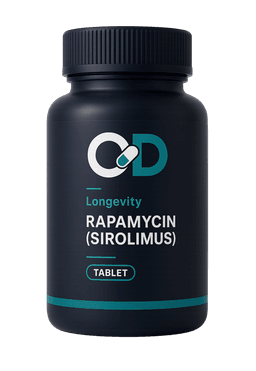 Discussed in this guideRapamycin (Sirolimus)from $59.00
A mechanism-focused overview of rapamycin (sirolimus), the mTOR signaling pathway, and why mTORC1 and autophagy are areas of research interest.
On this page
What rapamycin (sirolimus) is
Rapamycin, known by the generic name sirolimus, is a macrolide compound originally isolated from a soil bacterium, Streptomyces hygroscopicus, collected on Rapa Nui (Easter Island) — the source of its common name. It is generally described as an mTOR inhibitor, a label that reflects how the molecule is understood to interact with a specific cellular signaling protein rather than a promise about any particular result. The signaling pathway itself is named after the compound: mTOR stands for the mechanistic (historically mammalian) target of rapamycin, because the protein was identified through research into how the molecule is understood to act inside cells.
Sirolimus carries established FDA-approved indications in the immunosuppression setting, such as the prevention of organ rejection following kidney transplantation, and related molecules in the same class are used in other approved medical contexts. Those regulatory approvals describe defined, provider-directed uses under specific labeling. Any discussion of the compound outside those approved indications is a separate matter and is addressed later in this guide.
It is important to distinguish between an FDA-approved sirolimus product and a compounded preparation. Compounded medications are not FDA-approved drugs, and statements about them have not been evaluated by the FDA. This guide is educational only, is not medical advice, and is intended to describe how the molecule and its target pathway are generally understood, not to recommend use or predict any outcome.
The mTOR pathway and nutrient/growth signaling
mTOR is a protein kinase — an enzyme that adds phosphate groups to other proteins — that sits at the center of a signaling network cells are understood to use to sense their environment. It participates in two distinct multi-protein assemblies, referred to as mTOR complex 1 (mTORC1) and mTOR complex 2 (mTORC2). These complexes contain different partner proteins and are generally described as having different roles, with mTORC1 being the assembly most directly associated with the way rapamycin is understood to act.
mTORC1 is generally described as a hub that integrates signals about nutrient availability and growth cues. Inputs that are understood to feed into it include:
- The presence of amino acids
- Cellular energy status
- Oxygen
- Growth-factor signaling such as the insulin and insulin-like growth factor pathways
When these inputs indicate that building blocks and energy are plentiful, mTORC1 is understood to shift the cell toward anabolic, growth-oriented activity — for example, the assembly of new proteins. When inputs indicate scarcity, mTORC1 activity is understood to decline.
Because mTORC1 is positioned as a sensor of nutrient and growth conditions, it is often discussed as a molecular link between the states of feeding and fasting and the internal programs a cell runs in each state. This framing — a switch that reads the cell's supply situation and tilts activity toward growth or toward maintenance — is the conceptual backdrop for why researchers study agents understood to modulate the pathway. It describes a mechanism, not a clinical result.
How rapamycin is understood to interact with mTORC1
Rapamycin is understood to act indirectly rather than by binding mTOR on its own. Inside the cell it is generally described as first binding to a small intracellular protein called FKBP12 (the FK506-binding protein). The resulting rapamycin–FKBP12 pairing is then understood to associate with the mTOR protein at a specific site, and this combined interaction is understood to interfere with the activity of the mTORC1 assembly.
A frequently noted feature of this mechanism is that mTORC1 and mTORC2 are understood to respond differently. The rapamycin–FKBP12 interaction is generally described as acting more directly and acutely on mTORC1, while mTORC2 is often described as comparatively less affected by short exposure, though longer or sustained exposure has been described in the research literature as capable of influencing mTORC2 assembly in some cell types. This selectivity is part of why the molecule became a research tool for studying the pathway.
It is worth restating that describing a binding interaction is not the same as claiming a health effect. Saying that rapamycin is understood to bind FKBP12 and thereby dampen mTORC1 signaling is a statement about molecular mechanism at the level of proteins in a cell. Whether, when, and for whom any such mechanism is clinically appropriate is a medical judgment that belongs to an independent licensed provider, not something a patient can determine from a mechanistic description.
Autophagy and why mTOR inhibition draws investigational interest
One reason the mTOR pathway is discussed in longevity research is its relationship to autophagy. Autophagy is generally described as a cellular housekeeping process in which the cell packages and breaks down its own damaged components — misfolded proteins, worn organelles, and other debris — and recycles the resulting materials. Active mTORC1 signaling, associated with nutrient-rich conditions, is understood to suppress autophagy, whereas reduced mTORC1 activity is understood to be permissive of it. This is the mechanistic link researchers point to when they connect mTOR modulation to cellular maintenance programs.
In laboratory and animal models, agents understood to inhibit mTORC1 have been the subject of extensive study in the context of aging biology, cellular stress responses, and metabolic signaling. This body of work is exploratory. Findings in model organisms and cell systems are hypotheses about mechanism and do not translate automatically into established human benefits, and this guide makes no such claim. The relevance of these observations to any individual person remains an open, investigational question.
Any use of rapamycin outside its FDA-approved indications — including its inclusion in so-called longevity protocols — is off-label and investigational. It is not an FDA-approved use, compounded preparations are not FDA-approved drugs, and the statements here have not been evaluated by the FDA. Whether off-label use is ever appropriate for a given person, and under what monitoring, is a decision that rests entirely with an independent licensed provider who has reviewed that person's history. A patient may request a product; the clinical determination is not the patient's to make, and no dosing guidance is offered here because dosing is set by the prescribing provider.
How prescription review works on OpenDoseRx
OpenDoseRx is an educational catalog and request platform, not a prescriber. The process begins when you choose a product and strength and complete a medical intake — a structured set of questions about your health history and current medications. Submitting the intake is a request for review; it is not an order that is automatically filled, and it does not by itself result in a prescription.
Your request and intake are then reviewed by an independent licensed U.S. provider, who exercises their own clinical judgment about whether a prescription is appropriate for you. If the provider approves an order, it is filled by a licensed U.S. pharmacy. If the provider declines, the order is refunded in full. Any dosing, if a prescription is written, is determined by that prescribing provider, not by OpenDoseRx and not by the patient.
This review does not replace your own healthcare provider or an ongoing clinical relationship. It is intended as one supervised pathway for requesting a product, and it remains educational in nature — it is not medical advice, and compounded medications discussed here are not FDA-approved drugs. You are encouraged to share any decisions with the provider who manages your overall care.
Common questions
- Is rapamycin the same thing as sirolimus?
- Yes. Rapamycin and sirolimus refer to the same molecule; sirolimus is the generic (international nonproprietary) name, and rapamycin is the original name derived from where the compound was first isolated. This guide is educational only and is not medical advice.
- Is rapamycin FDA-approved for longevity or anti-aging use?
- No. Sirolimus carries FDA-approved indications in defined medical settings such as immunosuppression to help prevent organ rejection after transplantation, but longevity-protocol use is off-label and investigational. Compounded preparations are not FDA-approved drugs, and these statements have not been evaluated by the FDA.
- How is the dose of rapamycin decided?
- Any dosing is determined solely by the independent licensed provider who reviews your intake and, if appropriate, writes a prescription. This guide intentionally provides no dosing figures, schedules, or self-titration guidance, because those decisions belong to the prescribing provider.
Ready when you are
Rapamycin (Sirolimus)from $59.00
- Your exact strength
- Licensed provider review
- Full refund if declined
Browse longevity & healthy aging
Exact strengths and prices up front — reviewed by a licensed U.S. provider.
Keep reading
More plain-language guides on this topic.
NAD+ precursors: what NMN and NR are and how they work
A mechanism-focused look at NAD+ as a cellular coenzyme and how the precursors NMN and NR feed the salvage pathway that regenerates it.
NAD+ injectable vs. sublingual: how the delivery routes differ
A neutral, mechanism-focused look at how injecting NAD+ and absorbing it under the tongue differ in how the coenzyme travels from the point of administration into the bloodstream.
What glutathione is: the antioxidant tripeptide and its delivery forms
A mechanism-focused look at glutathione — the tripeptide built from glutamate, cysteine, and glycine — and how its reactive thiol, redox cycle, and delivery forms are understood to work.
This guide is for general education and is not medical advice. Compounded medications are not FDA-approved drugs, and statements on this site have not been evaluated by the FDA. A licensed provider reviews every prescription request.