Guide
NAD+ precursors: what NMN and NR are and how they work
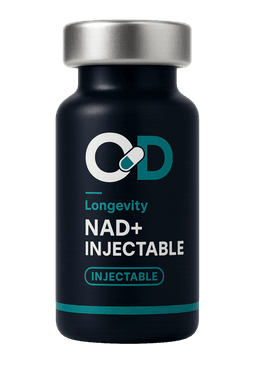 Discussed in this guideNAD+ Injectablefrom $87.60
A mechanism-focused look at NAD+ as a cellular coenzyme and how the precursors NMN and NR feed the salvage pathway that regenerates it.
On this page
NAD+: a coenzyme at the center of metabolism
NAD+, short for nicotinamide adenine dinucleotide, is a coenzyme found in every living cell. A coenzyme is a small helper molecule that many enzymes require in order to carry out their chemical work; without it, those enzymes cannot function. NAD+ is among the most abundant and heavily used coenzymes in human metabolism, and it is built from building blocks in the vitamin B3, or niacin, family of nutrients.
The best-understood role of NAD+ is in reduction-oxidation, or "redox," chemistry — the transfer of electrons from one molecule to another. NAD+ exists in two interconverting forms: an oxidized form (NAD+) that can accept electrons and a reduced form (NADH) that carries them. By cycling between these two states, the molecule acts as a shuttle, picking up electrons released as nutrients are broken down and delivering them elsewhere. This shuttling runs through the central pathways of energy metabolism, including glycolysis, the citric acid (Krebs) cycle, and the electron transport chain that cells use to extract chemical energy from food.
Because it participates in so many reactions, NAD+ is often described as a hub of cellular metabolism rather than a molecule with a single job. This article describes that biology at a general level. It is educational only, is not medical advice, and does not describe NMN, NR, or NAD+ itself as a treatment for any condition.
More than energy: NAD+ as a signaling substrate
Redox chemistry is only part of the picture. NAD+ also serves as a substrate — a raw material that certain enzymes consume and break apart rather than simply borrow. One well-studied family of these enzymes is the sirtuins, which use NAD+ as a co-substrate when they remove chemical tags from proteins. Through that activity, sirtuins are involved in processes such as gene regulation and the way cells respond to metabolic conditions, and their dependence on NAD+ links their activity to the cell's supply of the coenzyme.
Other NAD+-consuming enzymes include the PARPs, which are associated with DNA repair and stress responses, and CD38, an enzyme involved in immune signaling and other functions. Each of these enzymes cleaves NAD+ as part of its normal activity, releasing nicotinamide as a byproduct in the process. Because this consumption is continuous, the cell is constantly drawing down its NAD+ pool and must regenerate the coenzyme to keep pace — which is where the biosynthesis and recycling pathways come in.
How cells make and recycle NAD+
Cells have more than one way to produce NAD+.
- A de novo ("from scratch") route builds it from the amino acid tryptophan.
- The Preiss-Handler pathway makes it from nicotinic acid, one of the B3 vitamin forms.
- The salvage pathway recycles NAD+ from nicotinamide — the same nicotinamide released when sirtuins, PARPs, and CD38 break the coenzyme down.
In most mammalian tissues, the salvage pathway is understood to be the dominant route, because recycling existing material is more efficient than building the molecule from the beginning each time.
The salvage pathway runs through a short series of enzymatic steps. An enzyme called NAMPT converts nicotinamide into nicotinamide mononucleotide (NMN); this step is generally described as the rate-limiting one, meaning it sets the pace for the whole route. Enzymes called NMNATs then convert NMN into NAD+. The result is a continuous loop: NAD+ is consumed, nicotinamide is released, and the salvage pathway feeds that nicotinamide back toward NAD+ again.
Researchers have described a tendency for NAD+ levels in various tissues to decline with age and under certain metabolic stresses, and have studied the enzymes that both consume and regenerate the coenzyme. That body of research is what has drawn scientific attention to the salvage pathway and to the molecules that feed it. Describing this biology is not the same as claiming that any product changes it in a given person; those are separate questions this article does not answer.
What NMN and NR are
Nicotinamide mononucleotide (NMN) and nicotinamide riboside (NR) are two naturally occurring molecules within the vitamin B3 family, and both sit inside the salvage pathway as intermediates on the way to NAD+. They are closely related in structure. NR is a nicotinamide molecule joined to a ribose sugar. NMN is that same structure with an added phosphate group — in other words, NMN is the phosphorylated form of NR.
That structural relationship places them at different points along the salvage route. NMN sits directly adjacent to NAD+: a single step, carried out by the NMNAT enzymes, separates NMN from NAD+. NR sits one step earlier, before the phosphate group is added to form NMN. Both molecules occur in trace amounts in some foods and are also present inside cells as part of normal NAD+ turnover, rather than being wholly foreign substances.
How the precursors feed the salvage pathway
The reason NMN and NR are described as NAD+ "precursors" is that each can be converted, through the salvage pathway's enzymes, into NAD+. NR is understood to enter cells and then be phosphorylated by enzymes called nicotinamide riboside kinases (NRK1 and NRK2), which add the phosphate group that turns NR into NMN. From there, the NMNAT enzymes convert NMN into NAD+. In short, the studied route for NR runs NR to NMN to NAD+.
NMN, already carrying the phosphate group, sits one step closer to NAD+ and is understood to be converted directly by NMNAT. Exactly how NMN crosses the cell membrane has been an active area of research: some studies point to a dedicated transporter, while others describe NMN being converted to NR at the cell surface and then rebuilt into NMN inside the cell. These transport details remain a subject of ongoing scientific investigation and are one reason the two precursors are studied side by side.
What NMN and NR share is the same underlying logic: both supply substrate to the salvage pathway that regenerates NAD+. Whether, where, and to what degree a given intake changes NAD+ levels in specific human tissues is a scientific question that continues to be studied, and it is not something this article claims to settle. NMN and NR are also encountered in different forms and regulatory categories — including compounded preparations, which are not FDA-approved products — and how any particular preparation should be classified or used is not a determination to make from a general explainer.
How prescription review works on OpenDoseRx
OpenDoseRx is built so that a licensed clinician — not the shopper — makes any medical decision. You begin by choosing a product and the specific strength or option you are interested in, then complete a structured medical intake that asks about your health history, current medications, and other relevant information.
That intake is routed to an independent, licensed U.S. provider who reviews it and decides whether a prescription is appropriate for you. If the provider determines it is, the order is sent to a licensed U.S. pharmacy that fills and ships it. If the provider declines, the order does not proceed and you are not charged for the medication — you receive a full refund. This process is educational and procedural, not medical advice, and nothing here replaces a conversation with your own healthcare provider.
Common questions
- What is NAD+ and what does it do?
- NAD+ (nicotinamide adenine dinucleotide) is a coenzyme found in every cell. It carries electrons in the redox reactions that power energy metabolism, and it also serves as a substrate that enzymes such as sirtuins, PARPs, and CD38 consume during their normal activity. This dual role makes it a central molecule in cellular metabolism.
- What is the difference between NMN and NR?
- Both are NAD+ precursors in the vitamin B3 family. NR (nicotinamide riboside) is nicotinamide joined to a ribose sugar; NMN (nicotinamide mononucleotide) is the same structure with an added phosphate group, making it the phosphorylated form of NR. NR is understood to be converted to NMN inside cells, and NMN is one enzymatic step from NAD+.
- What is the NAD+ salvage pathway?
- The salvage pathway is the route cells use to recycle NAD+ from nicotinamide, the byproduct released when NAD+-consuming enzymes break the coenzyme down. The enzyme NAMPT converts nicotinamide to NMN, and NMNAT enzymes convert NMN to NAD+. It is understood to be the main way most tissues regenerate NAD+, and it is the pathway that precursors like NMN and NR feed into.
- Are NAD+ precursors a treatment for aging?
- This article is educational and does not describe NMN or NR as a treatment for aging or any other condition. Researchers have observed that NAD+ levels tend to decline with age, which is part of why the salvage pathway and its precursors are studied, but describing that biology is not a claim of results. Any decision about a specific product is a clinical judgment for an independent, licensed U.S. provider.
- Do products on OpenDoseRx require provider review?
- Yes. You choose a product and strength, complete a medical intake, and an independent, licensed U.S. provider reviews it. If it is appropriate, a licensed U.S. pharmacy fills and ships the order; if it is declined, you are not charged and receive a full refund. Nothing on the site replaces a conversation with your own provider.
Ready when you are
NAD+ Injectablefrom $87.60
- Your exact strength
- Licensed provider review
- Full refund if declined
Also relevant
Exact strengths and prices up front — a licensed provider reviews every request.
Browse longevity & healthy aging
Exact strengths and prices up front — reviewed by a licensed U.S. provider.
Keep reading
More plain-language guides on this topic.
How rapamycin (sirolimus) is understood to act on the mTOR pathway
A mechanism-focused overview of rapamycin (sirolimus), the mTOR signaling pathway, and why mTORC1 and autophagy are areas of research interest.
NAD+ injectable vs. sublingual: how the delivery routes differ
A neutral, mechanism-focused look at how injecting NAD+ and absorbing it under the tongue differ in how the coenzyme travels from the point of administration into the bloodstream.
What glutathione is: the antioxidant tripeptide and its delivery forms
A mechanism-focused look at glutathione — the tripeptide built from glutamate, cysteine, and glycine — and how its reactive thiol, redox cycle, and delivery forms are understood to work.
This guide is for general education and is not medical advice. Compounded medications are not FDA-approved drugs, and statements on this site have not been evaluated by the FDA. A licensed provider reviews every prescription request.