Guide
Oral vs. injectable GLP-1 medications: how the routes differ
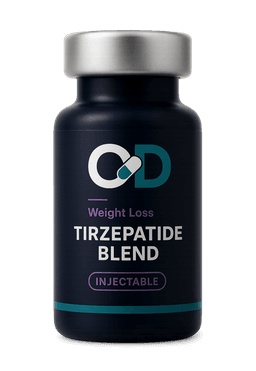 Discussed in this guideTirzepatide Blendfrom $138.29
A neutral, mechanism-focused look at how injecting a GLP-1 peptide under the skin and absorbing one by mouth differ in absorption and bioavailability.
On this page
Two delivery routes, one receptor target
GLP-1 receptor agonists are prescription medications designed to act on the receptor for glucagon-like peptide-1 (GLP-1), an incretin hormone the gut releases in response to food. These medications can reach the body by more than one route: most commonly by subcutaneous injection, and in some cases as an oral formulation. Changing the route does not change the receptor a molecule is built to engage — it changes how that molecule travels from the point of administration into the bloodstream.
The distinction matters because a GLP-1 receptor agonist is a peptide, a chain of amino acids, and peptides behave very differently depending on whether they pass through the digestive tract or enter tissue directly. This article looks at how each route handles the same general class of molecule, with a focus on absorption and bioavailability. It is educational only and is not medical advice or a recommendation of one route over another.
Both injectable and oral forms are prescription-only in the United States, and a licensed provider decides whether either is appropriate for a given person. Route is one of several considerations a clinician weighs alongside an individual's health history, so the comparison below is background for that conversation rather than guidance on what to do.
Why GLP-1 molecules are difficult to absorb by mouth
The digestive system is built to break proteins and peptides down into their component amino acids. Stomach acid and a range of digestive enzymes act on the bonds that hold a peptide together, so a peptide taken by mouth encounters the same breakdown machinery that ordinary food proteins face. Without some form of protection, much of a peptide would be degraded before it could reach its receptor.
Size and solubility create a second barrier. GLP-1 receptor agonists are relatively large, water-soluble molecules, and the lining of the intestine — the epithelium — is comparatively selective about what it allows across. Small, fat-soluble molecules tend to pass more readily than large, water-loving peptides. This combination of enzymatic breakdown and limited permeability is a central reason peptide medications have historically been delivered by injection rather than in pill form.
These are the two obstacles any oral peptide has to overcome: surviving the digestive environment and then crossing the gut wall into circulation. How a given route addresses these problems — or sidesteps them entirely — is what most distinguishes injectable delivery from oral delivery.
How subcutaneous injection delivers the molecule
A subcutaneous injection places the medication into the layer of tissue just beneath the skin, bypassing the stomach and intestines altogether. Because the molecule never passes through the digestive tract, it avoids the acid and enzymes that would otherwise degrade it, and it does not have to cross the selective intestinal lining. The two obstacles that make oral peptide delivery difficult are largely removed from the equation.
From the subcutaneous tissue, the molecule is absorbed gradually into the bloodstream through small blood and lymphatic vessels. This route is generally understood to deliver a large and relatively consistent fraction of the administered molecule into circulation. Many injectable GLP-1 receptor agonists are also chemically modified — for example with an attached fatty-acid chain — so that they bind to proteins in the blood and are released slowly, a design associated with a longer duration of action and, in the products studied to date, a typically once-weekly administration schedule.
The trade-off is the injection itself. Subcutaneous administration involves a needle, though the devices used are designed to make it a shallow injection into fatty tissue rather than a deep one. Whether this route suits a particular person is part of what an independent licensed provider considers, and the prescription defines how any product is to be used.
How oral GLP-1 delivery is engineered
Delivering a GLP-1 peptide by mouth means solving the two problems described earlier. One approach studied for oral peptides co-formulates the medication with an absorption enhancer — a substance intended to help a portion of the peptide cross the stomach lining in a localized area while creating a more favorable local environment that can temporarily buffer against acid. The peptide itself may also be structurally arranged to better resist enzymatic breakdown.
Even with these strategies, only a fraction of an orally administered peptide reaches the bloodstream, and that fraction tends to be smaller and more variable than what is seen with injection. Absorption can be sensitive to conditions in the stomach, such as the presence of food or water, which is why oral peptide products studied to date are generally associated with specific administration conditions and a daily rather than weekly rhythm. Those conditions are defined by the product and the prescribing provider, not by educational content.
Orally absorbed substances also pass through the liver before reaching general circulation, a step known as first-pass metabolism, which can further reduce how much active molecule becomes systemically available. Formulation science works to accommodate these hurdles, but the underlying biology is why an oral peptide and an injected one are not simply interchangeable versions of the same product.
Bioavailability and why the route matters
Bioavailability describes the fraction of an administered dose that reaches the bloodstream in active form. For peptides, subcutaneous injection is generally understood to achieve substantially higher and more predictable bioavailability than the oral route, because it avoids both digestion and the gut wall. Oral delivery, even when engineered with absorption enhancers, typically yields lower and more variable bioavailability by comparison.
Because of that difference, the amount of drug substance in an oral product and in an injectable product is not directly comparable: the two routes deliver different proportions of what is administered into circulation, so the strength appropriate for one route is set specifically for that route. This is one reason route and strength are decided together by a prescriber rather than converted from one form into the other.
For someone weighing the two forms, the practical considerations often include route preference, administration schedule, and how each is absorbed — factors a licensed provider evaluates against an individual's health history. It is also worth noting that some GLP-1 formulations available through compounding pharmacies are not FDA-approved products, a neutral fact a provider can explain during review. None of this is a recommendation; it is background for a conversation with a clinician.
How prescription review works on OpenDoseRx
On OpenDoseRx, the process is built so that a clinician — not the shopper — makes the medical decision. You begin by choosing a product and strength, including the route you are interested in, then complete a medical intake covering your health history and other relevant information.
That intake is routed to an independent, licensed U.S. provider who reviews it and decides whether a prescription is appropriate for you. If the provider determines it is, the prescription is sent to a licensed U.S. pharmacy for fulfillment and shipped to you. If the request is declined, you are not charged for the medication and receive a full refund. Nothing here replaces a conversation with your own healthcare provider, and every product is dispensed only after that independent clinical review.
Common questions
- Why can't every GLP-1 medication simply be taken as a pill?
- GLP-1 receptor agonists are peptides, and the digestive tract is designed to break peptides down with acid and enzymes. These molecules are also large and water-soluble, so they do not easily cross the selective intestinal lining. Overcoming both hurdles is why oral peptide delivery requires specialized formulation, and why injection has historically been the more common route.
- Does the injectable or the oral route deliver more of the molecule to the bloodstream?
- As a general pharmacological property, subcutaneous injection tends to achieve higher and more predictable bioavailability for peptides than the oral route, because it bypasses digestion and the gut wall. Oral delivery, even with absorption enhancers, typically yields lower and more variable bioavailability. This is background, not a judgment about which is right for any individual.
- Are oral and injectable GLP-1 strengths interchangeable?
- No. Because the two routes deliver different proportions of an administered dose into circulation, the strength appropriate for an oral product is set separately from that of an injectable one. Route and strength are decided together by a prescribing provider rather than converted from one form to the other.
- Do both routes require a prescription?
- Yes. Both oral and injectable GLP-1 receptor agonists are prescription-only in the United States. On OpenDoseRx, an independent licensed U.S. provider reviews your medical intake before anything is dispensed, and a licensed U.S. pharmacy fulfills the order only if the provider determines it is appropriate.
Ready when you are
Tirzepatide Blendfrom $138.29
- Your exact strength
- Licensed provider review
- Full refund if declined
Browse weight loss & glp-1 therapy
Exact strengths and prices up front — reviewed by a licensed U.S. provider.
Keep reading
More plain-language guides on this topic.
Semaglutide vs. tirzepatide: how GLP-1 and GIP/GLP-1 medications differ
A neutral, mechanism-focused comparison of two prescription incretin medications and the gut-hormone receptors they act on.
How GLP-1 medications interact with appetite and digestion
A neutral, mechanism-focused look at how GLP-1 receptor agonism engages the gut-brain satiety axis and the gastric-emptying signals tied to hunger and fullness.
How ondansetron (Zofran) is understood to work: the 5-HT3 pathway
A plain-language look at how ondansetron, an antiemetic often discussed alongside GLP-1 tolerability, is understood to act on the serotonin 5-HT3 pathway in the gut and brainstem.
This guide is for general education and is not medical advice. Compounded medications are not FDA-approved drugs, and statements on this site have not been evaluated by the FDA. A licensed provider reviews every prescription request.