Guide
Semaglutide vs. tirzepatide: how GLP-1 and GIP/GLP-1 medications differ
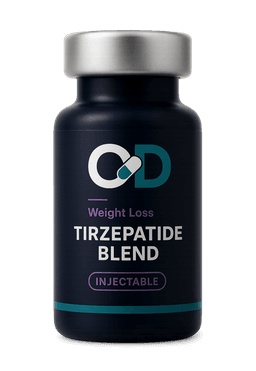 Discussed in this guideTirzepatide Blendfrom $138.29
A neutral, mechanism-focused comparison of two prescription incretin medications and the gut-hormone receptors they act on.
On this page
Two prescription medications, two receptor targets
Semaglutide and tirzepatide belong to a class of prescription medications often described as incretin-based therapies. Incretins are hormones the gut releases in response to food, and both molecules are designed to engage the receptors those hormones normally activate. Understanding each one starts with the receptor pathways it targets.
Semaglutide is a GLP-1 receptor agonist, meaning it is built to act on the receptor for glucagon-like peptide-1 (GLP-1). Tirzepatide is a dual agonist: it is designed to act on both the GLP-1 receptor and the receptor for glucose-dependent insulinotropic polypeptide (GIP), a second incretin hormone. This single structural difference — one receptor target versus two — is the central distinction between the two molecules.
Both are prescription-only products in the United States and are studied in the context of metabolic and glycemic health. Neither is available without review by a licensed provider, and this article is educational only, not medical advice or a recommendation of one product over another.
The gut-hormone pathways they act on
GLP-1 is a hormone secreted by cells in the intestine after eating. Through its receptor, it is involved in glucose-dependent insulin signaling from the pancreas, in the regulation of glucagon, and in signaling related to gastric emptying and appetite. A GLP-1 receptor agonist like semaglutide is engineered to bind this receptor and to resist rapid breakdown by the enzyme DPP-4, which is why it acts over a longer window than the natural hormone.
GIP is the other major incretin. It is released from a different population of gut cells and interacts with its own receptor, which is expressed in tissues including the pancreas and fat cells. GIP signaling participates in insulin release and in how the body handles nutrients after a meal. Because tirzepatide is designed to engage the GIP receptor in addition to the GLP-1 receptor, its mechanism spans both incretin pathways at once, whereas semaglutide engages the GLP-1 pathway alone.
How the mechanisms differ
The practical way to frame the difference is by breadth of receptor engagement rather than by any claim of superiority. Semaglutide is a single-pathway agent acting on GLP-1. Tirzepatide is a dual-pathway agent acting on GIP and GLP-1, and its molecular structure is arranged so that a single compound reaches both receptors.
Whether combined GIP and GLP-1 activity is appropriate for a given person, and how it compares to single-receptor activity in that person's situation, is a clinical judgment. Individual response, medical history, and tolerability all factor in, which is why these decisions belong to an independent licensed provider rather than to a general article.
Typical forms and administration
Both molecules are commonly prepared as solutions administered by subcutaneous injection, typically on a once-weekly schedule in the products studied to date. Formulations, concentrations, and the specifics of any given preparation vary. A provider determines whether a product is appropriate, and the prescription defines how it is to be used.
This article does not provide dosing guidance. Any starting point, adjustment, or schedule is decided by the prescribing provider based on the individual, not by educational content.
How prescription review works on OpenDoseRx
On OpenDoseRx, the process is built so that a clinician — not the shopper — makes the medical decision. You begin by choosing a product and strength, then complete a medical intake with your health history and relevant information.
That intake is routed to an independent, licensed U.S. provider who reviews it. If the provider determines a prescription is appropriate, it is sent to a licensed U.S. pharmacy for fulfillment and shipped to you. If the request is declined, you are not charged for the medication — you receive a full refund. Nothing here replaces a conversation with your own provider, and every product is dispensed only after independent clinical review.
Common questions
- What is the core difference between semaglutide and tirzepatide?
- Semaglutide is a GLP-1 receptor agonist, acting on a single incretin receptor. Tirzepatide is a dual agonist designed to act on both the GIP and GLP-1 receptors. The difference is the number of receptor pathways each molecule engages.
- What are GLP-1 and GIP?
- They are incretin hormones the gut releases in response to food. GLP-1 (glucagon-like peptide-1) and GIP (glucose-dependent insulinotropic polypeptide) each act on their own receptors and are involved in glucose-dependent insulin signaling and nutrient handling after meals.
- Do these medications require a prescription?
- Yes. Both are prescription-only in the United States. On OpenDoseRx, an independent licensed U.S. provider reviews your medical intake, and a product is only dispensed by a licensed U.S. pharmacy if the provider determines it is appropriate.
Ready when you are
Tirzepatide Blendfrom $138.29
- Your exact strength
- Licensed provider review
- Full refund if declined
Browse weight loss & glp-1 therapy
Exact strengths and prices up front — reviewed by a licensed U.S. provider.
Keep reading
More plain-language guides on this topic.
How GLP-1 medications interact with appetite and digestion
A neutral, mechanism-focused look at how GLP-1 receptor agonism engages the gut-brain satiety axis and the gastric-emptying signals tied to hunger and fullness.
Oral vs. injectable GLP-1 medications: how the routes differ
A neutral, mechanism-focused look at how injecting a GLP-1 peptide under the skin and absorbing one by mouth differ in absorption and bioavailability.
How ondansetron (Zofran) is understood to work: the 5-HT3 pathway
A plain-language look at how ondansetron, an antiemetic often discussed alongside GLP-1 tolerability, is understood to act on the serotonin 5-HT3 pathway in the gut and brainstem.
This guide is for general education and is not medical advice. Compounded medications are not FDA-approved drugs, and statements on this site have not been evaluated by the FDA. A licensed provider reviews every prescription request.