
Doxepin Gummy
Doxepin 1–6 mg Gummies
Low-dose doxepin in a gummy format for people who struggle to stay asleep. Same provider-directed care, no capsules required.
Rx only — requires provider review
$49.99
Included in this price
- Provider review of your intake
- Licensed U.S. pharmacy fulfillment
- No membership or visit fees — ever
- Support from a real person
Strength
Purchase option
Supply
- A licensed U.S. provider reviews your intake before anything ships.
- No charge if a provider declines — refunded in full.
- Filled by a licensed U.S. pharmacy.
- Typically ships within 1–2 business days of approval, then 3–5 business days in transit — shipping details.
- Free shipping on orders $200+.
Doxepin Gummy · 3 mg · 30 count
$49.99
Not available in AL, IN, KS, LA, MS, MO — checkout enforces state eligibility.
The science
About Doxepin Gummy
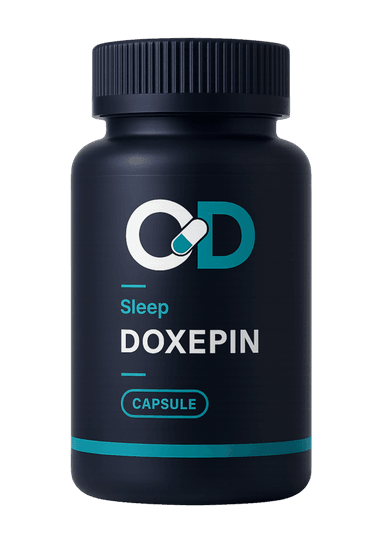
Doxepin Gummy is a compounded, low-dose gummy form of doxepin, a medication that works by quieting histamine, one of the brain's main wake-promoting signals. By turning down that signal, low-dose doxepin supports staying asleep through the night without acting as a controlled sedative.
It is typically chosen by people who want a sleep-maintenance option but prefer a gummy over capsules or tablets, whether for ease of use or personal preference. The goal it supports is the same: fewer middle-of-the-night and early-morning awakenings as part of a provider-directed sleep plan. Availability of this compounded format varies by state.
Doxepin Gummy is a prescription treatment used under medical supervision. OpenDoseRx treatments are dispensed only after a licensed provider reviews your health intake and determines a prescription is appropriate for you.
How ordering works
From your dose to your door
- 1
Choose your strength
Pick the exact dose and pack size. You see the price before you commit — nothing is hidden until checkout.
- 2
A provider reviews your intake
Complete a short medical intake. An independent, licensed U.S. provider decides if it's appropriate — and if they decline, you're refunded in full.
- 3
Compounded and shipped
Approved orders are prepared by a licensed U.S. pharmacy — typically shipped within 1–2 business days of approval, then 3–5 business days in transit to your door.
Common questions
Your questions, answered
Pairs well with
Related treatments
Keep learning
Related guides
Histamine and sleep: why H1 receptor antagonism is associated with drowsiness
A plain-language look at the brain's histamine system, the H1 receptor involved in wakefulness, and why reducing signaling at that receptor is understood to be associated with drowsiness — the pathway relevant to low-dose doxepin.
How melatonin signals day and night: the pineal hormone of darkness
A neutral, mechanism-focused look at how the pineal gland turns serotonin into melatonin at night and how MT1 and MT2 receptors read that signal as darkness and time of day.
How light sets the body clock: the suprachiasmatic nucleus and melanopsin
A plain-language look at how the brain's master clock keeps roughly 24-hour time and how melanopsin-containing cells in the eye tie that clock to the daily cycle of light and dark.