Guide
How prescription sleep medications work: the main pathways
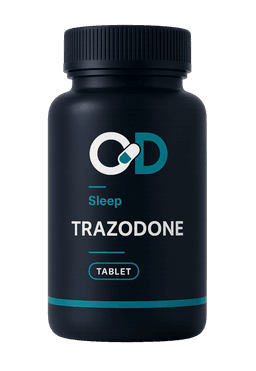 Discussed in this guideTrazodonefrom $32.00
A plain-language look at the signaling systems behind the sleep-wake cycle and how the main classes of prescription sleep medication are understood to act on them.
On this page
The sleep-wake cycle and the signals behind it
Sleep and wakefulness are not a simple on-off switch but the product of competing signaling systems in the brain. Two broad forces are often described: a homeostatic "sleep pressure" that builds the longer a person stays awake, and a circadian rhythm — a roughly 24-hour internal clock — that tracks the day-night cycle. Prescription sleep medications are studied for how they engage the neurotransmitter and receptor systems that carry these signals.
Several chemical messengers sit at the center of this balance:
- Some promote wakefulness and arousal, such as histamine and orexin
- Others quiet neural activity and are associated with the transition toward sleep, most notably GABA
- A hormone, melatonin, carries timing information about when the biological night begins
Different classes of prescription sleep medication are designed to act at different points in this network, which is why understanding the pathways helps explain how the categories differ from one another.
This article is educational only. It describes how these molecules are understood to act on receptors and pathways; it is not medical advice, a dosing guide, or a recommendation of any product. Whether any sleep medication is appropriate for a particular person is a clinical decision made by an independent licensed provider.
The GABA pathway: the brain's main inhibitory signal
GABA (gamma-aminobutyric acid) is the primary inhibitory neurotransmitter in the central nervous system. When GABA binds to its receptors — most relevant here, the GABA-A receptor — it makes neurons less likely to fire, dampening overall neural activity. This inhibitory tone is part of how the brain shifts away from an alert, active state.
A large group of prescription sedative-hypnotic medications is built around this pathway. Benzodiazepines and the non-benzodiazepine agents often called "Z-drugs" (such as zolpidem, eszopiclone, and zaleplon) act as positive allosteric modulators of the GABA-A receptor. That means they do not replace GABA; instead they bind at their own site on the receptor and enhance its response when GABA is present, increasing the inhibitory signal. The Z-drugs are designed to bind particular subtypes of the GABA-A receptor, a selectivity profile that is one way their pharmacology is distinguished from that of older benzodiazepines.
Because these medications amplify a powerful inhibitory system, many are controlled substances in the United States and carry specific prescribing considerations. A licensed provider weighs a person's history, other medications, and risk factors when deciding whether a GABA-acting medication is appropriate — this article does not address who should use one or how it should be taken.
The melatonin-receptor pathway: signaling circadian timing
Melatonin is a hormone the pineal gland releases as ambient light falls, and it functions less like a sedative and more like a timing signal — a message that the biological night has begun. It acts on two receptors, MT1 and MT2, which are concentrated in the suprachiasmatic nucleus, the region of the hypothalamus that serves as the body's master circadian clock.
Prescription medications in this category are melatonin-receptor agonists: molecules designed to bind MT1 and MT2 in place of the natural hormone. Ramelteon is one example of a prescription agent that acts selectively on these receptors. Its mechanism is tied to circadian signaling rather than to the broad neural inhibition of the GABA pathway, which is the main way this class differs from the sedative-hypnotics.
It is worth distinguishing prescription melatonin-receptor agonists from over-the-counter melatonin supplements. The supplement contains the hormone itself and is regulated as a dietary supplement, while a prescription agonist is a distinct pharmaceutical molecule reviewed as a drug. A provider evaluates which, if either, fits a person's situation.
The histamine pathway: a wake-promoting signal
Histamine is best known for its role in allergy, but in the brain it is also a wake-promoting neurotransmitter. Neurons in the tuberomammillary nucleus of the hypothalamus release histamine to support alertness, acting largely through the H1 receptor. Reducing signaling at this receptor is associated with drowsiness, which is why the histamine pathway is relevant to sleep.
This is the mechanism behind the familiar drowsiness of "first-generation" antihistamines: because they cross into the brain and block central H1 receptors, sedation accompanies their allergy action. Some prescription medications engage the same receptor deliberately in the sleep context; doxepin, for instance, is a molecule studied for its H1-blocking activity when a provider prescribes it for that purpose. Here the pathway being acted on is arousal-related rather than the inhibitory GABA system.
Histamine is not the only wake-promoting signal researchers target. Orexin (also called hypocretin) is another arousal neurotransmitter, and a newer class known as dual orexin receptor antagonists (DORAs) is designed to reduce orexin signaling. While orexin sits outside the three pathways this guide focuses on, it illustrates the same principle: several medication classes are built to turn down wake-promoting signals rather than to boost inhibitory ones.
Forms, routes, and why timing matters
Sleep-related medications are prepared in a range of forms — tablets, capsules, orally disintegrating tablets, and liquids among them — and some active ingredients are compounded to a particular strength or formulation in response to a specific prescription. Compounded preparations are not FDA-approved products; they are prepared by a licensed pharmacy to fill an individual prescription, which is a neutral fact rather than a mark of quality either way.
Because several of these pathways are tied to the circadian clock, timing is part of how the classes are understood to act. A melatonin-receptor agonist aligns with the body's own clock signaling, while GABA- and histamine-acting agents influence inhibition and arousal more directly. How any of this maps onto a specific person — including which pathway, form, or schedule is appropriate — is a clinical judgment, not something an educational article can decide, and this guide does not provide dosing or timing instructions.
How prescription review works on OpenDoseRx
On OpenDoseRx, the medical decision rests with a clinician, not the shopper. You begin by choosing a product and strength, then complete a medical intake that collects your health history and other relevant information.
That intake is routed to an independent, licensed U.S. provider who reviews it. If the provider determines a prescription is appropriate, it is sent to a licensed U.S. pharmacy to be filled and shipped to you. If the request is declined, you are not charged for the medication and you receive a full refund. Every product here is prescription-only and is dispensed only after independent clinical review — and nothing on this site replaces a conversation with your own healthcare provider.
Common questions
- What pathways do prescription sleep medications act on?
- The main pathways are the GABA system (the brain's chief inhibitory signal), the melatonin-receptor system (the MT1 and MT2 receptors involved in circadian timing), and the histamine system (a wake-promoting signal acting through the H1 receptor). Different medication classes are designed to act at different points in this network.
- Is over-the-counter melatonin the same as a prescription melatonin-receptor agonist?
- No. Over-the-counter melatonin is the hormone itself, regulated as a dietary supplement. A prescription melatonin-receptor agonist, such as ramelteon, is a distinct pharmaceutical molecule designed to bind the MT1 and MT2 receptors and reviewed as a drug. A licensed provider evaluates which, if either, is appropriate for a given person.
- Why do some allergy medications cause drowsiness?
- Histamine is a wake-promoting neurotransmitter in the brain that acts through the H1 receptor. Older "first-generation" antihistamines cross into the brain and block central H1 receptors, so sedation accompanies their allergy action. That is the same receptor pathway relevant to the histamine side of sleep.
- Do prescription sleep medications require a prescription, and how does OpenDoseRx handle that?
- Yes. They are prescription-only in the United States, and several are controlled substances. On OpenDoseRx, an independent licensed U.S. provider reviews your medical intake, and a product is dispensed by a licensed U.S. pharmacy only if the provider determines it is appropriate. If the request is declined, you receive a full refund.
Ready when you are
Trazodonefrom $32.00
- Your exact strength
- Licensed provider review
- Full refund if declined
Also relevant
Exact strengths and prices up front — a licensed provider reviews every request.
Browse sleep support
Exact strengths and prices up front — reviewed by a licensed U.S. provider.
Keep reading
More plain-language guides on this topic.
How trazodone and low-dose doxepin are understood to be used off-label for sleep
A neutral, mechanism-focused look at two prescription medications that originated as antidepressants and are discussed off-label in sleep contexts.
What sleep architecture is: REM, deep sleep, and the sleep cycle explained
A plain-language look at how a night of sleep is structured — the NREM stages, REM, the repeating sleep cycle, and the homeostatic and circadian drives that shape when we sleep.
Histamine and sleep: why H1 receptor antagonism is associated with drowsiness
A plain-language look at the brain's histamine system, the H1 receptor involved in wakefulness, and why reducing signaling at that receptor is understood to be associated with drowsiness — the pathway relevant to low-dose doxepin.
This guide is for general education and is not medical advice. Compounded medications are not FDA-approved drugs, and statements on this site have not been evaluated by the FDA. A licensed provider reviews every prescription request.