Guide
How trazodone and low-dose doxepin are understood to be used off-label for sleep
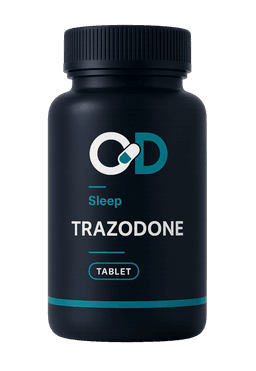 Discussed in this guideTrazodonefrom $32.00
A neutral, mechanism-focused look at two prescription medications that originated as antidepressants and are discussed off-label in sleep contexts.
On this page
Two antidepressant-class medications discussed in sleep contexts
Trazodone and doxepin are prescription medications that originated in the antidepressant category. Trazodone is generally described as a serotonin antagonist and reuptake inhibitor, a group sometimes abbreviated SARI. Doxepin is generally classified as a tricyclic antidepressant, or TCA. Both were first studied and labeled for their original antidepressant class, and that history is the starting point for understanding why they are also discussed in the context of sleep.
This article is educational only and is not medical advice or a recommendation of one product over another. Compounded medications are not FDA-approved drugs, and statements about them have not been evaluated by the FDA. Whether either medication is appropriate at all is a determination for an independent licensed provider based on an individual's health history.
How trazodone is understood to act
Trazodone is generally described as acting on serotonergic signaling in more than one way. It is understood to antagonize certain serotonin receptors, particularly the 5-HT2A subtype, while also inhibiting the reuptake of serotonin to a degree. This combination of receptor antagonism and reuptake inhibition is the basis for the SARI label applied to its original antidepressant class.
Trazodone is also understood to interact with receptors outside the serotonin system. It is generally described as an antagonist at histamine H1 receptors and at alpha-1 adrenergic receptors. Antihistamine activity of this kind is commonly associated with drowsiness, and it is this part of the receptor profile — rather than the serotonergic activity emphasized in its antidepressant class — that is typically discussed when trazodone is considered in a sleep context.
How prominent each of these actions is understood to be can vary with the amount prescribed, which is one reason the prescribing provider determines any dose. This guide does not provide dosing guidance of any kind.
How low-dose doxepin is understood to act
Doxepin is a tricyclic antidepressant. In the context of its original antidepressant class, it is understood to inhibit the reuptake of norepinephrine and serotonin and to interact with several receptor systems, including histaminic, muscarinic, and adrenergic receptors. That broad receptor activity is characteristic of the TCA class as a whole.
Among these interactions, doxepin is generally described as having high binding affinity for the histamine H1 receptor. At low amounts, it is understood to act in a relatively selective way at that H1 receptor, with its other receptor interactions understood to be less prominent than they are at the larger amounts associated with its antidepressant class. This comparatively selective antihistamine activity is the mechanism most often referenced when low-dose doxepin is discussed in relation to sleep.
As with trazodone, the description above is a mechanistic account of the drug class, not a claim about outcomes. Whether low-dose doxepin is suitable for a given person, and at what strength, is a clinical judgment made by an independent licensed provider.
Low-dose sleep use versus the original antidepressant class
The central distinction between low-dose sleep use and the antidepressant class of these medications is dose-dependent pharmacology: the balance of a molecule's receptor activity is understood to shift with the amount present. For doxepin, the low-amount profile is understood to be dominated by selective H1 antihistamine activity, whereas at the larger amounts associated with its antidepressant class, its reuptake inhibition and its muscarinic and adrenergic interactions are understood to become more prominent. It is the same molecule, described with a different mechanistic emphasis depending on the amount.
Trazodone is discussed in a similar frame. Its antihistamine and adrenergic antagonism, associated with sedation, is the receptor activity typically emphasized in sleep contexts, while its serotonergic activity is the feature emphasized in its original antidepressant class. In both cases the shift is one of mechanistic emphasis, not a change in the underlying molecule.
Because these are prescription medications, the appropriate product, the strength, and whether either is suitable at all are decisions for an independent licensed provider who reviews the patient's history. The patient requests; the provider decides. This guide intentionally provides no dosing figures, schedules, or titration guidance, and any such specifics are set by the prescribing provider.
How prescription review works on OpenDoseRx
On OpenDoseRx, the process is built so that a clinician — not the shopper — makes the medical decision. You begin by choosing a product and strength, then complete a medical intake covering your health history and relevant information.
That intake is routed to an independent, licensed U.S. provider who reviews it. If the provider determines a prescription is appropriate, the order is filled by a licensed U.S. pharmacy and shipped to you. If the request is declined, you are not charged for the medication and receive a full refund. Nothing here replaces a conversation with your own provider, and every product is dispensed only after independent clinical review.
Common questions
- Why are trazodone and doxepin discussed for sleep if they are antidepressants?
- Both originated in the antidepressant category, but each is understood to antagonize histamine H1 receptors, an activity commonly associated with drowsiness. When either is considered for sleep, it is used off-label, meaning a licensed provider is prescribing outside the original labeled indication. This guide describes those mechanisms only and makes no claim about results; suitability is a provider's decision.
- How is low-dose doxepin different from doxepin in its antidepressant class?
- The difference is understood to be dose-dependent. At low amounts, doxepin is understood to act in a relatively selective way at the histamine H1 receptor, while at the larger amounts associated with its antidepressant class, its reuptake inhibition and muscarinic and adrenergic interactions are understood to be more prominent. It is the same molecule with a different mechanistic emphasis, and the prescribing provider determines any dose.
- Does OpenDoseRx set my dose or guarantee a prescription?
- No. An independent licensed U.S. provider reviews your medical intake and determines whether a prescription is appropriate and, if so, its strength. Approved orders are filled by a licensed U.S. pharmacy; declined requests are refunded in full. Compounded medications are not FDA-approved drugs, this content is educational only, and it does not replace your own provider.
Ready when you are
Trazodonefrom $32.00
- Your exact strength
- Licensed provider review
- Full refund if declined
Also relevant
Exact strengths and prices up front — a licensed provider reviews every request.
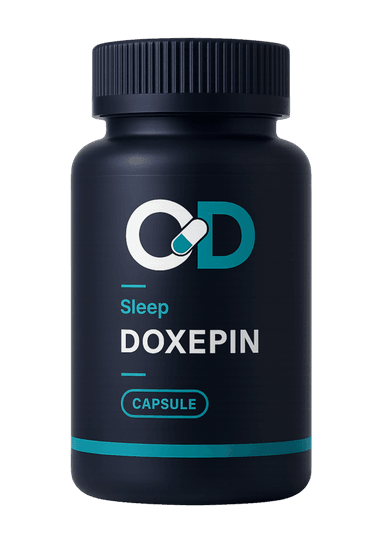
Browse sleep support
Exact strengths and prices up front — reviewed by a licensed U.S. provider.
Keep reading
More plain-language guides on this topic.
How prescription sleep medications work: the main pathways
A plain-language look at the signaling systems behind the sleep-wake cycle and how the main classes of prescription sleep medication are understood to act on them.
What sleep architecture is: REM, deep sleep, and the sleep cycle explained
A plain-language look at how a night of sleep is structured — the NREM stages, REM, the repeating sleep cycle, and the homeostatic and circadian drives that shape when we sleep.
Histamine and sleep: why H1 receptor antagonism is associated with drowsiness
A plain-language look at the brain's histamine system, the H1 receptor involved in wakefulness, and why reducing signaling at that receptor is understood to be associated with drowsiness — the pathway relevant to low-dose doxepin.
This guide is for general education and is not medical advice. Compounded medications are not FDA-approved drugs, and statements on this site have not been evaluated by the FDA. A licensed provider reviews every prescription request.