Guide
Methylene blue: from historical dye to mitochondrial research
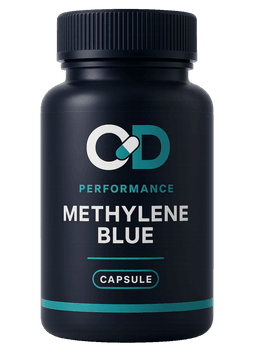 Discussed in this guideMethylene Bluefrom $30.00
A mechanism-focused look at methylene blue's origin as a textile dye and one of the first synthetic drugs, and how it is studied as a participant in mitochondrial electron transport.
On this page
What methylene blue is
Methylene blue is a synthetic compound classified chemically as a thiazine dye — a deeply blue-colored aromatic molecule built around a sulfur- and nitrogen-containing ring system. In a pharmacological setting it is generally described as an oxidation-reduction agent, a label that reflects how the molecule behaves chemically rather than a promise about any particular result. It is also one of the oldest synthetic substances that remains in documented medical use, which is part of why its story is told so often.
Methylene blue carries an established FDA-approved indication. Methylene blue injection is approved for the treatment of acquired methemoglobinemia, a blood condition in which hemoglobin is altered so that it carries oxygen poorly. That approval describes a defined, provider-directed use under specific labeling, and it is a narrow medical indication rather than a general-purpose one. Any discussion of the compound outside that approved indication is a separate matter addressed later in this guide.
It is important to distinguish between an FDA-approved methylene blue product and a compounded preparation. Compounded medications are not FDA-approved drugs, and statements about them have not been evaluated by the FDA. This guide is educational only, is not medical advice, and is intended to describe how the molecule and its history are generally understood — not to recommend use, describe it as a treatment for any condition, or predict any outcome.
From textile dye to one of the first synthetic drugs
Methylene blue's history begins outside medicine entirely. It was first synthesized in 1876 by the German chemist Heinrich Caro, working at the dye manufacturer BASF, as a colorfast blue dye for the textile industry. It emerged from the same nineteenth-century boom in synthetic aniline dyes that transformed European chemistry, and its earliest purpose was to color fabric, not to treat anything. Its intense, stable color is precisely what later made it useful in the laboratory.
That laboratory usefulness is what carried it into medicine. Because the dye bound selectively to certain tissues and microorganisms, it became a staining tool for microscopy, and the physician-scientist Paul Ehrlich worked with it extensively in the 1880s and 1890s. Ehrlich and Paul Guttmann reported using it in the treatment of malaria in 1891, an episode frequently cited as one of the first times a fully synthetic compound was deployed as a medicine. This work sits near the origins of both modern histological staining and the broader idea — often summarized as the search for a 'magic bullet' — that a synthetic molecule might act selectively inside the body.
Over the following century, newer compounds largely superseded methylene blue for malaria, and its place in general practice narrowed. It nonetheless remained in the pharmacopeia, most durably as the redox agent used for methemoglobinemia. Tracing this arc — dye, then stain, then early drug, then a narrowly indicated medicine — is a description of history, not a statement about how well it performs for any use. Historical prominence is not the same as clinical evidence, and this guide does not treat it that way.
Redox chemistry: the core of how it behaves
Almost everything about how methylene blue is understood to act traces back to its behavior in oxidation-reduction, or 'redox,' chemistry — the transfer of electrons between molecules. Methylene blue exists in two interconverting forms: an oxidized form, which carries the familiar deep blue color, and a reduced, essentially colorless form generally called leucomethylene blue. The molecule can pick up electrons to become the colorless form and give them back up to return to blue, so it is described as cycling between these two states rather than being consumed in a single direction.
This electron-shuttling behavior is what underlies its FDA-approved role in methemoglobinemia. In that condition, iron in hemoglobin has been oxidized to a form that binds oxygen poorly, and methylene blue is understood to participate in a cellular pathway that helps return that iron to its normal state. A notable and well-documented feature of the chemistry is that it is concentration-dependent: the direction in which the molecule tends to push a reaction can differ at low versus high concentrations, which is one reason the amount involved is treated as a matter of careful clinical control rather than a casual variable.
Describing this redox cycling is a statement about chemistry at the level of molecules and electrons. It explains why the compound is grouped with oxidation-reduction agents and why the same underlying behavior shows up in very different contexts. It is not, on its own, a claim that the molecule produces any specific effect in a given person; that is a separate question that chemistry alone does not answer.
Methylene blue and the mitochondrial electron transport chain
The reason methylene blue appears in metabolic and longevity research is that its redox chemistry places it near the machinery cells use to extract energy from food. Inside mitochondria, the electron transport chain moves electrons through a series of protein complexes — carried in from molecules such as NADH, passed along to an intermediate carrier called cytochrome c, and ultimately delivered to oxygen — while the energy released is used to make ATP. Methylene blue's redox potential is understood to sit between NADH and cytochrome c, meaning it can, in chemical terms, accept electrons from one and donate them to the other.
Because of that positioning, methylene blue is described in the research literature as a possible 'alternative electron carrier.' The general model is that it accepts electrons from NADH — becoming the colorless leucomethylene blue in the process — and then donates them directly to cytochrome c, regenerating the blue form, and repeats the cycle. In laboratory systems where one of the normal complexes is blocked, this rerouting has been described as allowing some electron flow to continue by bypassing the blockage. This is the mechanistic observation that has drawn scientific attention to the molecule in the context of mitochondrial bioenergetics and neuroprotection research.
It is essential to keep this framing precise. These observations come largely from cell and animal models, and translating them into established human benefit has proven difficult — a Phase 3 clinical trial of a related methylene-blue chemistry in Alzheimer's disease, for example, reported negative results, and the broader human evidence is generally characterized as preliminary and inconsistent. Any use of methylene blue outside its FDA-approved methemoglobinemia indication is off-label and investigational, compounded preparations are not FDA-approved drugs, and the statements here have not been evaluated by the FDA. Describing an electron-transfer mechanism is not a claim that it improves health, energy, cognition, or longevity in any person. Whether such a mechanism is ever appropriate for an individual is a medical judgment for an independent licensed provider, and this guide offers no dosing guidance because dosing is set by the prescribing provider.
Safety considerations that shape clinical review
Methylene blue is not a neutral substance, and several well-documented safety considerations are exactly why provider review is central rather than optional. The most emphasized in current labeling is the risk of serotonin syndrome. Methylene blue is understood to act as a potent inhibitor of monoamine oxidase, an enzyme that breaks down serotonin, so combining it with medications that raise serotonergic activity — including many antidepressants such as SSRIs and SNRIs, and other MAO inhibitors — is described as capable of producing a serious and potentially fatal reaction. This is a significant, history-dependent interaction that only a clinician reviewing a person's full medication list can properly weigh.
A second long-recognized consideration is glucose-6-phosphate dehydrogenase (G6PD) deficiency, an inherited enzyme condition. In people with G6PD deficiency, methylene blue has been associated with the breakdown of red blood cells (hemolysis), and the same redox chemistry that defines the molecule can behave differently — and unfavorably — in that setting. This is one reason the compound's appropriateness depends on individual biology and cannot be inferred from a product description.
These considerations are illustrative rather than a complete safety profile, and they underscore a single point: decisions about whether methylene blue is appropriate, and at what dose, belong to an independent licensed provider who has reviewed a person's health history and current medications. Nothing in this guide is a substitute for that review, and no self-directed use is implied or advised.
How prescription review works on OpenDoseRx
OpenDoseRx is an educational catalog and request platform, not a prescriber. The process begins when you choose a product and strength and complete a medical intake — a structured set of questions about your health history and current medications. Submitting the intake is a request for review; it is not an order that is automatically filled, and it does not by itself result in a prescription.
Your request and intake are then reviewed by an independent licensed U.S. provider, who exercises their own clinical judgment about whether a prescription is appropriate for you. If the provider approves an order, it is filled by a licensed U.S. pharmacy. If the provider declines, the order does not proceed and is refunded in full. Any dosing, if a prescription is written, is determined by that prescribing provider — not by OpenDoseRx and not by the patient.
This review does not replace your own healthcare provider or an ongoing clinical relationship. It is intended as one supervised pathway for requesting a product, and it remains educational in nature — it is not medical advice, and compounded medications discussed here are not FDA-approved drugs. You are encouraged to share any decisions with the provider who manages your overall care.
Common questions
- Was methylene blue really the first synthetic drug?
- It is often described as among the first fully synthetic compounds used as a medicine. It was created in 1876 as a textile dye by the chemist Heinrich Caro at BASF, and in 1891 Paul Ehrlich and Paul Guttmann reported using it in the treatment of malaria — an episode frequently cited near the origins of modern chemotherapy and staining. 'One of the first' is the careful phrasing; this guide is educational only and is not medical advice.
- What does it mean that methylene blue is a 'redox agent'?
- It means the molecule works through oxidation-reduction chemistry — the transfer of electrons. Methylene blue cycles between an oxidized blue form and a reduced, colorless form (leucomethylene blue), picking up and giving back electrons. Describing this behavior is a statement about chemistry, not a claim that it produces any particular effect in a person.
- How is methylene blue understood to interact with mitochondria?
- Its redox potential is understood to sit between NADH and cytochrome c in the mitochondrial electron transport chain, so in research settings it is described as a possible 'alternative electron carrier' that can accept electrons from NADH and pass them to cytochrome c, in some models bypassing a blocked complex. This is a mechanistic observation drawn largely from cell and animal studies. It is investigational, human evidence is preliminary and inconsistent, and it is not a claim of benefit for energy, cognition, or longevity.
- Is methylene blue FDA-approved?
- Methylene blue injection carries an FDA-approved indication for the treatment of acquired methemoglobinemia, a specific blood condition. Uses outside that indication are off-label and investigational, and compounded preparations are not FDA-approved drugs; these statements have not been evaluated by the FDA. Either way, it is prescription-only.
- Why does provider review matter specifically for methylene blue?
- Because it carries well-documented, history-dependent safety considerations. It is understood to inhibit monoamine oxidase, so combining it with serotonergic medications such as many antidepressants has been associated with serious serotonin syndrome, and it has been associated with red-blood-cell breakdown in people with G6PD deficiency. Whether it is appropriate, and at what dose, is a clinical judgment for an independent licensed provider who has reviewed your history and medications — not a decision made from a product page.
Ready when you are
Methylene Bluefrom $30.00
- Your exact strength
- Licensed provider review
- Full refund if declined
Browse longevity & healthy aging
Exact strengths and prices up front — reviewed by a licensed U.S. provider.
Keep reading
More plain-language guides on this topic.
NAD+ precursors: what NMN and NR are and how they work
A mechanism-focused look at NAD+ as a cellular coenzyme and how the precursors NMN and NR feed the salvage pathway that regenerates it.
How rapamycin (sirolimus) is understood to act on the mTOR pathway
A mechanism-focused overview of rapamycin (sirolimus), the mTOR signaling pathway, and why mTORC1 and autophagy are areas of research interest.
NAD+ injectable vs. sublingual: how the delivery routes differ
A neutral, mechanism-focused look at how injecting NAD+ and absorbing it under the tongue differ in how the coenzyme travels from the point of administration into the bloodstream.
This guide is for general education and is not medical advice. Compounded medications are not FDA-approved drugs, and statements on this site have not been evaluated by the FDA. A licensed provider reviews every prescription request.