Guide
Oral vs. topical minoxidil: how the two routes differ
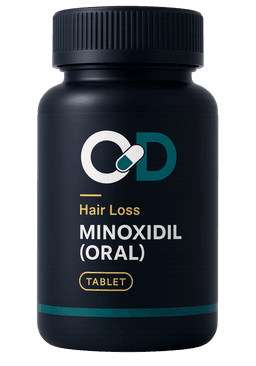 Discussed in this guideMinoxidil (Oral)from $39.00
A neutral, mechanism-focused look at how the same minoxidil molecule behaves differently when it is applied to the scalp versus taken by mouth — where it becomes active, and how far it travels.
On this page
Two routes for one molecule
Minoxidil is a single molecule that can reach the body by more than one route: applied directly to the scalp as a topical solution or foam, or taken by mouth as a tablet that acts systemically. Changing the route does not change what the molecule is. What it changes is where the medication is delivered, where in the body it is switched into its active form, and how much of it ends up circulating through the rest of the body. This article looks at how those routes differ mechanistically, and it is educational only — not medical advice or a recommendation of one route over another.
Minoxidil is generally described as a vasodilator and, more specifically, a potassium channel opener. It was originally developed in the 1970s as an oral medication for hard-to-treat high blood pressure, and increased hair growth was noticed as a side effect of that systemic use. That observation led to a topical formulation studied in the context of androgenetic alopecia, or pattern hair loss. In other words, the same molecule carries two histories that map onto its two routes — one that began in the bloodstream and one that begins on the scalp.
Standard-strength topical minoxidil is available over the counter, while other forms — including oral tablets and many compounded topical preparations — are prescription-only, and compounded products are not FDA-approved. Whether any particular route or formulation is appropriate for a given person is a clinical decision that belongs to a licensed provider. The comparison below is background for that conversation rather than guidance on what to do.
Why minoxidil has to be activated first
Minoxidil is what pharmacologists call a prodrug: the molecule as applied or swallowed is largely inactive and must be converted inside the body into its active form, minoxidil sulfate. That conversion is carried out by a family of enzymes called sulfotransferases. Because of this step, the molecule a person administers is not quite the molecule that acts — a chemical reaction in the body has to switch it on first.
The enzyme most associated with this activation is SULT1A1. Sulfotransferase activity varies from person to person and from tissue to tissue, and that variation is studied as one reason minoxidil response is understood to differ between individuals. Crucially, where this activation happens depends heavily on the route of administration. That single fact — the site of activation — is the thread that connects the rest of this article.
Once activated, minoxidil sulfate is understood to act at the level of the hair follicle and the tissue around it. As a vasodilator it is thought to widen small blood vessels and may increase local blood flow, and it is associated with shifting follicles into, and prolonging, the anagen (active growth) phase of the hair cycle. Notably, minoxidil does not act on hormones or on DHT the way finasteride is studied to. That is the follicle-level picture; the two routes differ in how the molecule reaches the follicle and where it is switched on along the way.
How topical delivery concentrates action at the scalp
Topical minoxidil is applied directly to the scalp. From there it is understood to permeate the outer layers of skin and reach the hair follicles and the cells surrounding them, where local sulfotransferase activity can convert it into the active sulfate form. Because the drug is both delivered and activated at or near its intended target, its action is concentrated at the site of application rather than spread through the body.
This local activation is also why individual differences in follicular sulfotransferase are relevant to the topical route: the conversion to the active molecule depends on the enzyme activity present in the scalp itself. Researchers have studied follicular SULT1A1 activity as a factor associated with how a given person responds to topical minoxidil. That is a line of scientific inquiry, not a claim about any individual, and interpreting it for a specific person is a matter for a clinician.
A defining feature of the topical route is that only a small fraction of applied minoxidil is absorbed into the general circulation — figures commonly cited are on the order of a couple of percent, and the amount can vary with the formulation, the concentration, and the condition of the skin. Most of the molecule stays near where it is applied. That is the mechanistic meaning of "topical": the route is designed to keep the medication's action local rather than distribute it throughout the body.
How oral delivery works through the bloodstream
Oral minoxidil is swallowed as a tablet and absorbed through the gastrointestinal tract. Unlike a peptide, which the digestive system tends to break down, minoxidil is a small molecule that survives digestion well; the labeling for the FDA-approved oral tablet describes it as absorbed to a high degree — on the order of 90% — from the gut. Once absorbed, it enters the bloodstream and travels throughout the body.
With the oral route, activation to minoxidil sulfate happens systemically rather than only at the scalp. The liver, among other tissues, has abundant sulfotransferase activity, so the conversion to the active form is not dependent solely on the enzyme activity present in the hair follicle. The active molecule then reaches scalp follicles the same way it reaches other tissues — carried there by the circulation rather than applied on top of them.
Because an oral dose circulates systemically, the vasodilator that was first developed to lower blood pressure is acting on blood vessels throughout the body, not just in the vicinity of the scalp. That whole-body reach is the mechanistic reason the oral route is associated with considerations that extend beyond the scalp, and it is a central part of what a provider weighs when the route is discussed. This article does not provide dosing guidance; any dose or schedule is set by the prescribing provider based on the individual.
Comparing the routes: activation site, exposure, and regulatory status
Set side by side, the routes share a molecule, a prodrug step, and the same follicle-level activity, but they differ in two mechanistic respects. Topical minoxidil is delivered and activated locally, with little of it entering the general circulation. Oral minoxidil is delivered systemically, activated systemically, and distributed through the whole body before reaching the follicle. Neither is presented here as better than the other; they simply differ in where the molecule becomes active and how far it travels.
The regulatory picture reflects that history.
- Topical minoxidil at standard strengths — 2% and 5% — is FDA-approved and sold over the counter for androgenetic alopecia.
- The oral tablet is FDA-approved for high blood pressure, not for hair loss, so prescribing it for hair loss is an off-label use; the FDA-approved oral tablet also carries a boxed warning — the FDA's most prominent safety warning — as part of its approved labeling.
- Separately, compounded formulations — such as custom-strength topicals or combinations prepared to a specific prescription — are not FDA-approved as compounded products.
These are neutral regulatory facts a provider can explain during review.
Which route is appropriate, at what strength, and whether an off-label or compounded option fits a given situation are clinical judgments that depend on an individual's health history — they belong to an independent licensed provider, not to a general article. Route and strength are decided together and are not interchangeable across forms, since the same amount of drug substance does not reach the bloodstream the same way by every route.
How prescription review works on OpenDoseRx
On OpenDoseRx, the process is built so that a clinician — not the shopper — makes the medical decision. You begin by choosing a product and strength, including the route and formulation you are interested in, then complete a medical intake covering your health history and other relevant information.
That intake is routed to an independent, licensed U.S. provider who reviews it and decides whether a prescription is appropriate for you. If the provider determines it is, the prescription is sent to a licensed U.S. pharmacy for fulfillment and shipped to you. If the request is declined, you are not charged for the medication and receive a full refund. Nothing here replaces a conversation with your own healthcare provider, and every prescription product is dispensed only after that independent clinical review.
Common questions
- Are oral and topical minoxidil the same drug?
- Yes — both are the same molecule, minoxidil. What differs is the route: a topical is applied to the scalp, while a tablet is swallowed and acts systemically. Changing the route changes where the medication is delivered, where it is converted into its active form, and how much of it circulates through the body, but not the underlying molecule.
- What does it mean that minoxidil is a "prodrug"?
- It means minoxidil is largely inactive as administered and must be converted inside the body into its active form, minoxidil sulfate, by enzymes called sulfotransferases (SULT1A1 is the one most often studied). Where that activation happens differs by route: the topical route relies on enzyme activity in the scalp, while the oral route allows activation to occur systemically, including in the liver.
- How does systemic absorption differ between the two routes?
- As a general pharmacological property, only a small fraction of topical minoxidil — commonly cited on the order of a couple of percent — is absorbed into the general circulation, so its action stays largely local. Oral minoxidil, by contrast, is absorbed to a high degree from the gut and circulates throughout the body. This is background on how the routes behave, not a judgment about which is right for any individual.
- Is oral minoxidil FDA-approved for hair loss?
- The oral tablet is FDA-approved for high blood pressure, not for hair loss, so using it for hair loss is considered an off-label use, and the approved tablet carries a boxed warning — the FDA's most prominent safety warning — as part of its labeling. Standard-strength topical minoxidil is FDA-approved over the counter for pattern hair loss, while compounded formulations are not FDA-approved as compounded products. Whether an off-label or compounded option is appropriate is a determination for a licensed provider.
- Do these require a prescription?
- Standard-strength topical minoxidil is available over the counter, but oral minoxidil and many compounded topical formulations are prescription-only. On OpenDoseRx, an independent licensed U.S. provider reviews your medical intake before any prescription product is dispensed, and a licensed U.S. pharmacy fulfills the order only if the provider determines it is appropriate for you.
Ready when you are
Minoxidil (Oral)from $39.00
- Your exact strength
- Licensed provider review
- Full refund if declined
Also relevant
Exact strengths and prices up front — a licensed provider reviews every request.
Browse hair loss treatments
Exact strengths and prices up front — reviewed by a licensed U.S. provider.
Keep reading
More plain-language guides on this topic.
How finasteride and minoxidil work for hair loss
A plain-language look at the biology of pattern hair loss and how these two prescription ingredients act on different parts of the process.
DHT and the hair growth cycle explained
A neutral, mechanism-focused look at the androgen dihydrotestosterone and how it is understood to relate to the follicle's growth, transition, and rest phases.
How ketoconazole shampoo is understood to work: the antifungal mechanism on the scalp
A plain-language look at how an azole antifungal is designed to interrupt ergosterol synthesis in fungal cells, and why that mechanism is studied in the context of the scalp.
This guide is for general education and is not medical advice. Compounded medications are not FDA-approved drugs, and statements on this site have not been evaluated by the FDA. A licensed provider reviews every prescription request.