Guide
Telomeres and the science of cellular aging
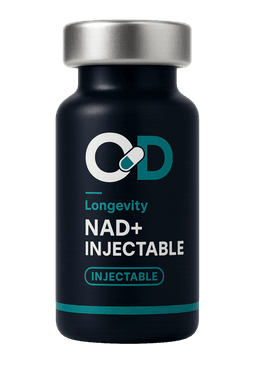 Discussed in this guideNAD+ Injectablefrom $87.60
A plain-language, mechanism-focused look at the protective caps on our chromosomes — why they shorten as cells divide, the limit that shortening imposes, and the enzyme that can rebuild them.
On this page
What telomeres are
Inside almost every cell, the instructions that build and run the body are stored in DNA, packaged into structures called chromosomes. Human cells carry 46 of them, each a long, tightly wound thread of DNA. At the very tip of each chromosome sits a specialized cap called a telomere. Rather than coding for a protein, a telomere is a stretch of the same short sequence repeated over and over — in humans, the six-letter unit TTAGGG, tandem-repeated thousands of times. It is often compared to the plastic aglet on the end of a shoelace: a protective tip that keeps the strand underneath from fraying.
That protective role is more than an analogy. A cell has machinery whose job is to detect broken DNA and repair it, and a raw chromosome end can look, chemically, a lot like a dangerous break. Telomeres are understood to keep the natural ends of chromosomes from being mistaken for damage. They do this partly through their repetitive sequence and partly through a set of proteins — collectively called shelterin — that bind the telomere and help fold it into a protected configuration. In this arrangement, the end is capped and shielded rather than flagged for emergency repair.
This article is educational only. It describes how telomere biology is understood to work at the level of cells and molecules; it is not medical advice, does not describe a treatment for any condition, and is not a claim about what any product does. Its purpose is to explain a piece of cell biology that comes up often in aging research.
Why telomeres shorten each time a cell divides
Most cells reproduce by dividing in two, and before a cell can divide it must copy all of its DNA so that each daughter cell receives a complete set. That copying is carried out by an enzyme called DNA polymerase. The catch is a well-described quirk of how this enzyme works, known to biologists as the 'end-replication problem.' DNA polymerase can only build a new strand in one direction, and it needs a small starter piece — an RNA primer — to begin. On one of the two strands, copying proceeds smoothly. On the other, the so-called lagging strand, the enzyme has to work in short backward segments, each begun by its own primer.
When those primers are later removed, there is one place the machinery cannot fill in: the very end of the chromosome, where there is no room upstream to lay down a final primer and extend it. The result is that a small piece of the tip is left uncopied and is lost with each round of replication. Because the ends are made of the disposable, repetitive telomere sequence rather than essential genes, this loss is buffered — the telomere is, in effect, a sacrificial length that gets a little shorter each time so the meaningful DNA underneath stays intact.
Over many divisions, this adds up. A newborn's cells carry longer telomeres than an older adult's, and in dividing tissues telomeres are generally understood to grow gradually shorter across the lifespan. Other factors studied in research, such as oxidative stress, are also associated with telomere wear, but the end-replication problem is the built-in, mechanical reason telomeres shorten simply as a consequence of cells copying themselves.
The Hayflick limit and replicative senescence
For a long time, cells grown in the laboratory were assumed to divide indefinitely. In 1961, the biologist Leonard Hayflick reported otherwise: normal human cells in culture divide only a finite number of times — very roughly 40 to 60 for many cell types — before they stop. This ceiling is now called the Hayflick limit, and it reframed aging research by suggesting that individual cells carry an internal counter on how many times they can reproduce.
Telomeres are widely described as the molecular basis of that counter. Each division trims the telomere a little, and when a telomere becomes critically short, the protective cap can no longer be maintained. The exposed end is then recognized by the cell's DNA-damage sensors, which is understood to trigger a permanent pause in dividing. A cell in this state is called senescent: it is still alive and metabolically active, but it no longer divides. In some cases the same trigger leads instead to apoptosis, a programmed self-destruction. Both outcomes are understood as ways of preventing a cell with damaged or exhausted ends from continuing to replicate.
Because telomere length tracks roughly with how many divisions a cell has undergone, telomeres are sometimes described as a 'mitotic clock' — a rough record of a cell's replicative history. This is one of the reasons telomeres feature so prominently in the science of cellular aging: they connect a concrete molecular event, the shortening of a chromosome tip, to a whole-cell outcome, the loss of the ability to divide. It is worth noting that this describes replicative aging in dividing cells and is one thread within a larger picture, not a complete account of why an organism ages.
Telomerase: the enzyme that rebuilds the caps
If every division shortens telomeres, some cells must have a way to rebuild them, or lineages that need to divide many times — such as those that produce eggs and sperm — would run out of telomere within a few generations. The answer is an enzyme called telomerase. Telomerase is a reverse transcriptase, meaning it can build DNA using an RNA template, and remarkably it carries its own template with it. Its two core parts are a protein component, TERT, that does the building, and an RNA component, TERC, that provides the pattern for the TTAGGG repeat. Using them together, telomerase can add fresh repeats back onto the chromosome end, counteracting the loss that ordinary replication causes.
The discovery of telomeres and telomerase is associated with the researchers Elizabeth Blackburn, Carol Greider, and Jack Szostak, whose work in this area was recognized with the 2009 Nobel Prize in Physiology or Medicine. Their studies helped establish both how chromosome ends are protected and how the enzyme that maintains them works.
Crucially, telomerase is not switched on at full strength everywhere. It is understood to be highly active in germ cells and in embryonic and certain adult stem cells — populations that must divide extensively — while in most ordinary body (somatic) cells its activity is very low or effectively off. That pattern is a central reason those everyday cells experience progressive telomere shortening and eventually reach the Hayflick limit, whereas stem-cell populations can renew for much longer. The balance between telomere loss during division and telomere restoration by telomerase is what sets a cell's replicative lifespan.
Telomeres in aging research — and why the picture is not simple
It is tempting to read the biology as a straight line: shorter telomeres mean older cells, so more telomerase would mean younger cells. Research describes the reality as considerably more nuanced, and one finding in particular is a caution against oversimplifying. The great majority of human cancers — commonly cited as around 90 percent — reactivate telomerase, using it to rebuild their telomeres and escape the normal replicative limit. In that context, the shutdown of telomerase in ordinary cells and the resulting Hayflick limit are understood as protective, a barrier that helps stop damaged cells from dividing without end. This is why telomerase is studied from two directions at once: as a maintenance enzyme in healthy renewal and as a factor in unchecked cell growth.
Telomere length is also studied as a biomarker — a measurable signal that researchers correlate with age and with various health conditions across populations. But a correlation measured across groups does not establish cause in an individual, and in modern aging biology telomere attrition is described as just one of several interacting 'hallmarks of aging,' alongside processes such as changes in nutrient signaling, mitochondrial function, and the accumulation of senescent cells. Describing these mechanisms is not the same as claiming that altering any one of them changes how a person ages; much of this work comes from cell and animal models and remains an active, unsettled area of science.
For that reason, statements framing telomere or telomerase manipulation as a way to slow, stop, or reverse aging should be read as descriptions of research questions, not as established outcomes. Products discussed in a longevity context are prescription-only where applicable, and compounded preparations are not FDA-approved drugs; the statements here have not been evaluated by the FDA. Whether any longevity-oriented approach is appropriate for a given person is a clinical judgment that belongs to an independent licensed provider who has reviewed that person's history — not something a general article can decide, and no dosing guidance is offered here because dosing is set by the prescribing clinician.
How prescription review works on OpenDoseRx
On OpenDoseRx, the process is built so that a clinician — not the shopper — makes the medical decision. You begin by choosing a product and strength, then complete a medical intake that collects your health history and other relevant information. That intake is routed to an independent, licensed U.S. provider who reviews it.
If the provider determines that a prescription is appropriate, it is sent to a licensed U.S. pharmacy for fulfillment and shipped to you. If the request is declined, your order does not proceed and you are not charged for the medication — you receive a full refund. Every product is prescription-only, so nothing is prepared or shipped without that independent review.
This overview is educational and procedural, not medical advice. It explains how telomere biology is understood to work and how the ordering workflow is structured; it does not recommend a treatment for any particular person, and it makes no claim about slowing or reversing aging. The reviewing clinician makes the clinical decision, and nothing here replaces a conversation with your own healthcare provider.
Common questions
- What are telomeres?
- Telomeres are protective caps at the ends of chromosomes, made of a short DNA sequence (TTAGGG in humans) repeated thousands of times, together with binding proteins called shelterin. They do not code for proteins; they are understood to keep chromosome ends from fraying and from being mistaken by the cell for damaged, broken DNA. This is background biology, not medical advice.
- Why do telomeres get shorter as cells divide?
- Because of a built-in quirk of DNA copying known as the end-replication problem. The enzyme that duplicates DNA cannot fully copy the very tip of a chromosome, so a small piece is left out with each division. Since the ends are made of disposable, repetitive telomere sequence rather than essential genes, this shortening acts as a buffer that protects the meaningful DNA underneath while the telomere itself grows gradually shorter over many divisions.
- What is the Hayflick limit?
- The Hayflick limit, described by Leonard Hayflick in 1961, is the finite number of times a normal human cell can divide in culture — very roughly 40 to 60 for many cell types — before it stops dividing. Telomeres are widely described as the molecular basis of this limit: when a telomere becomes critically short, the cell's DNA-damage sensors are triggered and the cell typically enters a non-dividing state called senescence, or undergoes programmed self-destruction (apoptosis).
- Does telomerase reverse aging?
- Telomerase is the enzyme that rebuilds telomeres by adding fresh TTAGGG repeats, and it is highly active in germ cells and stem cells while being largely switched off in ordinary body cells. Framing it as an anti-aging switch, though, oversimplifies the science: most cancers reactivate telomerase to divide without limit, so its shutdown in everyday cells is understood as protective. Telomere biology is one of several interacting hallmarks of aging studied in research, and this is a description of mechanism, not a claim of benefit. Whether any longevity-oriented product is appropriate for a person is a decision for a licensed provider.
Ready when you are
NAD+ Injectablefrom $87.60
- Your exact strength
- Licensed provider review
- Full refund if declined
Also relevant
Exact strengths and prices up front — a licensed provider reviews every request.
Browse longevity & healthy aging
Exact strengths and prices up front — reviewed by a licensed U.S. provider.
Keep reading
More plain-language guides on this topic.
NAD+ precursors: what NMN and NR are and how they work
A mechanism-focused look at NAD+ as a cellular coenzyme and how the precursors NMN and NR feed the salvage pathway that regenerates it.
How rapamycin (sirolimus) is understood to act on the mTOR pathway
A mechanism-focused overview of rapamycin (sirolimus), the mTOR signaling pathway, and why mTORC1 and autophagy are areas of research interest.
NAD+ injectable vs. sublingual: how the delivery routes differ
A neutral, mechanism-focused look at how injecting NAD+ and absorbing it under the tongue differ in how the coenzyme travels from the point of administration into the bloodstream.
This guide is for general education and is not medical advice. Compounded medications are not FDA-approved drugs, and statements on this site have not been evaluated by the FDA. A licensed provider reviews every prescription request.