Guide
What lipotropic injections are: MIC, B12, and the ingredients explained
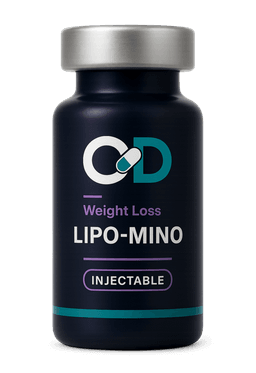 Discussed in this guideLipo-Minofrom $43.60
A plain-language look at what lipotropic "MIC" blends are and the metabolic roles attributed to methionine, inositol, choline, and vitamin B12 — the components in lipo-mino and lipo-b.
On this page
What "lipotropic" means
The word lipotropic dates to nutrition research from the 1930s, when investigators studying diet-related fatty liver in animals described certain nutrients as "lipotropic factors" — substances that were observed to prevent the deposition of fat in the liver. The term is often glossed as "acting on fat," and it came to describe a small group of dietary compounds associated with the transport and metabolism of lipids, particularly in liver cells. Choline was the first substance characterized this way, and later work tied the concept to the body's methyl-donor chemistry. Understanding that history is the clearest way to understand what modern "lipotropic injections" are named after.
In current usage, a lipotropic injection usually refers to a compounded blend abbreviated MIC — methionine, inositol, and choline — the three classic lipotropic components. These blends are sold under several names. "MIC B12" or "lipo-b" typically describes the MIC trio combined with vitamin B12, while "lipo-mino" (sometimes "lipo-mino mix") generally refers to a broader formulation that adds further B-vitamins and amino acids alongside the MIC base. The exact contents differ from one preparation to the next, because there is no single standardized recipe.
That variability follows from how these products are made. They are compounded blends, prepared by a licensed pharmacy to fit a prescription, rather than a single mass-manufactured drug — there is no one FDA-approved "MIC" product. Compounded medications are not themselves FDA-approved; that is a neutral statement about the compounding pathway, not a judgment about quality. This article describes the biochemistry of the ingredients at a general level. It is educational only, does not describe these components as a treatment for any condition, and does not claim that receiving them changes body weight — there is no established body of controlled evidence that injecting lipotropic blends produces weight loss independent of diet, exercise, and the rest of a supervised program. Whether any such preparation is appropriate for a given person is a clinical judgment for a licensed provider.
Choline: the original lipotropic factor
Choline is an essential nutrient and the compound the term lipotropic was originally coined to describe. Its best-studied role relevant here is as a precursor to phosphatidylcholine, one of the major phospholipids that make up cell membranes. Phosphatidylcholine is also a required component of the very-low-density lipoprotein (VLDL) particles that the liver assembles to package triglycerides and export them into the bloodstream. Through this role in building VLDL, choline is understood to participate in how the liver moves fat out of its own cells — the biology behind its historical classification as a lipotropic factor.
Choline serves a second role that connects it to the other MIC ingredients: it is a source of methyl groups. One of its metabolites, betaine, can donate a methyl group in the reaction that regenerates the amino acid methionine from homocysteine. In this way choline feeds into the same one-carbon, or methylation, chemistry that methionine and vitamin B12 are also part of, which is why these compounds are so often discussed together. Choline is additionally the precursor the body uses to make acetylcholine, a neurotransmitter, though that function sits outside the lipotropic story.
Describing these established biochemical roles is not the same as claiming that a given dose changes lipid handling in a particular person. Choline metabolism is one thread in a much larger metabolic picture, and how — or whether — a specific preparation affects any individual is a scientific and clinical question this general explainer does not attempt to answer.
Methionine and the methylation cycle
Methionine is a sulfur-containing essential amino acid, meaning the body cannot make it and must obtain it from the diet. Beyond its role as a building block of proteins, methionine is the entry point to the methionine cycle. Combined with ATP, it is converted into S-adenosylmethionine, commonly abbreviated SAMe, which is often described as the body's universal methyl donor — the molecule most enzymes draw on when they need to attach a methyl group to another molecule.
That methyl-donation activity reaches a wide range of reactions, including the synthesis of certain phospholipids (among them phosphatidylcholine, linking methionine back to choline), the production of some neurotransmitters, and chemical modifications of DNA, RNA, and proteins. After SAMe gives up its methyl group, it is ultimately converted to homocysteine, which the body can remethylate back into methionine — a step that draws on either choline-derived betaine or the folate-and-B12 pathway. This shared cycle is the reason methionine, choline, and vitamin B12 are grouped together in the same blends. Historically, methionine was itself classified among the lipotropic agents.
As with the other components, this is a description of well-characterized biochemistry rather than a statement about outcomes. Whether methionine within a compounded blend is appropriate for a specific person, and in what form or amount, is a determination for a licensed provider — not something an educational article can decide.
Inositol: membrane phospholipids and cell signaling
Inositol is a sugar alcohol — a small carbohydrate-related molecule — that exists in several isomers, of which myo-inositol is the most abundant in the body. It was once loosely grouped with the B-vitamin-like compounds, and it is found throughout human tissues. Its role differs from choline's and methionine's: rather than sitting mainly in the methylation cycle, inositol is best understood through its place in cell membranes and in cellular signaling.
Inositol is incorporated into membrane phospholipids as phosphatidylinositol. From there, it serves as the backbone of the phosphoinositide signaling system — molecules such as PIP2 that, when cleaved, release second messengers like inositol trisphosphate (IP3) that relay signals inside the cell. This phosphoinositide machinery is studied in the context of many pathways, including insulin signaling, where inositol-derived messengers are involved in how cells respond to the hormone. This is the biology usually referenced when inositol is described as a component involved in lipid and glucose metabolism.
It is worth being precise about the framing: inositol's inclusion in "lipotropic" blends reflects the historical grouping of these nutrients as much as any single shared mechanism. Describing the phosphoinositide and insulin-signaling pathways it participates in is a statement about general cell biology, not a claim about what an injection does for a given individual.
Why vitamin B12 is commonly included
Vitamin B12, or cobalamin, is a water-soluble vitamin that the body uses as a cofactor for two enzymes. One is methionine synthase, which catalyzes the conversion of homocysteine back into methionine — placing B12 directly inside the same methylation cycle that choline and methionine feed. The other is methylmalonyl-CoA mutase, an enzyme involved in the breakdown of certain fatty acids and amino acids. B12 is also broadly required for red blood cell formation, DNA synthesis, and normal neurological function. Its overlap with the methionine cycle is a large part of why it is paired with the MIC trio in "MIC B12" and "lipo-b" preparations.
B12 appears in supplements and compounded preparations in more than one chemical form, including:
- Cyanocobalamin
- Methylcobalamin
- Hydroxocobalamin
- Adenosylcobalamin
Some are already in a metabolically active form, while others are converted by the body after absorption. Which form a particular preparation uses varies, and that choice — like everything else about a formulation — is part of what a prescriber and pharmacy determine rather than something fixed across all products.
Lipotropic blends are prepared for injection, typically subcutaneous or intramuscular, because that is how these preparations are formulated; the prescription defines how any given product is to be used. This article does not provide dosing guidance — any amount or schedule is set by the prescribing provider based on the individual. And because these are compounded blends rather than an approved drug, the earlier point bears repeating: compounded medications are not FDA-approved, and evaluation by a licensed provider is central to whether one is appropriate at all.
How prescription review works on OpenDoseRx
OpenDoseRx is built so that a licensed clinician — not the shopper — makes any medical decision. You begin by choosing a product and the specific option you are interested in, then complete a structured medical intake that asks about your health history, current medications, and other relevant information. That intake is routed to an independent, licensed U.S. provider who reviews it and decides whether a prescription is appropriate for you.
If the provider determines it is, the order is sent to a licensed U.S. pharmacy that prepares and ships it. If the provider declines, the order does not proceed and you are not charged for the medication — you receive a full refund. This overview is educational and procedural, not medical advice. It describes what the ingredients are and how their biochemistry is understood to work; it does not recommend a treatment for any particular person, and nothing here replaces a conversation with your own healthcare provider.
Common questions
- What does MIC stand for, and what is in a lipotropic injection?
- MIC stands for methionine, inositol, and choline — the three classic "lipotropic" components. Lipotropic injections are compounded blends of these, often combined with vitamin B12 (marketed as "MIC B12" or "lipo-b") or expanded with additional B-vitamins and amino acids ("lipo-mino"). Because they are compounded, the exact contents vary from one preparation to the next.
- What does "lipotropic" actually mean?
- The term dates to 1930s nutrition research and was coined to describe nutrients — choline first among them — that were observed to prevent fat deposition in the liver. It is often glossed as "acting on fat." It refers to compounds historically associated with the transport and metabolism of lipids in the liver; it is a description of a biochemical grouping, not a claim of any particular result.
- Are lipotropic or MIC injections FDA-approved?
- There is no single FDA-approved "MIC" drug. Lipotropic injections are compounded blends prepared by a licensed pharmacy to fit a prescription, and compounded medications are not themselves FDA-approved. That is a neutral statement about the compounding pathway, not a judgment about quality. Either way, whether such a preparation is appropriate is a decision for a licensed provider.
- Why is vitamin B12 added to MIC injections?
- B12 (cobalamin) is a cofactor for methionine synthase, the enzyme that converts homocysteine back into methionine, which places it inside the same methylation cycle that choline and methionine feed. It is also involved in red blood cell formation and nervous-system function. That biochemical overlap is a large part of why B12 is commonly paired with the MIC trio; it appears in several forms, such as cyanocobalamin and methylcobalamin.
- Do lipotropic injections cause weight loss?
- This article is educational and does not make efficacy or outcome claims. It describes the biochemistry of the ingredients, not results. There is no established body of controlled evidence that injecting lipotropic blends produces weight loss independent of diet, exercise, and a supervised program. Whether any preparation is appropriate for a specific person is a clinical judgment for an independent, licensed U.S. provider, and nothing here is a substitute for a conversation with your own provider.
Ready when you are
Lipo-Minofrom $43.60
- Your exact strength
- Licensed provider review
- Full refund if declined
Also relevant
Exact strengths and prices up front — a licensed provider reviews every request.
Browse weight loss & glp-1 therapy
Exact strengths and prices up front — reviewed by a licensed U.S. provider.
Keep reading
More plain-language guides on this topic.
Semaglutide vs. tirzepatide: how GLP-1 and GIP/GLP-1 medications differ
A neutral, mechanism-focused comparison of two prescription incretin medications and the gut-hormone receptors they act on.
How GLP-1 medications interact with appetite and digestion
A neutral, mechanism-focused look at how GLP-1 receptor agonism engages the gut-brain satiety axis and the gastric-emptying signals tied to hunger and fullness.
Oral vs. injectable GLP-1 medications: how the routes differ
A neutral, mechanism-focused look at how injecting a GLP-1 peptide under the skin and absorbing one by mouth differ in absorption and bioavailability.
This guide is for general education and is not medical advice. Compounded medications are not FDA-approved drugs, and statements on this site have not been evaluated by the FDA. A licensed provider reviews every prescription request.